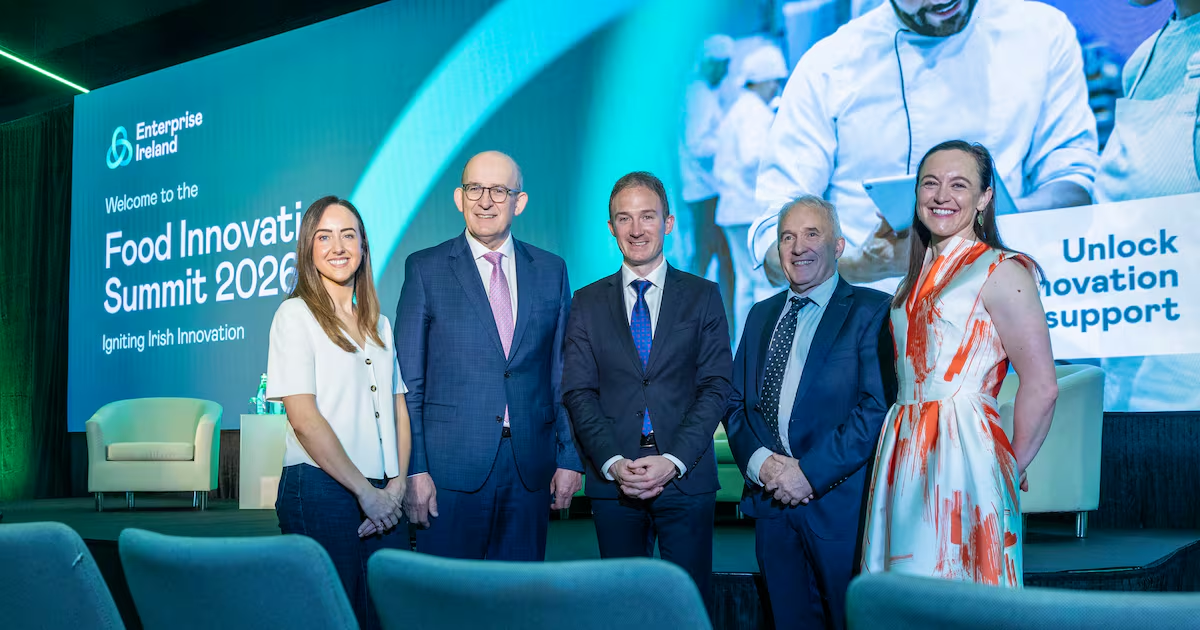
More than 300 food and drink companies, researchers and industry partners gathered in Croke Park last month for Enterprise Ireland’s fourth annual Food Innovation Summit, the State’s only dedicated event focused on innovation in the sector.The summit followed another year of growth for the sector, with food, drink, nutrition and climate tech exports reaching €16.98 billion, up 5 per cent on 2024. “The food and drink industry is a cornerstone of the economy, employing almost 70,000 people in towns and villages right across the country,” says Enterprise Ireland senior client adviser Ellen Ní Cléirigh.Despite that growth, the summit came at a demanding time for the industry, Ní Cléirigh says. “Companies across the food and drink sector are managing significant cost pressures. Inflation is now running at about 3.5 per cent. It’s going to come down a little bit next year but some of the businesses that we work with have margins of between 3 per cent and 5 per cent. What we were trying to do this year was reassure companies that there are solutions to the challenges that they are facing, and to emphasise the importance of spending money on R&D and innovation. The companies that keep investing in R&D and innovation and their people throughout this time are going to come out strongest.”Other themes explored during the day were the application of artificial intelligence (AI) to the industry and the need for continuous investment in people and skills.Enterprise Ireland client companies in the sector spend less than 0.7 per cent of their total sales on research and development (R&D). “That’s a bit of an alarm bell for us. We want them to get to 1 per cent or higher. But we recognise that it’s hard to find money to spend on R&D right now, but this is something companies need to do and we’re here to support them in that. We had a moderator from EY talking about the R&D tax credit and we spoke about how our supports can help de-risk and support investments in R&D,” says Ní Cléirigh.The AI discussion was firmly focused on the practical. “There’s a lot of hype, a lot of crazy valuations, but we have to talk about it because it’s disrupting how we work and how we live. However, if you’re employing 50, 60 people in the midlands or in Cork and your margins are being squeezed, where do you start and how do you make this work better for you? We focused on having practical examples of AI being used and where the benefits are going to lie.”One of those examples was provided by Kerry Group. “They demoed a new tool on the day and showed how their product development pathway was much faster and how they were able to pull in consumer insights and other data into models that gave them faster prototypes at a cheaper cost than before. We also had Kerry’s global supply chain director, Brian O’Connor, speaking on the day. He talked about the thousands of decisions that you have to make in a business when you’re dealing with logistics and supply chains and how AI was automating some of those decisions and making the process leaner as a result.”Turning to the people and skills theme, Ní Cléirigh says: “Investing in people has to be the cornerstone of what businesses do because you can’t adopt new technologies or innovate unless you have the right people. We discussed the skills and the capability that the sector needs and how Enterprise Ireland is there to support companies in people and skills development.”A new feature of this year’s summit was the Discovery Zone. Running alongside the main programme, the interactive space gave companies a hands-on introduction to the supports available to begin and sustain their innovation journey. “Kerry demoed their AI tool in the Discovery Zone,” she notes. “European Digital Innovation Hubs, the Factory Xchange and CeADAR, Ireland’s centre for AI, were also there to provide advice and guidance for food sector businesses.”Returning to the central theme of innovation, Ní Cléirigh stresses its critical importance. “We still don’t fully understand the potential impact of GLP-1 drugs. They are going to change how people eat and increase demand for nutrient dense food that delivers the right amount of calories and the right amount of protein. That is a major trend that food companies are going to have to look at. Food businesses need to find new ways of working, new ways of bringing new products to market, and look for the spaces for product development that maybe didn’t exist two or three years ago. They need to innovate to stay ahead and to find those gaps so that they are not just copying their competitors.”
Food Innovation Summit: Industry prepares for impact of weight loss drugs
Enterprise Ireland senior client adviser Ellen Ní Cléirigh says the food and drink industry is a cornerstone of the economy
785 words~4 min read