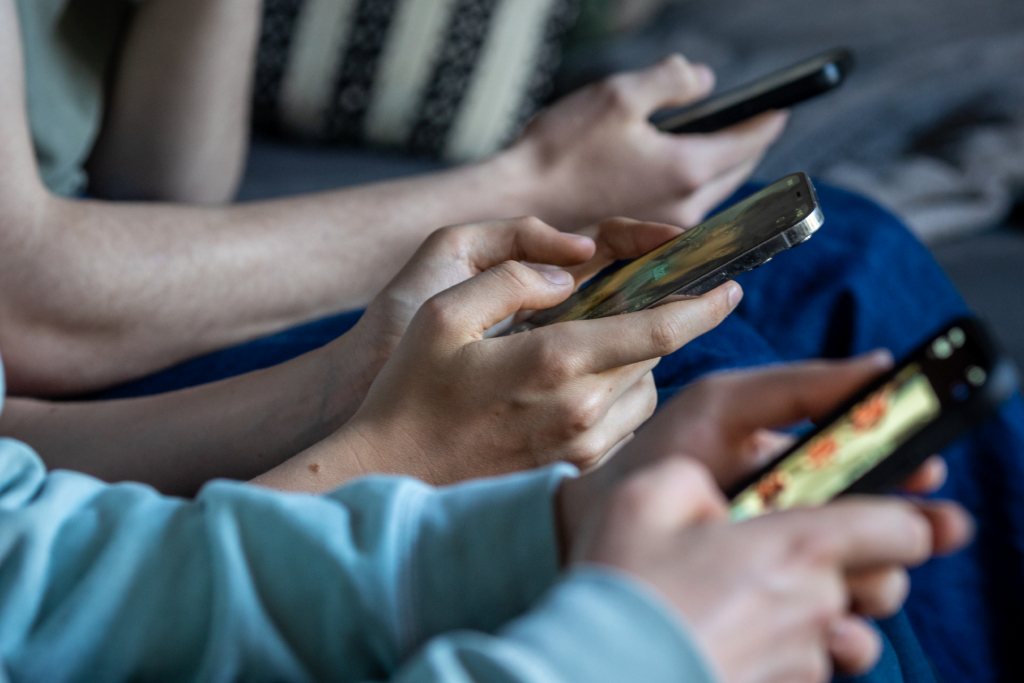
Tech giants spent billions of dollars designing apps to keep people online longer, while policymakers focus mainly on restricting the phones children use to access them. The result is a debate that places the burden of a structural problem on schools and parents, rather than on the companies whose profits depend on capturing children’s attention. | Photo: iStock/ Getty Images
From France and Brazil to Denmark and South Korea, restrictions on smartphones in schools are spreading at remarkable speed. A UNESCO Global Education Monitoring Report found that 114 education systems (58% of countries worldwide) now enforce national-level restrictions on mobile phones in schools. Australia has become the first country to ban social media for children under 16. India has not announced a national ban yet; however, the debate has reached its shores too: Karnataka and Andhra Pradesh announced state-level restrictions on children’s social media use in March 2026.(Sign up for THEdge, The Hindu’s weekly education newsletter.)The rationale for restricting social media use, or banning phones altogether, is almost the same everywhere. Children are spending too much time online. Anxiety, depression, cyberbullying, and sleep disruption are rising. Teachers report shrinking attention spans and distraction in classrooms. There is also growing alarm over children stumbling onto adult content and gambling apps designed to look and feel like games. These concerns are real, and governments, schools, and families have every reason to worry about children’s learning and well-being.Design vs deviceHowever, in this rush to ban phones and social media, governments are targeting the wrong thing. They are treating the phone as the problem when it is only the delivery van, not the factory. Most of the harms parents and educators worry about do not come from a slab of glass and metal sitting in a teenager’s pocket. They come from what runs on it. Apps like Instagram, TikTok, and YouTube are not built to entertain for a few minutes and then let go. They are built to keep a person watching for as long as possible. Because the longer someone stays, the more money the app makes. This is not an accident. It is a deliberate design by Meta, ByteDance, and Google. Features like infinite scrolling, autoplay, algorithmic recommendations, and relentless notifications are engineered to maximise engagement. That is why videos autoplay one after another, a feed never really ends, and a notification appears the moment attention starts to drift. The irony is that tech giants are well aware of these harmful effects, yet they continue to update features in pursuit of greater profit.Schools can confiscate a device. They cannot confiscate the business model behind it. A student stopped from scrolling Instagram Reels in class goes home to the very same feed. A phone ban may cut exposure during school hours, but it does nothing to change why these apps are built the way they are. Removing phones from classrooms, therefore, treats only a symptom while leaving the root cause untouched. If governments are serious about protecting children, regulation should target these design practices rather than the devices through which they operate.This matters because the politics of phone bans quietly move the blame. The conversation shifts from platform design to student behaviour, from technology companies to teachers and parents. Governments announce action, schools are left to enforce it, and the firms behind these platforms face little real pressure to change them. Tech giants spent billions of dollars designing apps to keep people online longer, while policymakers focus mainly on restricting the phones children use to access them. The result is a debate that places the burden of a structural problem on schools and parents, rather than on the companies whose profits depend on capturing children’s attention.Phone, a classroomThe picture becomes more complicated once we look beyond the wealthy countries that dominate this debate. In large parts of the Global South, the smartphone is not simply a distraction. It is often a library, a classroom, and a gateway to opportunities schools cannot always provide. India itself is investing heavily in digital learning through initiatives such as DIKSHA, PM eVIDYA, and SWAYAM, all aimed at expanding access to quality education, particularly for students in remote and under-resourced communities. For first-generation learners and children in underserved communities, the phone is often not the enemy of education, but the gateway to it. Blanket restrictions modelled on wealthier countries can carry costs that go unacknowledged here. The student distracted by social media and the student accessing a lesson through the same device are being treated as if they are the same person. They are not. Policies that fail to see this difference risk widening the very inequalities they claim to fix.Digital literacyNone of this means schools should abandon limits on phone use. There is a strong case for creating spaces where attention is protected and learning can take place without constant interruption. But a quiet classroom is not a permanent solution. What is needed is transparency in how these platforms are built and accountability for the business models that profit from children’s attention. That kind of accountability is unlikely to arrive quickly. Platform regulation involves technical, cross-border, and politically contested questions. Even where governments have tried, the process has taken years to move from legislation to enforcement. Children cannot be expected to wait that long.While that process unfolds, digital literacy can work. This is not about teaching children how to use a laptop or navigate a spreadsheet. Most already do that better than the adults teaching them. It is about teaching them to understand how a feed is built to keep them scrolling, why certain content is pushed to them over other content, and how their attention and data are quietly converted into revenue. A child who understands this is harder to manipulate, either in the classroom or at home. A phone can be confiscated. Understanding cannot.(Gowhar Rashid is associated with NCTE. Views expressed are personal.) Published - July 09, 2026 08:00 am IST