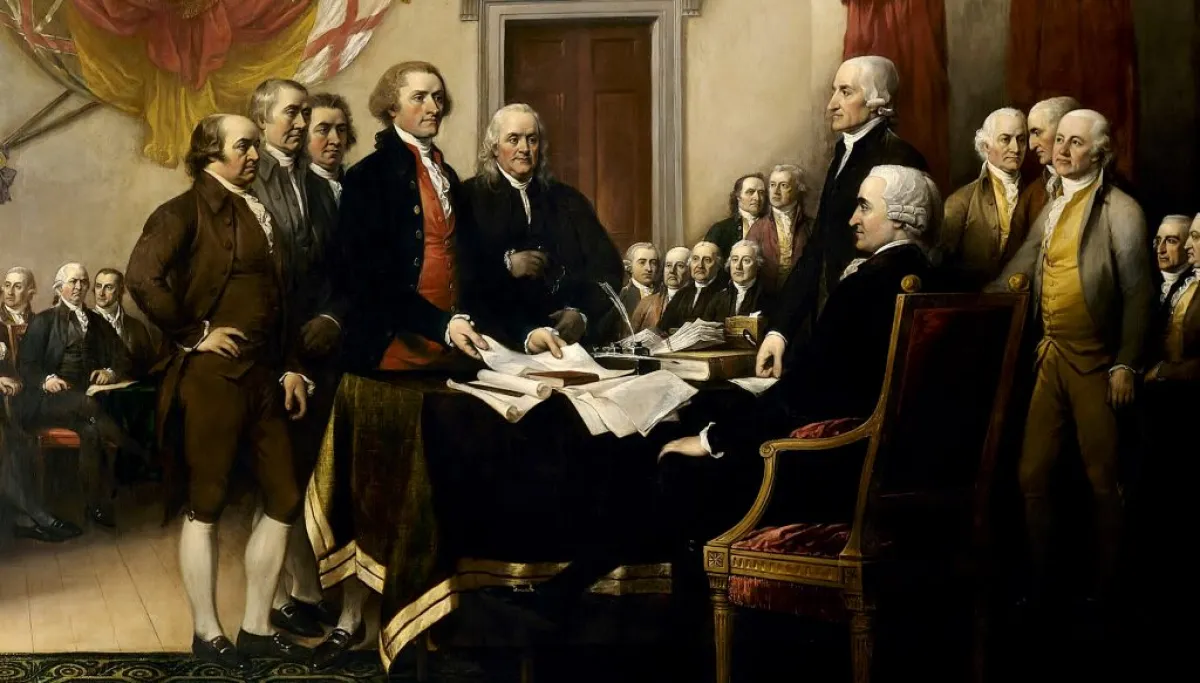
WANG SON-TAEK Last week marked the 250th anniversary of American independence. Although Americans celebrate it as the birth of their nation, the anniversary deserves recognition far beyond the United States because it marks the emergence of the modern democratic republic as a practical model of government. The principles underlying liberal democracy had existed long before 1776. Ancient Athens experimented with democracy, Ancient Rome contributed republican traditions, and Enlightenment thinkers such as John Locke and Montesquieu articulated natural rights, limited government and the separation of powers. Yet those principles were first successfully integrated into a functioning constitutional order with the founding of the United States. That achievement became the prototype for many modern democratic states. Seven features of the American experiment deserve particular attention.The first contribution was the successful integration of liberalism, democracy and republican government into a single constitutional framework. Before the American Revolution, these traditions largely existed as separate intellectual currents. Liberalism emphasized individual liberty. Democracy asserted that sovereignty belonged to the people. Republicanism rejected arbitrary personal rule in favor of public institutions governed by law. The American founders fused these principles into a single constitutional system capable of governing a large and diverse nation. That integration became one of the defining characteristics of the modern democratic republic.The second contribution was the constitutional protection of fundamental rights. For centuries, individual freedoms depended largely upon the goodwill of monarchs or ruling elites. The American Constitution and the Bill of Rights fundamentally changed that relationship. Freedom of speech, freedom of religion, freedom of the press, property rights, due process and many other liberties were recognized as constitutional guarantees rather than privileges granted by rulers. Governments themselves became subject to constitutional limits. This model later inspired constitutional reforms across Europe, Latin America, Asia and many newly independent states after World War II.The third contribution was the creation of the modern presidency. Throughout most of history, heads of state typically inherited power through hereditary succession or seized it through military coups. The US introduced an executive leader whose legitimacy ultimately rested on the consent of the governed rather than hereditary succession. Equally important, presidential power was constitutionally limited by law and by the authority of other institutions.The fourth point was the institutionalization of the separation of powers. Legislative, executive and judicial branches were assigned distinct responsibilities while simultaneously checking one another. No institution was intended to dominate the others permanently. Instead, institutional checks and mutual restraint became normal features of government. This architecture reduced the danger of concentrated authority and established a durable model for constitutional governance around the world.The fifth contribution was constitutionalism itself. The American founders insisted that no public official — not even the president — should stand above the Constitution. Government derived its legitimacy from constitutional rules rather than personal authority or political popularity. Public power existed within legal boundaries established by the people. Today, this principle appears self-evident, but in the 18th century it represented a revolutionary departure from the traditions of absolute monarchy.The sixth contribution was the establishment of regular elections and peaceful transfers of political power. Elections had existed in various forms before America, but few political systems institutionalized periodic leadership change under stable constitutional rules. The American experiment demonstrated that both governments and legislatures could be peacefully replaced through ballots instead of violence, dynastic succession or military coups. Citizens could dismiss one administration or representatives and peacefully entrust authority to another. That principle remains one of the greatest achievements of modern democracy and one of its most valuable political traditions.The seventh was the successful operation of a federal system. The United States showed that national unity and regional autonomy were not mutually exclusive. States retained substantial authority while sharing sovereignty with the federal government under a common constitutional framework. Federalism reduced the risks of excessive centralization while preserving national cohesion. Although each country has adapted federalism differently according to its own history and geography, the American experience became an important constitutional reference for many later federations.None of these achievements erased America's own historical failures. Slavery, racial discrimination, the displacement of Native Americans and other injustices remain undeniable parts of its history. Yet acknowledging those failures should not obscure the remarkable political legacy that emerged from the American founding.Ironically, the 250th anniversary arrives at a moment when some of these very principles appear increasingly vulnerable, including within the US itself. Political polarization has intensified. The personalization of political power, something George Washington consciously sought to avoid, is becoming increasingly evident. Excessive personal loyalty to individual leaders sometimes seems to overshadow commitment to constitutional institutions. Political civility has steadily eroded. Public confidence in elections, courts and the rule of law has weakened. Such developments risk shifting attention away from the constitutional ideals that made the American experiment historically significant.Nor is this challenge uniquely American. Democratic societies around the world face similar pressures. South Korea, despite its remarkable democratic achievements, continues to experience painful controversies and historical distortions surrounding the Gwangju Democratic Uprising. Public ridicule and hateful expressions directed at the victims of one of the nation's defining democratic struggles demonstrate how easily societies can lose respect for the sacrifices that secured their freedoms. Such controversies should not be dismissed as ordinary political disagreements. They reflect a deeper erosion of democratic culture.The true significance of America's 250th anniversary, therefore, lies beyond patriotic celebration. It is an opportunity to renew our commitment to the constitutional principles that transformed global politics over the past two and a half centuries. The anniversary belongs not only to Americans but to everyone in the world who believes that political power should originate from the people, remain constrained by constitutional law and exist to protect individual liberty. The greatest tribute to America's founding is not admiration for its past, but fidelity to the constitutional principles it bequeathed to the world.- - -Wang Son-taekWang Son-taek is an adjunct professor at Sogang University. He is a former diplomatic correspondent at YTN and a former research associate at Yeosijae. The views expressed here are the writer’s own. — Ed.
[Wang Son-taek] America 250: Liberal democracy 250
Last week marked the 250th anniversary of American independence. Although Americans celebrate it as the birth of their nation, the anniversary deserves recognit
1,003 words~5 min read