WHAT’S HAPPENING TODAY: Good afternoon and happy Wednesday, readers! President Donald Trump announced that the ceasefire in Iran has ended, following the U.S. and Iran exchanging attacks overnight. The president also threatened to continue launching strikes at Iran. The escalation in the Middle East has sent oil prices back up. 🛢️🇺🇲🇮🇷In other news, the Department of Energy has finalized a $3.26 billion loan to improve thousands of transmission lines in Texas. ⚡Meanwhile, a mining project in Arizona has reached a permitting milestone, which would help to produce critical minerals such as zinc and copper. 🪨⛏️ Keep reading to learn more about the project. ⬇️
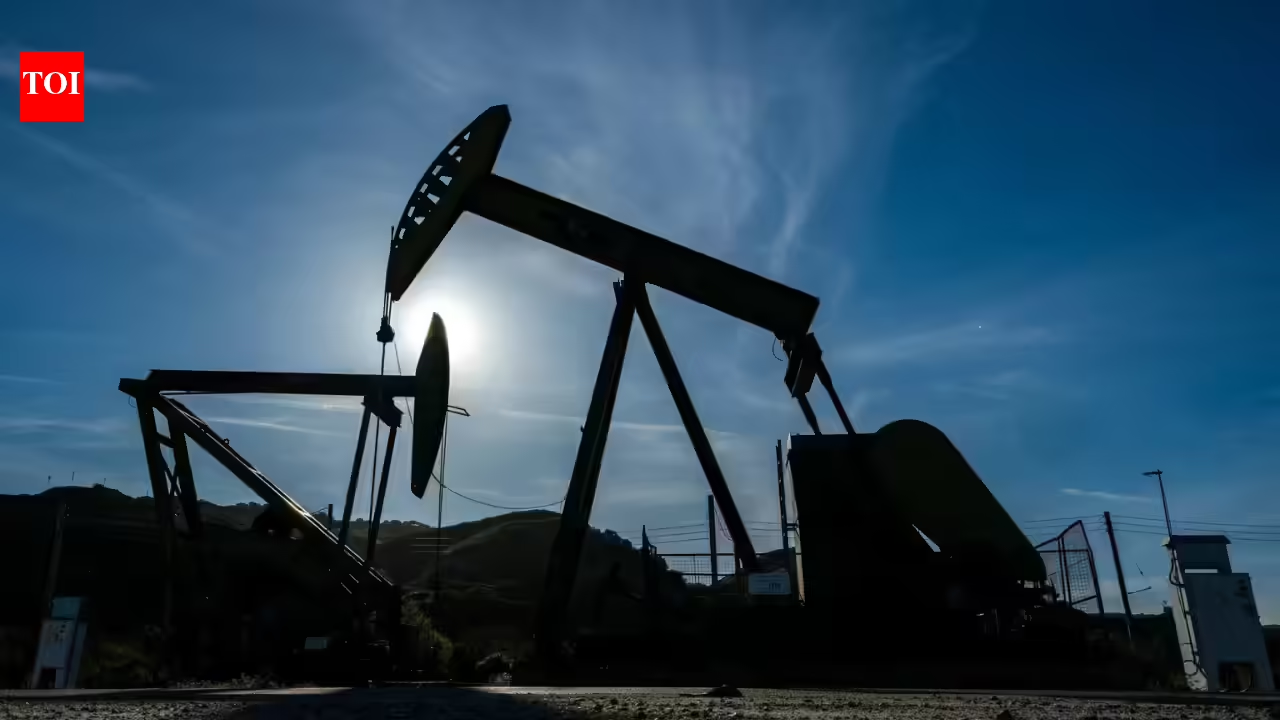
Welcome to Daily on Energy, written by Washington Examiner energy and environment writers Callie Patteson (@CalliePatteson) and Maydeen Merino (@MaydeenMerino). Email cpatteson@washingtonexaminer dot com or mmerino@washingtonexaminer dot com for tips, suggestions, calendar items, and anything else. If a friend sent this to you and you’d like to sign up, click here. If signing up doesn’t work, shoot us an email, and we’ll add you to our list.TRUMP SAYS CEASEFIRE WITH IRAN IS OVER: President Donald Trump said that the ceasefire in Iran is over, following an exchange of strikes by the two countries. “I think it’s over. I don’t want to deal with them anymore. They’re scum,” Trump told reporters at the NATO summit in Turkey. The U.S. and Iran exchanged strikes overnight, making it the second escalation since the two signed an interim agreement to end the war last month. The president noted that the U.S. will likely launch strikes against Iran on Wednesday evening. He has also threatened to seize Iran’s primary oil terminal, known as Kharg Island. “Maybe we’ll take over Kharg Island. We may take over Kharg Island. There’s not a thing they could do about it,” Trump said. Oil prices jump: The ending of the ceasefire sent oil prices up today. Just before 3 p.m. EDT this afternoon, West Texas Intermediate was up 4.73% to $73.77 and Brent crude was up 5.5% to $78.24. TRUMP BACKS TRANSMISSION BUILD-OUT IN TEXAS: The Energy Department finalized a $3.26 billion loan for a subsidiary of utility giant American Electric Power to upgrade thousands of transmission lines across Texas, helping the state’s electrical grid supply energy to power-hungry data centers. The details: The agency announced this morning that it closed the loan with AEP Texas, saying the loan would finance roughly 100 transmission projects across Texas, including the rebuilding or reconductoring of existing transmission lines, as well as the construction of new transmission infrastructure spanning 2,800 miles.The Energy Department said these projects will double the power-carrying capacity of transmission infrastructure in Texas, helping meet rapidly growing electricity demand caused by data centers that power artificial intelligence technology, as well as increased manufacturing and oil and gas development in the Permian Basin, which is in the western part of the state. This marks the third time the agency’s Office of Energy Dominance Financing (formerly the Loan Programs Office) committed to supplying utility financing under the Trump administration. Quick note: Texas has found itself at the center of the AI boom, having roughly 335 existing facilities and expecting to see at least another 248 data center projects built in the state, according to the Texas Tribune. These projects are making up for the overwhelming majority of new power requests in Texas, with ERCOT saying in June that data centers account for 89%. Read more from Callie here. NUCLEAR REGULATORS OVERHAUL ENVIRONMENTAL REVIEW RULES: The Nuclear Regulatory Commission has proposed what it called the “most comprehensive update” to its conduct of environmental reviews when issuing license renewals and approvals for new nuclear reactors. TLDR: The NRC is narrowing the scope of its environmental reviews required under the National Environmental Policy Act, expanding the number of categorical exclusions for nuclear operators, and discontinuing some draft environmental review documents, thereby eliminating the public’s ability to comment on a draft environmental impact statement. It’s important to note that the agency is not proposing eliminating public comment periods completely, as there will be other opportunities during the review process. Chairman Ho K. Nieh explained that the agency was not required under NEPA to issue a draft environmental impact statement and as such, was eliminating this step. You can read the full proposal here. The why: This update to how the NRC implements NEPA is a part of the agency’s broader overhaul and simplification of its regulatory processes for approving new nuclear energy projects and relicensing of existing plants. This stems from an executive order signed by Trump in May 2025 that called on the NRC to make decisions on reactor licenses within 18 months. Expected outcome: When pressed on how the changes will save time and money, Kimyata Savoy, the NRC’s Chief Environmental Review and Permitting Officer, told reporters that the agency is expecting the overhaul will result in around $135 million in savings for applicants seeking new or renewed licenses. As for time, the changes propose ensuring that an environmental assessment is conducted within one year and environmental impact statements are finished in two years. RACE TO DEPLOY NUCLEAR WITH CHINA HEATS UP: The NRC’s efforts to accelerate its licensing for new reactors come at a critical time as the U.S. looks to secure as much domestic energy as possible to get ahead of China in the race for AI. China has for years been outpacing the U.S. to deploy nuclear energy for AI and broader electrification, and is now in the position to take the U.S.’s spot as the world’s largest producer of nuclear power. A new report released by BloombergNEF today found that global nuclear capacity is on track to increase 44% over the next 10 years. The report found that there was around 372 gigawatts of installed nuclear power across the world last year. That could jump to as much as 535 gigawatts by 2036. China could hold the largest share of that, the report warned. At the end of 2025, the Asian superpower had 59 gigawatts of reactors under construction. It is expected to have 102 gigawatts under construction by the end of the decade. As of this spring, the U.S. had around 96 operating nuclear reactors, with a combined capacity of just over 94 gigawatts. For comparison, the city of San Francisco is estimated to require around 1 gigawatt of electricity.CHEVRON TO SELL CHEMICAL TECH TO RIVAL DRILLERS: Chevron is answering the Trump administration’s call to increase domestic oil and gas production by allowing rival drillers to purchase the company’s chemical technology that boosted its own production from shale wells. The details: Chevron announced a deal with ZL Chemicals Ltd today allowing the chemical firm to commercialize the oil major’s chemical surfactant technology. These chemicals help reduce damage to the shale formation that occurs during fracking, helping clear out particles that often are lodged in cracks and block oil flow. This technology improved Chevron’s production from newly drilled shale wells by up to 20%, according to Reuters. It also reduced production decline in existing wells by between 5% and 8%. “With constraints on energy in the world today, there’s a call on oil and gas companies to get more energy to market,” Chevron’s Chief Technology and Engineering Officer Ryder Booth told Reuters. “This is a way that we can answer the call to help boost production.”Why does this matter? Trump and his cabinet officials have directly called on oil and gas companies to ramp up production in recent months, urging drillers to take advantage of high oil prices caused by the war in Iran. But, as seen in the latest quarterly Dallas Fed survey released last month, many producers have been wary of significantly ramping up production, as there has been so much uncertainty over where prices could end up week over week. And many drillers need to see prices stable for months to years. Using Chevron’s tech could open a door for other companies to increase their production without making investments in lots of new wells. FROM THE OCEAN TO SPACE: The federal agency responsible for leasing offshore waters for mining, oil, gas, and wind energy projects is considering using its authority to manage offshore space launches in the future. The Department of the Interior’s Bureau of Ocean Energy Management issued a request for information yesterday regarding the use of federal water for “offshore space launch and re-entry activities.” “Offshore launch, re-entry, and recovery infrastructure could expand operational flexibility, increase capacity, reduce constraints on growing launch demand, and strengthen the nation’s commercial and national security space capabilities,” Acting BOEM director Matt Giacona said. The request for information opens a 30-day comment period for the agency to collect technical, environmental, and operational information from industry, researchers, stakeholders, and the public. The comment period ends Aug. 7. Some background: BOEM has roughly 3.2 billion acres of federal water under its jurisdiction, off the coasts of Alaska and Hawaii, in the Gulf region, and in the Atlantic and Pacific Oceans. More than 12 million acres of these waters have active oil and gas leases. RUSSIA BANS DIESEL EXPORTS FOLLOWING UKRAINE REFINERY ATTACK: Russia banned exports of diesel after Ukraine carried out drone attacks on a major Russian refinery, Bloomberg reports. The move could further tighten global fuel markets, which have been disrupted by the war in Iran. Ukrainian drones hit a Russian refinery in Omsk yesterday. The attacks against Russian refineries are part of an effort to limit war funding from oil revenues. ICYMI – PERMITTING MILESTONE FOR SOUTH32: The Trump administration has approved the South32 Hermosa Critical Mineral Project in Arizona. The U.S. Forest Service issued its final record of decision yesterday for the project, marking the completion of its federal environmental review and allowing for the development of the mine. South32 Hermosa, an Australian mining and metals company, proposed a $2.16 billion mining and processing project in Santa Cruz County in Arizona. The project is part of the Permitting Council’s FAST-41 program, which is a federal initiative that helps to coordinate and streamline the permitting process for key infrastructure projects. South32’s proposal was the first mining project to move through the FAST-41 initiative, where it has gained support from both the Biden and Trump administrations. The project will be capable of producing critical minerals such as zinc, manganese, silver, lead, and copper. RUNDOWN Inside Climate News Climate Change Is Helping an Invasive Predator Wreak Havoc on Iconic Alaskan FishUSA Today Was that climate change? Scientists ponder a deadly July 4 weekendVox The climate case against leather