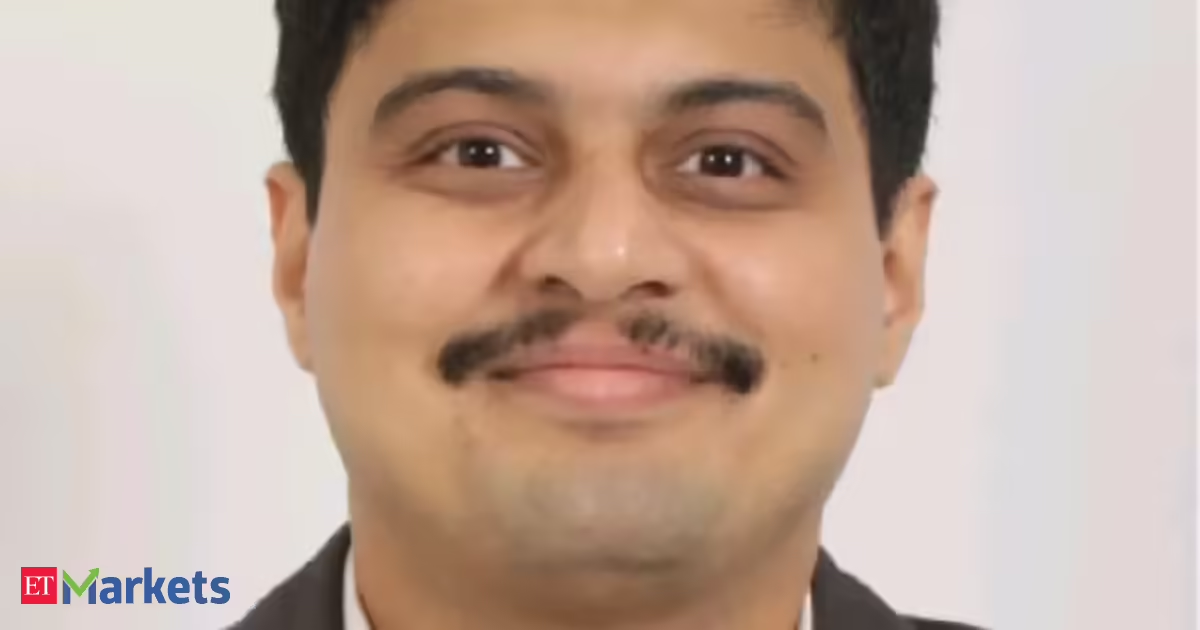
The first customers for Mestastop, a startup developing therapies to stop cancer metastasis—the spread of cancer from the primary tumour to other organs—aren’t in India.“They’re abroad,” says founder Arnab Roy Choudhary. “For deep-tech products, awareness and understanding are much higher globally. The Indian market often waits for Western validation before embracing new technologies.”His experience reflects a broader shift. Long before commercialising products at home, a growing number of Indian biotech startups are generating their first revenues from customers in the US and Europe...The reason is straightforward: overseas markets reward innovation faster, and better.Selling where the science paysA US biotech company or contract research organisation typically pays within 30-45 days and offers gross margins of 35-40 per cent on products such as specialty enzymes, recombinant proteins and preclinical research, said Mayur Sirdesai, Partner, Somerset Indus Capital Partners. Indian buyers, by contrast, often negotiate aggressively, operate on payment cycles stretching up to six months and offer materially lower margins.The result, he said, is that startups can build $500,000-2 million in annual recurring revenue within two years—providing the capital needed to expand teams and accelerate research.Founders say the challenge extends beyond economics.Yet commercialising abroad does not mean abandoning India.For Mestastop, global markets will remain the primary revenue driver, although Choudhary insists India remains strategically important as demand grows for high-quality, locally developed biotech products.Immuneel Therapeutics, one of India’s pioneers in CAR-T cell therapy, deliberately chose to commercialise domestically before expanding overseas. “India first, global next has always been our philosophy,” said CEO Amit Mookim.The company’s objective, he said, was to prove that globally benchmarked CAR-T therapies could be developed, manufactured and commercialised in India while addressing one of the country’s largest unmet medical needs. He stressed, the vision has always been ‘India first, global next.’Investors argue this global orientation is less a strategic pivot than a natural evolution of the industry.From cost centre to innovation hubIn many ways, Sampathkumar says, Indian biotech is following a trajectory similar to the country's SaaS boom a decade ago—but for entirely different reasons. While SaaS companies leveraged cloud infrastructure and engineering talent to sell software globally, biotech startups are capitalising on India's pharmaceutical expertise and structural cost advantage at a time when drug discovery costs in the West have ballooned to nearly $2.2 billion per asset.That shift is also redefining India's role in the global biotech value chain."A decade ago, India was viewed as a cost centre that executed outsourced research. Today, founders are engineering globally competitive products here at a fraction of global costs," said Sirdesai. Increasingly, India is becoming the place where biotech products are designed and manufactured, while global markets become the first destination for commercialisation.Yet, for the ecosystem to mature further, funding remains the missing piece. While early-stage grants have improved, startups continue to face a shortage of validation-stage capital needed to navigate expensive clinical development. Sampathkumar said the government's ₹1 lakh crore Research, Development and Innovation Fund could prove catalytic if complemented by deeper institutional funding, shared R&D infrastructure, easier access to cGMP manufacturing facilities and policies that encourage scientists to commercialise their research.For India's biotech founders, the playbook is becoming increasingly clear: build in India, validate globally and eventually bring those innovations back home.Published on July 8, 2026
Indian biotechs are scaling abroad before coming home
Indian biotech startups are increasingly finding initial customers abroad, leveraging global markets for faster innovation and growth.
537 words~2 min read