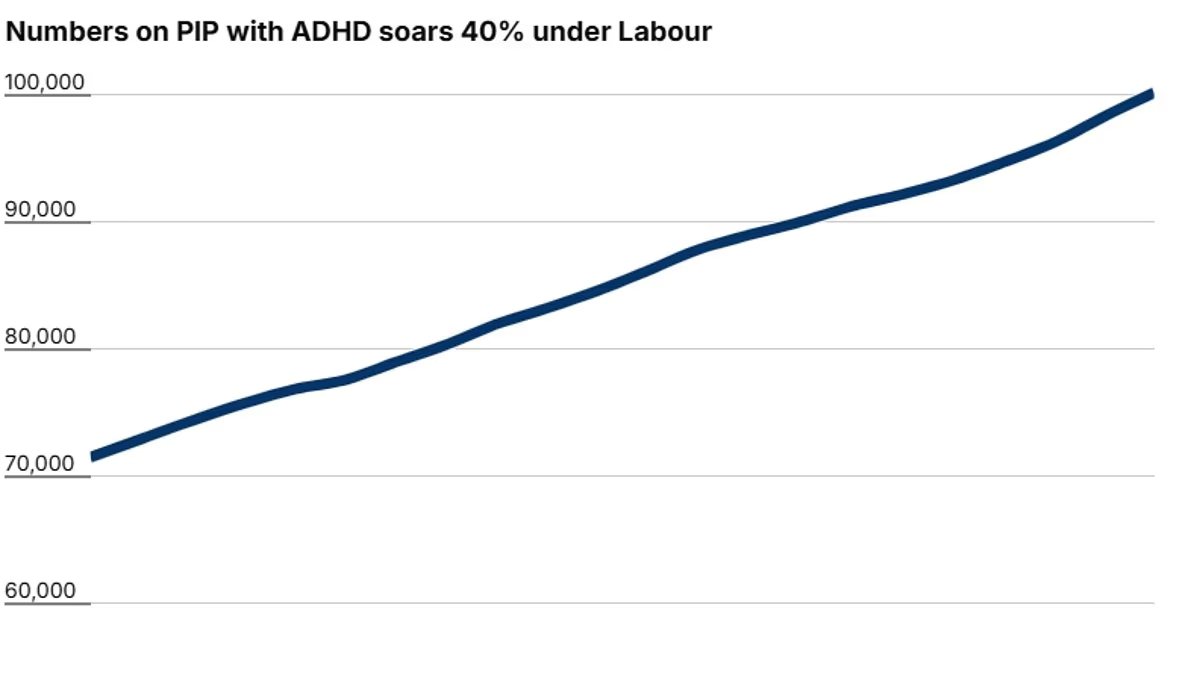
Our government is making excellent progress in keeping our next generation unemployed.Having put off businesses from hiring new staff by bumping up their National Insurance obligations, Labour has alighted on another wheeze to keep workers sitting on their sofas all day. For there has been staggering rise in people with Attention Deficit Hyperactivity Disorder being paid disability benefits, with no requirement even to seek a job.As someone with both severe ADHD and mild autism, I find this horrifying because the very worst way to handle one’s neurodiversity is to bow out of society and languish on the dole.More than 100,000 people with ADHD are now approved for ‘personal independence payments’ (PIP) – a ridiculous term, for there is nothing ‘independent’ about not working for a living. The tally is a 40 per cent rise since Labour took power.More than half of this cohort features young people between 16 and 24; all citing ADHD, as well as autism, depression or anxiety as their disability. It’s a generation doomed to fail, and for no good reason whatsoever.ADHD is not an affliction of the young, nor is it new. Humans have been dealing with it, and finding success, all through history. It’s a hereditary condition considered by some scientists to have evolutionary benefits, which might explain why it has lingered in the gene pool for so long.Yes, I can attribute a lot of misery at school to my ADHD – I was messy, consistently late and not great with authority – but I still graduated with straight As. It has also made certain aspects of professional life tricky, but I’ve built a successful career regardless. Annabel Fenwick Elliott says all young people need a purpose in life, and feel a sense of reward when they do well Annabel says the money given in PIP could be better spent on counselling, or teaching people how to take advantage of their differencesWe all have to play to our strengths and not our weaknesses. If you’re bad at science, you probably shouldn’t pursue a career in medicine. I know, from experience, that having ADHD would make me an abysmal secretary (I’m disorganised and lack attention to detail), but it really helps me in my job as a writer, because I thrive on variety and tight deadlines.If anything, when harnessed correctly, I view the condition as a superpower. We’re excellent under pressure, creative in problem-solving and able to utilise ‘hyperfocus’; a state under which we can concentrate intently for hours on end in a way neurotypicals struggle with.If I was hiring personnel, I’d want at least one person with ADHD on my team. I wouldn’t expect them to be particularly good at timekeeping or to churn out mundane, repetitive tasks. But I’d certainly rely on them for original thinking and turn to them first in a crisis.All young people need a purpose in life, and feel a sense of reward when they do well. This is only more heightened in those of us with ADHD. Most of us would go mad without projects, goals and competition.Why, then, is the government paying people who have up to £194 a week in PIP handouts without the provision that they even try to find work? What a colossal waste - of taxpayer’s money and of these people’s potential.Couldn’t that money be better spent on counselling, or teaching them how to take advantage of their differences?I was 34 when I was diagnosed with ADHD and officially became ‘disabled’. That’s according to the UK’s Equality Act 2010, which classifies the neurological condition as such.‘Disabled’ is a label, however, that I refuse to wear. That’s not to say I’m minimising the importance of mental health. I know firsthand how badly one’s brain can break, just like any other organ in the body. The swimmer Michael Phelps is one example of countless prominent figures who have ADHD and live with itIn the past, I’ve had depression so severe that I’ve been temporarily unable to read words from a page or tie my shoelaces, let alone work. It was terrifying – and infuriating, because I loved my job. Luckily, I’m now on medication that keeps Dr Samuel Johnson’s Black Dog at bay.I’m also, as I mentioned, autistic, which genuinely makes life – and particularly social interactions – harder than it is for neurotypicals, but again, I’ve developed adaptations.I can quite see why those on the low-functioning end of the spectrum need government support. But there are plenty of us on the milder side of the scale who do very well, despite the limitations. Just look at Elon Musk. He’s autistic and also the richest human on the planet.As for ADHD, there are countless prominent figures who have it and live with it: from sports stars such as swimmer Michael Phelps to business mogul Richard Branson. These are the icons we should be encouraging the young and impressionable to look up to. Instead, we’re paying them to sit on their hands and grow complacent.It’s easy to blame the PIP handouts on the huge increase in people being diagnosed with ADHD, as well as various other mental afflictions. Recorded ADHD diagnoses among men in England have more than doubled in less than a decade, and quadrupled for women.But I don’t think that’s where the problem lies. Personally, I’ve found it very useful to have my neurological quirks confirmed, and to understand them better. I genuinely believe I would have been much happier, and felt much less alone, growing up had I known I had these conditions earlier.But to use the labels as an excuse to give up? Therein lies the issue. You wouldn’t expect to get out of sports at school because of having shorter than average legs. You can’t punch someone in the face and get away with it because you ‘lack impulse control’.No, we all must manage the hand we were dealt. To assess what we are good and bad at, how our individual brain chemistry works, and which coping mechanisms are best suited to our personalities. And then get on with it.Rewarding ever higher numbers of people for being lazy is yet another way Labour is failing this country. I’ve got two children, and chances are they’ll inherit some version of my brain. I can’t think of anything more depressing than them growing up in a society that implies it’s a problem without a fix.On the contrary, I’ll teach them all the ways to make the most of it.
I've got ADHD - it's no excuse to not work: ANNABEL FENWICK ELLIOTT
Our government is making progress in keeping our next generation unemployed. For there has been rise in people with Attention Deficit Hyperactivity Disorder being paid benefits.
1,075 words~5 min read