ICRA estimates the auto component industry will invest ₹20,000-25,000 crore during FY27
| Photo Credit:
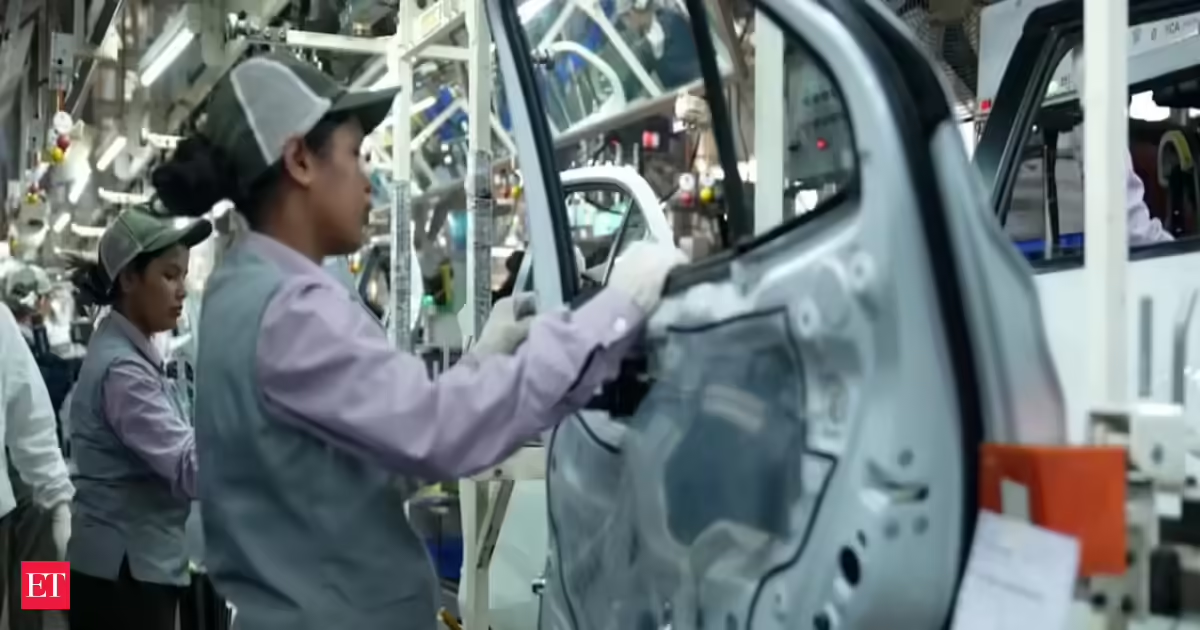
Nearly ₹540 crore of disclosed investments announced at the start of the second quarter of FY27 underscore a growing shift in capital towards India’s automotive supply chain, with investors backing battery materials, advanced manufacturing and localisation even as ICRA estimates the auto component industry will invest ₹ 20,000-25,000 crore during FY27.Leading the investment cycle, Australian battery materials company Sicona Battery Technologies, backed by Himadri Speciality Chemical Ltd, secured up to AUD 45 million (around ₹255 crore) from the Australian Renewable Energy Agency (ARENA) to commercialise its silicon-carbon anode technology for lithium-ion batteries.Automotive component supplier JRG Automotive Industries raised ₹125 crore from Piramal Alternatives to expand manufacturing capacity, modernise factories and pursue acquisitions, while AISIN announced a ₹150-crore expansion in Punjab to localise premium transmission and powertrain components.The investments follow Himadri’s decision last month to raise its stake in US-headquartered International Battery Company (IBC) to 20.47 per cent through an additional investment of $0.66 million, strengthening its presence across the battery materials value chain.Fresh investment is increasingly targeting battery materials, precision manufacturing, automotive electronics and other high-value components where India continues to rely on imports despite the auto component industry’s ₹7.6 lakh crore turnover and ICRA’s projected ₹20,000-25,000 crore capex cycle for FY27.Battery-materials gain scaleThe ARENA-funded facility will manufacture Sicona’s proprietary silicon-carbon anode material while producing qualification samples for battery manufacturers and EV OEMs. According to the company, the technology can improve lithium-ion battery energy density by up to 20 per cent and enable charging speeds up to 40 per cent faster than conventional graphite anodes, while remaining compatible with existing lithium-ion battery manufacturing infrastructure.“We see tremendous potential in combining Himadri’s advanced materials expertise with IBC’s battery technology and manufacturing capabilities. This collaboration strengthens our position across the global battery value chain,” Choudhary said.The transactions point to a broader shift in capital allocation across India’s automotive ecosystem. Rather than flowing primarily into vehicle manufacturers, fresh investments are increasingly targeting upstream technologies and manufacturing capabilities that improve domestic value addition, accelerate localisation and position suppliers to capture rising domestic and export demand.Investors are also favouring powertrain-agnostic suppliers whose products are used across petrol, diesel, hybrid and electric vehicles. As vehicles become more software-defined and electronics-intensive, companies capable of increasing component content per vehicle are expected to benefit regardless of the propulsion technology adopted by automakers.Manufacturing draws fresh capitalA different investment thesis is unfolding in conventional component manufacturing. Unlike battery materials, which are attracting strategic technology investments, the JRG transaction reflects growing investor appetite for scaling established manufacturing businesses through capacity expansion and acquisitions.JRG Automotive, which manufactures powertrain-agnostic injection-moulded plastic components for passenger vehicles and two-wheelers, will use the ₹125-crore investment to expand manufacturing capacity, modernise factories and pursue acquisitions, enabling it to broaden its product portfolio and increase the value of components supplied per vehicle.“The fresh capital endorsement will allow us to scale our manufacturing capabilities and infrastructure to better serve our long-term OEM partners,” said Pawan Goyal, Managing Director, JRG Automotive Industries.Kalpesh Kikani, Chief Executive Officer of Piramal Alternatives, said the investment reflected JRG’s track record of increasing component content per vehicle and its established relationships with leading automotive manufacturers.Chakan enters new investment cycleManufacturing clusters such as Pune-Chakan are entering a fresh investment cycle as component suppliers automate factories, expand machining capacity and diversify into higher-value sub-assemblies to meet OEM localisation requirements. Manufacturers are also investing in automation to address skilled labour shortages while preparing for larger domestic and export programmes.Industry executives say the next phase of investment is extending beyond battery materials into automotive electronics, thermal management systems, precision manufacturing and lightweight components as suppliers respond to rising technology content in modern vehicles and opportunities created by global supply-chain diversification.Published on July 8, 2026