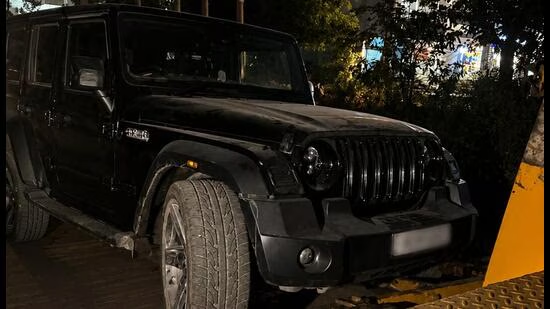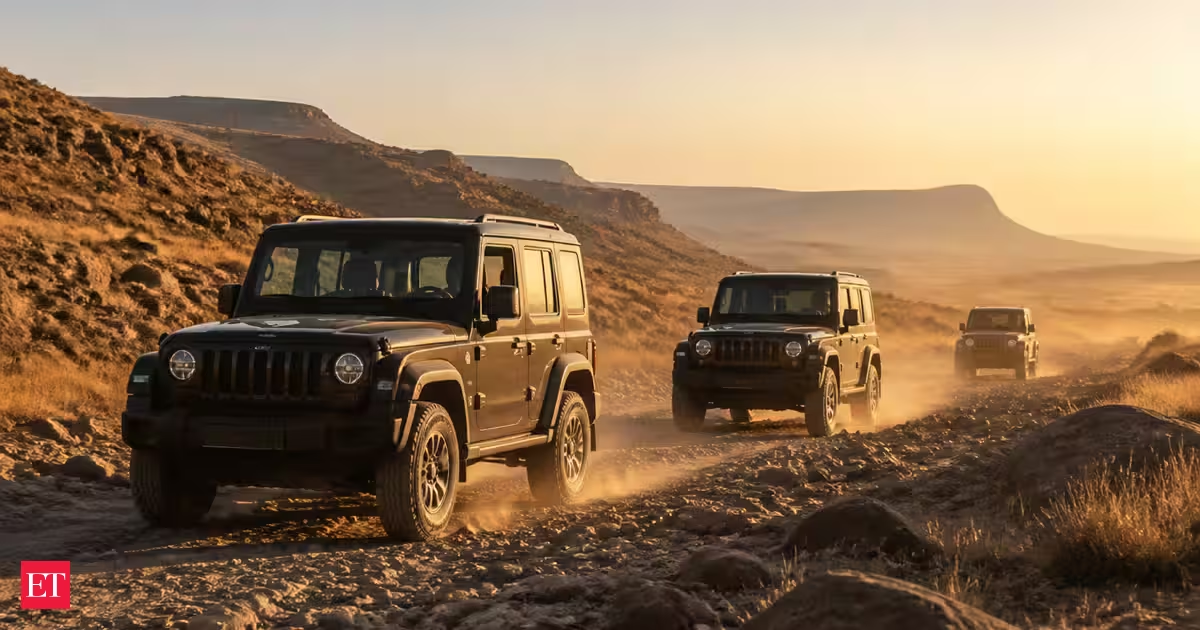
Goa will stop issuing new rental licences for Mahindra Thars, the state transport minister Mauvin Godinho said on Monday, after a string of fatal crashes involving the SUVs turned the vehicle into a contentious road-safety symbol.Featured image made on Canva (Representative image)Godinho told reporters that a proposal to restrict permits for self-drive rental Thars would be presented to the state transport authority (STA). Had the law allowed it, he said, the government would have banned rental Thars outright because they had “too much speed and no control”.The decision came after two accidents. In February, a rented Thar killed 65-year-old Bhopal tourist Bhagat Ram Sharma at Assagao. In May, a Thar driven by a tourist, believed to be inebriated, killed a 32-year-old man and critically injured a minor in North Goa.It isn’t the first time Thars have run into controversy.In November 2025, then-Haryana director general of police O.P. Singh said Thar and Bullet motorcycle owners in Gurugram tended towards a reckless mindset, and that the SUV was “not a car”, but a “statement”. A Gurugram resident who used a Thar had subsequently sent Singh a legal notice, demanding a public apology for the reputational harm.That image isn’t exclusive to the Thar. Other SUVs – among them the Scorpio and Fortuner – have earned similar reputations, often associated with drivers who defy traffic rules and perform stunts posted on social media.Also read: HT Auto The psychology of bigger, taller, tougherResearch on consumer behaviour offers partial explanations for the popularity of SUVs and their reputation.A 2025 paper in the journal Human Settlements and Sustainability found that SUV buyers cite dominant road presence and a sense of protection among the main reasons for the purchase. The cars’ elevated seating positions and rugged exteriors create a sense of security, even if safety trials and data might show otherwise.A 2022 survey of 100 respondents in Odisha’s Bhubaneswar, published in the International Journal of Research Publication and Reviews, said that SUV buyers ranked safety, off-road ability, ruggedness, space and status among their top reasons for choosing the 4x4 vehicles. It also described SUV purchases as “aspirational”.Another 2022 study in the journal Energy Research & Social Science, based on a survey of nearly 1,000 Vancouver residents in Canada, said SUV owners regarded their vehicles as a status symbol that signaled success.Similarly, a 2023 study in the journal European Chemical Bulletin, focused on buyers in the Delhi-NCR, referred to a similar drift.Consumers increasingly describe utility vehicles, including SUVs and compact SUVs, as economical, powerful and stylish rather than merely utilitarian, with affordability, style and status cited as the main drivers of demand, alongside size, visibility and towing capacity.Social media has scaled up this identity, a May 2024 paper analysing online posts on the Thar noted. It said digital platforms “amplify its rugged charm while silencing pragmatic concerns, creating a feedback loop of desire”. Separately, online groups such as the ‘Gang of Thars’, which has an Instagram following of 16,200, have built a community around the vehicle.Also read: Goa Thar accident: Delhi student booked, gets bail after Bhopal man diesDriving-behaviour studiesResearch across countries has pointed to a pattern once a driver is behind the wheel of an SUV.A 2017 observational study, published in the journal Wiener klinische Wochenschrift and conducted at three busy intersections in Austrian capital Vienna, recorded 43,168 ordinary cars and 5,653 SUVs. Of this, 13.8% of the drivers did not wear the seatbelt, 3.1% used a handheld phone, and 2.5% ran red lights.The violations were more common among SUV drivers than other passenger cars, the study noted.Another simulator study, published in the journal Traffic Injury Prevention in 2006, tested the effect of higher seat positioning. Drivers seated higher chose faster speeds, sped up or slowed down more often, and kept a less consistent lane position than those seated lower, even though the higher vantage point had no effect on following distance to a slower vehicle ahead, the study found.Then, a 2006 study in TheBMJ analysed drivers at intersections in London and found that those in four-wheel-drive vehicles – or SUVs – were four times more likely than other drivers to be seen using a handheld phone, and somewhat more likely to skip wearing a seatbelt.Also read: Five held, six cars seized for stunt video on NH-919 in Nuh‘Blame the driver, not the vehicle’The studies reinforce part of a pushback that SUV drivers have been making – it’s not the cars as much as a social behavioural issue with some.On popular Reddit forum CarsIndia, for instance, threads on a vehicle’s public image regularly trigger spirited debates. Indian actor Rohit Roy, a Thar owner, had argued after the Haryana DGP’s comments that the “car isn't the problem, the people are”. He noted that he also owns six superbikes and has never used them to perform stunts. Actor and car enthusiast Gul Panag also spoke against sweeping generalisations about owners of SUVs.Similarly, Amarjit Singh of the ‘Gang of Thars’ online group had said it was unfair to categorise an entire ownership base by the actions of a visible few.HT reached out to Mahindra with requests for comment via e-mail. The report will be updated if and when there is a response.Whatever the reputational tension, the commercial one is firmly in favour of SUVs. Utility vehicles, the category that includes SUVs and compact SUVs, captured a record 67% share of India’s passenger vehicle market in the 2025-2026 financial year, Livemint reported.
Goa wants to curb rental Thars: Why SUVs aren't able to outrun reckless-driving perception
Minister's remark revives a debate that goes beyond one vehicle. Here's what studies say about SUVs, status and risky driving. | India News
900 words~4 min read