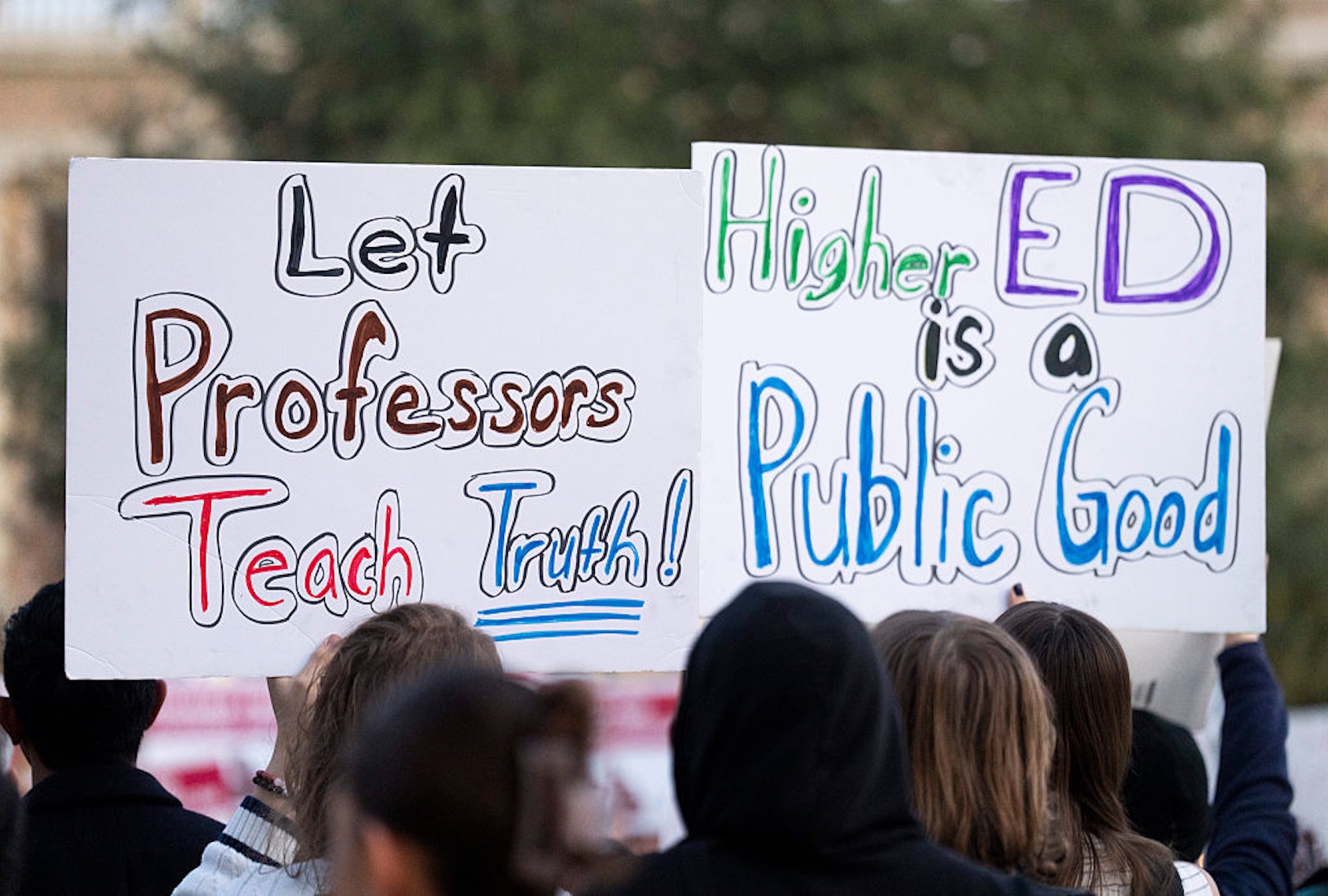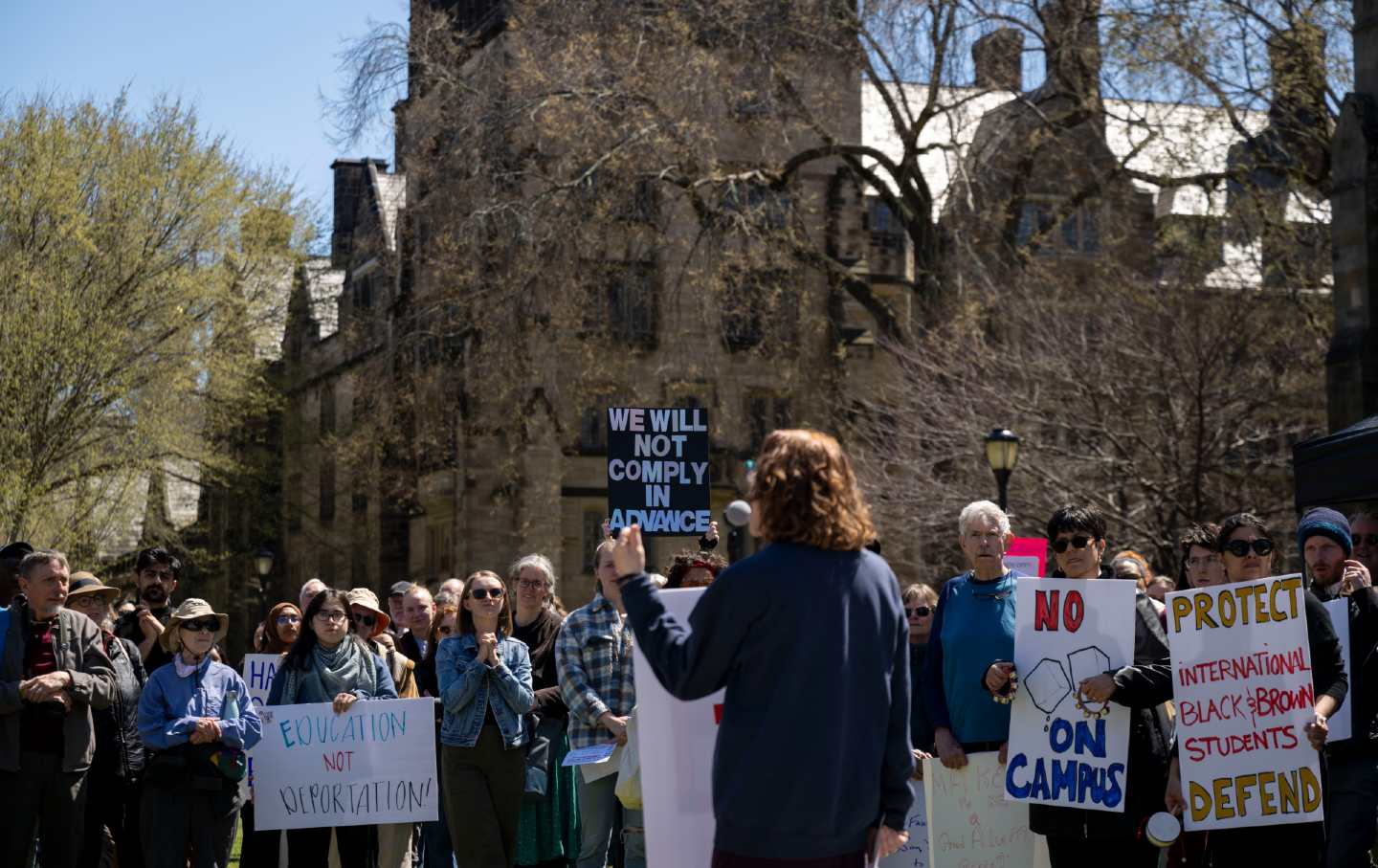
Are there any organizations with enough courage and clout to defend traditional higher education principles like faculty independence, shared governance, and institutional autonomy? Here are four possibilities.gettyAcademic freedom at American universities is under assault. Sometimes the attack has taken the form of new state laws or federal policies mandating what is taught and by whom. In other instances, institutions preemptively curtail faculty input into academic affairs, limit students’ freedom to learn, and impose top-down restrictions on university senates and academic requirements, even exceeding what’s required by law. Academic freedom and institutional independence are not just faculty perks, they’re essential principles for a democratic society to protect universities from political interference and safeguard scholarly inquiry against censorial impulses. According to the 2026 Academic Freedom Index, U.S. institutional autonomy has deteriorated 50 percent since 2015, a decline that started in 2020 and has accelerated since 2025, driven by several Trump administration policies.PEN America’s recent report – America’s Censored Campuses 2025: Expanding the Web of Control — further documents the crisis. It found that 23 states had enacted laws or policies censoring higher education since 2021, affecting over half of all enrolled U.S. college students.Examples of assaults on academic freedom and faculty influence have become distressingly easy to find. Earlier this year, Texas A&M University administrators told a professor he either would have to drop writings by Plato on race and gender from his introductory philosophy class or teach a different course. That mandate was an attempt to comply with a new Texas A&M Board of Regents’ policy that no “system academic course will advocate race or gender ideology, or topics related to sexual orientation or gender identity.”Last year, Texas passed a law reducing the size, influence and independence of faculty senates at its public institutions. Authored by Senator Brandon Creighton, now the Chancellor of the Texas Tech University system, the law strengthened the power of university governing boards and central administrators over curriculum while stripping away much of the authority faculty bodies have traditionally held on such matters.Auburn University’s Board of Trustees recently voted to dissolve the university’s faculty senate and gave itself total control over course offerings, curriculum, and degree requirements. The Florida Board of Governors has eliminated Introduction to Sociology from the general education curriculum at all 12 public universities. Ohio’s far-reaching SB1 mandates that its public institutions require a 3-credit-hour course in American civic literacy, further specifying that the course must cover Adam Smith’s The Wealth of Nations.The Iowa legislature passed House File 2800, mandating that students attending one of Iowa’s three public universities must take a three-credit introductory American history course and a three-credit American government course. At the University of Iowa, that law forces them to take those courses only through the recently created Center for Intellectual Freedom, a unit that’s seen very low enrollments in its offerings. The nation’s colleges need more advocates to exert checks against these attacks on institutional autonomy and faculty freedoms. Normally, accrediting agencies would serve this watchdog purpose, assigning sanctions for violations of traditional academic standards. However, accreditors are in retreat, the result of executive orders and states challenging their authority along with the rapid creation of several accreditor alternatives to which colleges are being driven. Who’s left to speak out and stand up for the importance of academic freedom? Are there organizations with enough courage and clout to meaningfully defend essential principles like faculty independence, shared governance, and institutional autonomy? The courts have proven to be a reasonably effective check on the autocratizing pressures faced by institutions, but relying on lawsuits for protection is costly, time-consuming and inconsistent as either a preventive or remedial measure. Litigation might undo a bad law, but it’s not likely to stop college administrators from too easily acquiescing to the political pressures now bearing down on many campuses. Here are four possibilities for collective action that could provide bulwarks against the abandonment of academic freedom, the marginalization of faculty, and the curtailment of institutional processes that have become far too common. AAUP CensureThe American Association of University Professors maintains a list of university administrations that it has censured because of “violations of the generally recognized principles of academic freedom and tenure.” It’s a kind of blacklist aimed at shaming institutions into cleaning up their act and deterring them from straying too far from valued academic and governance practices. Currently, about 60 institutions are on the censure list, although many others have had their censure removed after they reformed their practices. AAUP could be more aggressive in investigating institutions and censuring those whose governance policies it finds blameworthy. While AAUP censure carries no legal impact for institutions, it’s a public scolding that generates enough bad publicity that most institutions will try to prevent it or have the stigma removed as soon as possible.However, the barb of being put on the list may have lost a bit of its sting in an era where too many public officials interpret faculty outcry as a positive indicator that power is being wrested from “woke” professors so it can be rightfully restored to legislators, governing boards and central administrators. In addition, AAUP’s affiliation with the American Federation of Teachers might mobilize the anti-union sentiments common in some administrative and governmental circles.AAU SanctionsThe Association of American Universities (AAU) is an invitation-only association of America’s leading research universities. Its 71 research public and private institutions proudly proclaim their membership as a badge of excellence, and universities that aspire to AAU membership work long and hard to gain entry. In a recent Inside Higher Education op ed, Kumble Subbaswamy, former chancellor of the University of Massachusetts at Amherst, suggests that the AAU should impose sanctions on member institution that flagrantly violate principles involving institutional autonomy, academic freedom and shared governance. (Full disclosure: Subbaswamy and I were colleagues together at the University of Kentucky, where we each served terms as provost.)Subbaswamy argues that if AAU would “act in accordance with its principles," it “would have far-reaching impact beyond its membership" because being a member “carries a form of currency that no accreditor can match: prestige.” Were that prestige to be conditioned on the maintenance of academic freedom, Subaswamay maintains that it would become “a lever—perhaps the only remaining lever—capable of altering the political calculus that university leaders now face.”The threat of suspension or expulsion from the organization would be a strong consequence for current members. In addition, an institution’s assurance that it protects academic freedom and enshrines shared governance could be established as requirements for applicant universities.The scope of AAU sanctions would, of course, be limited to large research universities, but their symbolic value would be substantially more far-reaching.Private Foundation Grant EligibilityIn recent years, U.S. private foundations have awarded $11-12 billion in grants to higher education institutions annually. Since 2008, those grants have totaled nearly $91 billion. While many of those grants have gone to individual faculty members, others have been awarded to colleges and universities for a variety of purposes, including capital projects, student financial aid, and academic program development.Foundations have great freedom to establish the criteria used in making grant awards. They can prioritize faculty quality, institutional mission, student diversity, or social mobility. They also could elect to make their grants be contingent on institutions’ assurances and track record of protecting academic freedom, resisting censorship, and respecting the role of faculty in institutional governance. A little philanthropic pressure from the Gates Foundation or the Lily Endowment might go a long way.Ranking University’s Academic EnvironmentCollege ranking schemes like those published annually by U.S. News, Forbes, and Washington Monthly have a substantial influence on institutional behavior. Institutions spend money, reassign resources, make strategic plans, and sometime even fudge their own data to climb up the ranking ladders. What’s measured always matters. College ranking systems could add an institution’s governing environment to the list of factors they weight in arriving at their scores. That’s another lever that, when pulled, might influence university leaders. There’s a precedent for such assessments. The Foundation for Individual Rights and Expression (FIRE) surveys college undergraduates about their perceptions and experiences regarding free speech on their campuses and generates an annual College Free Speech Rankings, which receives a great deal of national attention, despite its methodological problems. In a paper slated for publication in Academe, AAUP’s magazine, Jennifer Lundquist, professor of Sociology at the University of Massachusetts Amherst and Robert M. Dowling, professor of English at Central Connecticut State University, call for adding metrics that tap the conditions upon which academic quality depends. "If U.S. News continues to claim authority over what counts as a "best" college or university, it should no longer ignore whether a campus has the courage -- and the governing freedom -- to function as a university at all," they write. What are those essential conditions? Lundquist and Dowling point to "curricular autonomy, due process, faculty oversight, and freedom from political coercion regardless of whether from the right or the left.” Ranking systems, including U.S. News, have shown a willingness to refine their metrics and redefine what they mean by quality. It’s time to do so again, with the addition of one or more measures of academic freedom to the list of factors by which institutions are judged. Challenges and QuestionsEach of these strategies face limitations and challenges that need careful consideration. One is operationalizing the threshold for action. What qualifies as an anti-governance offense or academic freedom infringement that’s serious enough to cause a school to be censored by AAUP or expelled from the AAU? Is dissolving a faculty senate enough? How about requiring pre-approval of course syllabi or limiting faculty input on graduation requirements? How much weight should be given to a ranking metric or a grant criterion that involves an institution’s commitment to academic freedom? And who guarantees such a commitment — the provost, the president, or the governing board?Should the consequences for universities that are complying with a statute or gubernatorial executive order be differentiated from those that are engaging in anticipatory compliance? One could argue that institutions that practice preemptive submission should be treated more harshly than those subjected to a particularly intrusive state legislature or governor. On the other hand, you could take the position that fault shouldn’t matter. If the governor of Florida doesn’t care whether the University of Florida and the University of South Florida remain in the AAU, perhaps their removal from the membership would send the necessary, albeit painful, message that political interference into university affairs needs to end.The American university is a unique institution that’s contributed to the nation’s progress in many ways. Although our universities have faced struggles throughout their existence, today’s combined challenges constitute a unique threat to the principles that have made them the envy of the world. Universities now need independent allies to rally to their defense, offering both practical and moral support to counter the forces that seek to diminish them.
If States And Colleges Won’t Protect Academic Freedom, Here’s Who Can
With universities under increased attack, there's a growing need for independent bodies to help protect academic freedom and uphold faculty's key role in governance.
1,810 words~8 min read