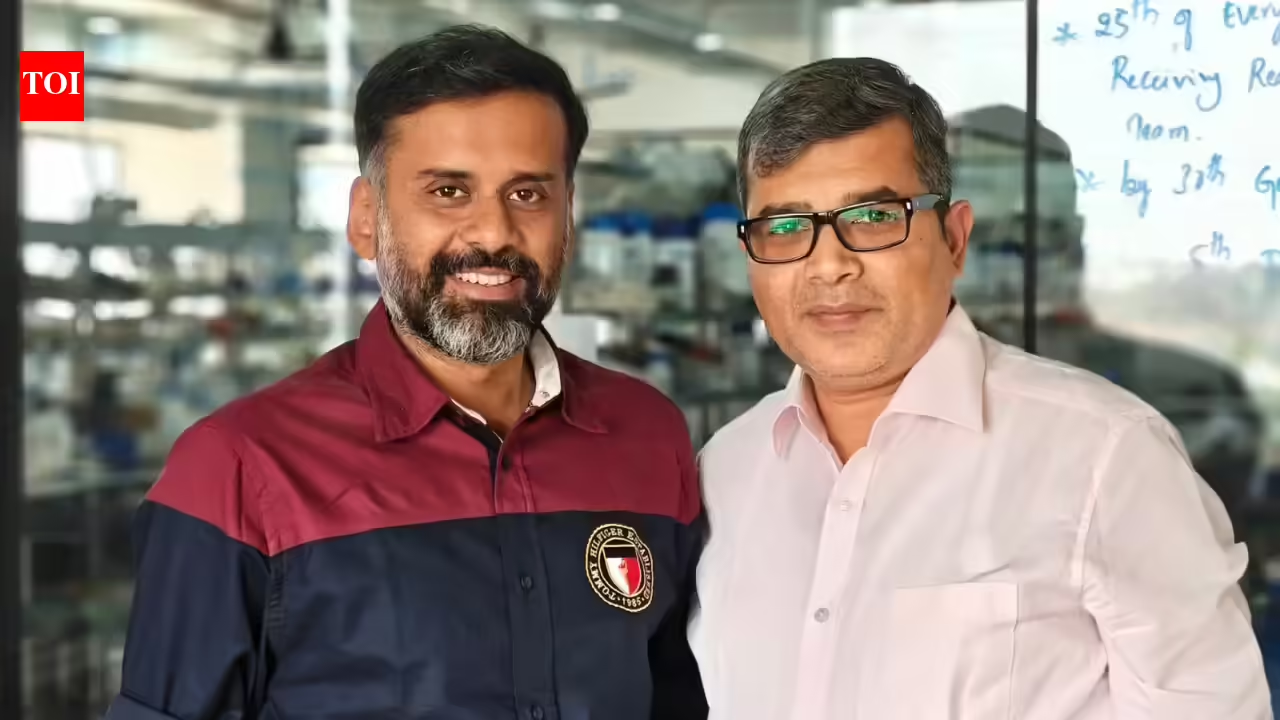
Anagha Rajesh, founder, BioCompute
DNA data storage start-up BioCompute is on track to close a major funding round by the end of July, with commitments expected to exceed its initial target of $2 million.The surge in investor interest follows a viral appeal by content creator Vyom Bhatia, providing the Bengaluru-based startup with the capital needed to move beyond its working prototype and towards its first commercial product.Founder Anagha Rajesh said the fresh funding will primarily be used to manufacture specialised microfluidic and nanofluidic chips, hire scientific and engineering talent, and build the hardware infrastructure required to commercialise the technology.Reimagining long-term data storageAt the heart of BioCompute's proposition is an attempt to rethink how the world's rapidly growing digital data is archived.Today's storage infrastructure relies largely on magnetic media or trapped electrons to preserve binary information—systems that consume significant amounts of electricity, require constant cooling, and occupy large physical footprints.BioCompute instead converts conventional binary code into biological information stored within DNA.Although DNA data storage has been researched globally since the 1980s, with companies in the US and Europe pursuing commercialisation, Rajesh argues that BioCompute has developed a significantly cheaper method for both writing and reading DNA-based data.A different approach to DNA storageMost existing DNA storage companies synthesise entirely new strands of DNA to encode digital information, a process that remains both time-consuming and expensive.Rather than creating synthetic DNA from scratch, the company uses naturally occurring DNA as a template and modifies it using proprietary enzymes.Rajesh likens these enzymes to "sticky notes" that attach or remove molecular tags without altering the DNA's underlying genetic sequence.Because the DNA template itself remains unchanged, the company says it can avoid expensive full-genome sequencing and instead rely on a proprietary sensing mechanism that significantly reduces the cost of encoding information.For retrieval, BioCompute uses the latest-generation nanopore sequencing technology. As tagged DNA molecules pass through nanoscale pores under an electrical current, each molecular tag produces an unique voltage signature. These electrical patterns are decoded back into DNA information and ultimately reconstructed into the original binary data.Experts see promise—but with caveatsThe technology has drawn cautious optimism from academia. Sangeeta Sawant, Head of Department of Bioinformatics at Savitri Bai Phule University, Pune, said DNA-based data storage is scientifically feasible but is currently better suited for institutional archival applications rather than consumer electronics.According to Sawant, maintaining molecular-level precision remains expensive, making large-scale deployment inside everyday devices commercially challenging at present.She also pointed to significant hardware integration hurdles. DNA is inherently biological material and is susceptible to heat-induced degradation. Integrating it into laptops, smartphones or other consumer electronics would therefore require substantial advances in thermal management and hardware engineering to ensure long-term reliability.Taking aim at enterprise archival storageRather than targeting consumers, BioCompute is positioning itself as an enterprise infrastructure company.Its immediate focus is the cold-storage market, where organisations archive infrequently accessed data using tape-based systems such as Amazon S3 Glacier.Rajesh claims BioCompute's DNA-based storage offers write and retrieval speeds comparable to existing tape libraries while addressing three longstanding industry challenges: the large physical footprint required to store data, high energy consumption, and the periodic replacement of magnetic media, which typically needs refreshing every 18 to 24 months to minimise data degradation.Instead of competing with cloud providers, BioCompute intends to supply its technology to them, enabling lower infrastructure costs over time.Commercial roadmapTo validate the platform, BioCompute has already secured pilot customers in the media industry, where organisations generate vast quantities of archival content but face relatively fewer regulatory constraints. Its business model combines hardware sales with recurring revenues from service contracts and consumables.Initially, the company plans to partner with established hardware manufacturers to build commercial devices before gradually bringing chip manufacturing in-house.Over the longer term, Rajesh envisions DNA becoming an invisible layer of long-term storage embedded inside consumer devices such as laptops and smartphones, allowing infrequently accessed files to be preserved locally without consuming conventional flash memory.(The writer is an intern with businessline)Published on July 8, 2026