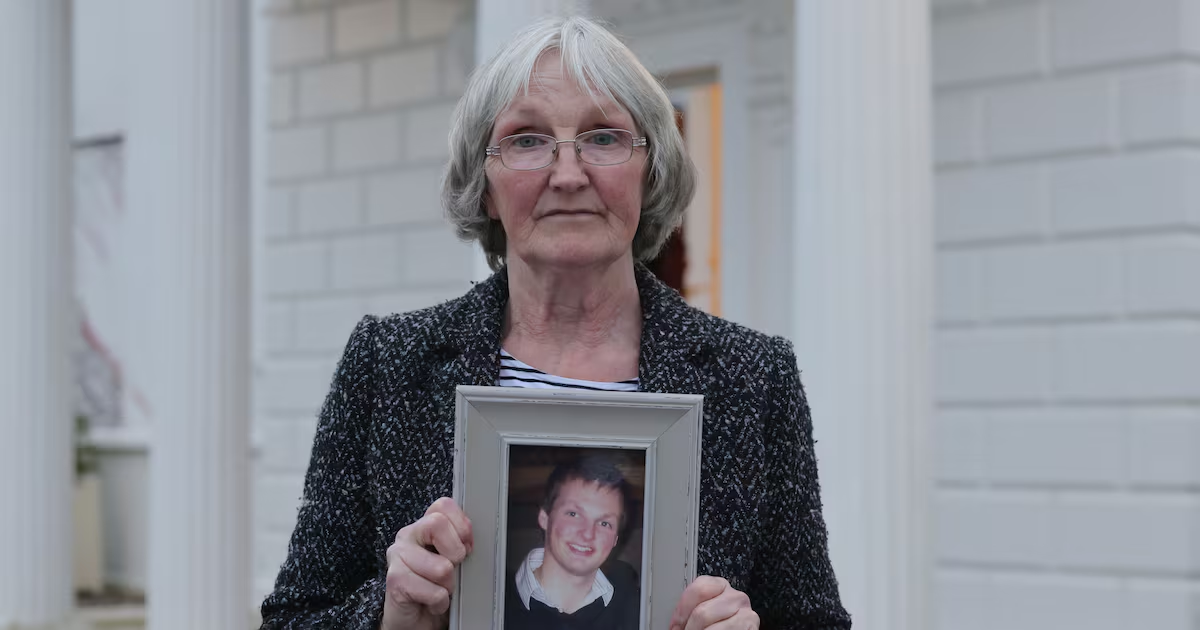
A woman whose son was killed in a hit-and-run incident by a driver on bail has called for court prosecution decisions to be removed from gardaí to lawyers as part of bail law reforms.Lucia O’Farrell said the State needs to be “far more intolerant” of bail breaches and one of the main issues arising from the death of her son Shane is that the courts are not given full information concerning continuous breaches of bail.She supported the view of the 2018 report of the Commission on the Future of Policing in Ireland that all prosecution decisions should be taken away from gardaí and given to an expanded State solicitor or national prosecution service. O’Farrell also supported an amendment to the Bail Act 1997 to provide for power to arrest, without warrant, a person suspected of breaching a bail condition to bring them before the court for revocation of bail or amendment of bail conditions.These, and other recommendations of a review of the bail laws carried out by senior counsel Lorcan Staines should be implemented, she urged. “There is a desperate need for root-and-branch change.” O’Farrell, accompanied by her husband Jim, was addressing a hearing on Tuesday of the joint Oireachtas committee on justice, home affairs and migration.Representatives from the Bar of Ireland, the Law Society of Ireland and the Irish Penal Reform Trust also addressed the hearing, which focused on the current bail laws.Committee chair Sinn Féin TD Matt Carthy, said public confidence in the criminal justice system “depends on having a bail system that both protects the constitutional rights of accused persons and one that protects communities”. The experience of the O’Farrell family highlighted “the tragic consequences that can arise where bail conditions are repeatedly breached”, he said.The 15 recommendations of the Staines review include improving the quality of information available to judges during bail applications, strengthening monitoring of bail conditions, potential use of electronic monitoring and measures to address repeat offending while on bail.The review was promised in May 2025 by the Minister for Justice, Jim O’Callaghan, when he apologised in the Dáil on behalf of the Government to the O’Farrell family, saying the criminal justice system did not protect Shane as it should have. The 23-year-old died in 2011 after being knocked off his bicycle near his home in Carrickmacross by a car driven by Zigimantas Gridziuska, a Lithuanian national on bail at the time. Gridziuska had 42 previous convictions including for road offences and aggravated burglary. Gridziuska pleaded guilty to failing to stop at the scene and to report the incident. He was acquitted of dangerous driving causing death and served no prison time.Seven months before the incident, a judge had ordered Gridziuska be brought back before him if he committed further offences. Gridziuska was charged with further offences but was not brought back before the judge and remained on bail. On Tuesday, Gary Mulchrone, of the Law Society’s Criminal Law Committee, and Aoife O’Leary, of the Bar of Ireland’s Criminal State Bar Committee, stressed the importance of upholding the constitutional principles underpinning the bail system, particularly the presumption of innocence. Both asked the committee to recognise the broader context in which bail decisions are made, including prison overcrowding, and focus on practical measures that strengthen enforcement and improve information sharing. The Bar’s view is that, as the Staines report concluded, Irish bail law has already gone as far as is permissible, said O’Leary. “The principal challenge is not an absence of legal powers but in the cumbersome, inefficient and inconsistent operation of the existing system.”Mulchrone said judges should be permitted to consider electronic monitoring as part of bail conditions. Saoirse Brady of the Irish Penal Reform Trust said research being published by the trust later this month indicates that Irish bail laws, and their application in practice, is an “opaque” area of the criminal justice system in need of “major, evidence-based reform”. People should only be remanded to custody as a last resort yet almost one in five people in prison are in pretrial detention or on remand while awaiting trial or sentencing, often for minor offences, she said. Last year, 74 per cent of people on remand did not go on to serve a sentence because they were either not found guilty or the time they had spent in remand custody was considered as time already served. The criminalisation of people with mental health issues is a key area of concern, she added.
Take court-prosecution decisions away from gardaí, Oireachtas committee told
Woman whose son was killed in hit-and-run incident by driver on bail says State needs to be ‘far more intolerant’ of bail breaches
739 words~3 min read