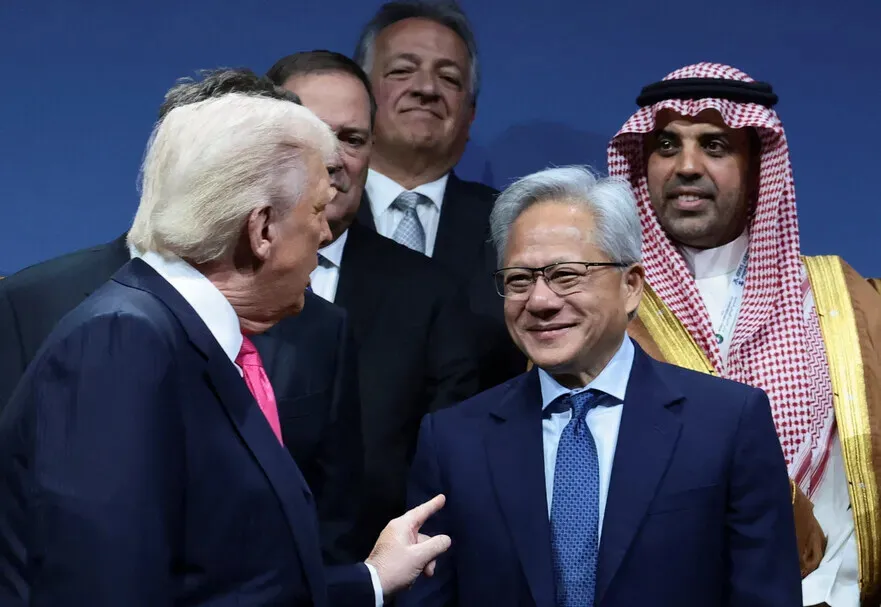
US President Donald Trump speaks to Nvidia CEO Jensen Huang at the US-Saudi Investment Forum at the Kennedy Center, on Nov. 19, 2025, in Washington. (Reuters/Yonhap)
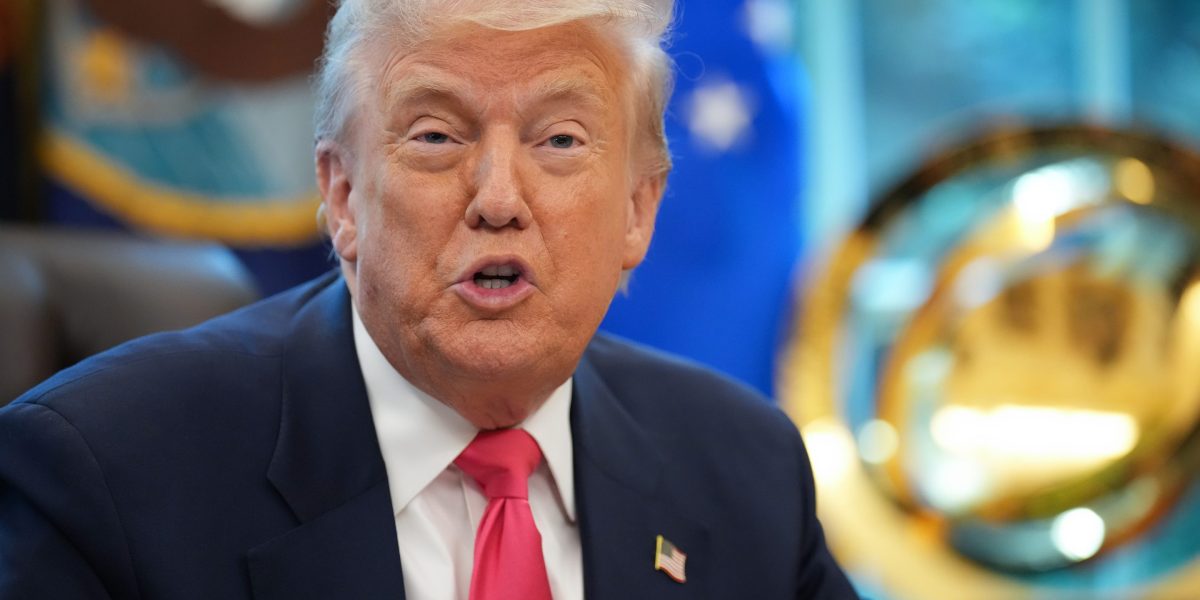
In August 2025, the US government under President Donald Trump announced plans to convert US$8.9 billion in subsidies for Intel into an equity stake in the cash-strapped chipmaker. That acquisition gave the US government a 10% stake, becoming Intel’s largest shareholder.Washington may not be managing Intel directly, but the government becoming the majority shareholder of the US’ biggest semiconductor firm remains controversial. The move has prompted speculation about whether the US, long a leading advocate of the free market, is moving toward Chinese-style state capitalism.In the following months, the US’ other major tech firms have announced investments in, and partnerships with, Intel. That September, Nvidia said it would invest US$5 billion in Intel and use the company’s CPUs in its own products. This year, SpaceX founder Elon Musk signed a deal to incorporate Intel technology into his planned next-generation semiconductor plant called Terafab.Then in June, Trump disclosed that Apple will be partnering with Intel, writing on social media that “finally, Apple has agreed to work with Intel to design and build its Chips in America.”Analysts think these trends are being coordinated behind the scenes by the Trump administration.“Commerce Secretary Howard Lutnick began pressuring tech leaders to work with Intel, including [Jensen] Huang of Nvidia, Elon Musk of SpaceX and Tim Cook of Apple,” The New York Times reported, quoting a US government official who was not authorized to speak on the record.That would suggest that central figures in the US government are heavily involved in corporate decision-making. Corporate decisions shaped by another kind of “invisible hand”This marks a departure from the industrial policy pursued by the Biden administration. Under the CHIPS and Science Act, the government’s role consisted of providing cash subsidies, tax credits and financial support. But the Trump administration has gone further by lining up customers for favored companies.Such actions have previously been inconceivable in American-style capitalism. Some are concerned that direct government intervention in resource distribution — which should generally be left to the market — could lead to inefficiencies and distortions.While there are examples of such government intervention in the past, that has generally been limited to emergency situations such as wars, the COVID-19 pandemic and global financial crises.Trump has announced the goal of increasing the US’ chipmaking self-sufficiency from the current level of 10% to 50% before the end of his term. Building enough semiconductor capacity to meet half the US’ chip demand at home is a tall order. It’s reminiscent of China’s “Made in China 2025” plan, announced in 2015, to reach 70% semiconductor autonomy within 10 years.The US had also adopted a policy of intervention in the semiconductor industry back in the 1980s, but its methodology was different back then. As Japanese chipmakers consolidated their grip on the global market, the US reached a semiconductor agreement with Japan in 1986 under which Japan was to raise foreign chipmakers’ share of the domestic market to 20% and to block exports of chips sold below market value.In 1987, the US threatened to impose punitive tariffs on Japan under Section 301 of the Trade Act of 1974 for failing to abide by the agreement. While Washington generally used commercial pressure at the time, it’s now intervening directly in corporate management with the goal of expanding semiconductor fabrication capacity inside the US in a tight timeframe.To achieve that, the Trump administration is seeking to build a domestic firm into a “national champion” while pushing Taiwanese firm TSMC, the world’s biggest semiconductor foundry, to build more factories in the US.In January, the US strong-armed Taiwan into promising large-scale investments in the US in return for lowering tariffs to 15%. The main planks of the agreement were for TSMC to spend US$250 billion on building semiconductor plants in the US and for the Taiwanese government to provide US$250 billion in credit to help manufacturers of semiconductor parts relocate to the US and establish a chip ecosystem there.“We’re going to have hundreds of companies coming here. We’re going to build giant semiconductor industrial parks in America,” US Commerce Secretary Howard Lutnick said in an interview with CNBC at the time, explaining that “the objective is to bring 40% of Taiwan’s entire supply chain and production [. . .] into America.”These policies illustrate the surging anxiety felt by the US. In the 1980s, Americans were also anxious about Japan’s technological advances, which were sometimes likened to a second attack on Pearl Harbor. But those fears were strictly economic in nature.In contrast, China today has emerged as an economic and military competitor stronger than any the US has ever faced. And semiconductors are regarded as the lifeblood of future-oriented industries and a chokepoint that will separate the winners from the losers in cutting-edge industries, as well as cutting-edge weaponry, in the AI era.US fears are further fueled by its reliance on TSMC for 90% of its chips and by the geopolitical risk presented by Taiwan. In that context, the US’ approach to semiconductors goes beyond industrial policy and assumes the nature of national security policy. Industrial policy starts to evoke the 1930sThe Trump administration is strengthening its control of strategic industries by acquiring equity stakes not only in chipmakers, but in companies in such fields as critical minerals and nuclear power.Even the Pentagon is getting in on the action. In July 2025, the US Defense Department spent US$400 million to acquire a 7.5% stake in rare earth miner MP Materials and an option for buying another 7.5% stake.Then late last year, after China moved to tighten controls on exports of rare earths, the US expanded its investment in mining companies such as Vulcan Elements. In addition, the US Commerce Department snagged an option to buy an 8% stake in nuclear power company Westinghouse last October.In an article written for the International Monetary Fund last month, Cornell University professor Nicholas Mulder said that the US and other governments “are taking over private enterprises and resources at the fastest pace in 50 years.”“Geopolitical instability, commodity market disruptions, and renewable energy development are driving these takeovers. And as more governments embrace interventionist economic policies, the current wave of nationalizations shows no signs of letting up,” Mulder wrote.Mulder said that we are in “the fourth great wave of nationalizations in the past 100 years,” following earlier waves in the 1930s, during the Great Depression; in the late 1940s, as countries turned to mixed economies following World War II; and in the 1970s, in the wake of energy shocks.Compared with past instances of nationalization, the current trend is similar in many respects to the 1930s.US President Franklin Roosevelt’s “New Deal” sought not only to reboot the economy and stabilize society through an industrial revival but also to bolster the defense industry. In the protectionism and prewar tensions of the Great Depression, Roosevelt concentrated on restoring the US’ production base and expanding its ability to produce its own strategic materials.Ray Dalio, the founder of the Bridgewater Associates hedge fund and author of “How Countries Go Broke: The Big Cycle,” discussed these trends in an interview with the Financial Times in September 2025.“In a world in which there are great conflicts and possibly even wars between countries, governments increasingly take control of what businesses do. For example, it is now the case that whichever country wins the technology and economic wars will win the more important geopolitical and possibly military wars. [. . .] The part of the Big Cycle that we are in is most analogous to the 1928 to 1938 period,” he said. How feasible is the US’ bid to become self-sufficient in chipmaking?Thus far, the investment boom in AI has been aiding Intel’s recovery. Its stocks have risen fivefold over the past year. While that’s partly due to contracts with other Big Tech firms and the managing acumen of CEO Lip-Bu Tan, the biggest factor of all has been the semiconductor shortage.With TSMC and other leading firms unable to keep up with demand, desperate customers have been inundating Intel with orders despite the lower quality of its products. Another tailwind for Intel is increasing demand for central processing units (CPUs) as evolving AI models move from the learning to the inference stage.But it’s uncertain whether a company that has struggled to keep up with decisive technological shifts, including smartphones and AI, since the mid-2000s can regain its competitive edge so fast. It will probably take time for Intel to stabilize the yield of its advanced 18A (1.8 nanometer) process and for its clients to recognize the competitiveness of its products.While leading tech firms are announcing plans to cooperate with Intel for fear of getting on Trump’s bad side, they’re unlikely to install Intel chips in top-of-the-line products. Apple, for example, reportedly plans to use Intel chips not in its smartphones but in its laptop computers, which are less technologically demanding.Another question is whether US policy is sustainable. With its entrenched leadership, China is capable of sticking with a long-term development strategy, but because of rotating administrations, the US’ industrial policy is prone to change. Beyond that, Trump’s policy moves are notoriously tough to predict.While attending an event in May for the expansion of a Micron Technology semiconductor factory, US Trade Representative Jamieson Greer said the US had no tariffs planned in the short term but could use tariffs at an appropriate time to promote domestic semiconductor production pending investigations based on Section 232 of the Trade Expansion Act of 1962. Greer’s comments suggest that the US could once more brandish its tariff bludgeon against Korea and other allies if chip production in the US does not expand as hoped.By Park Hyun, editorial writerPlease direct questions or comments to [english@hani.co.kr]