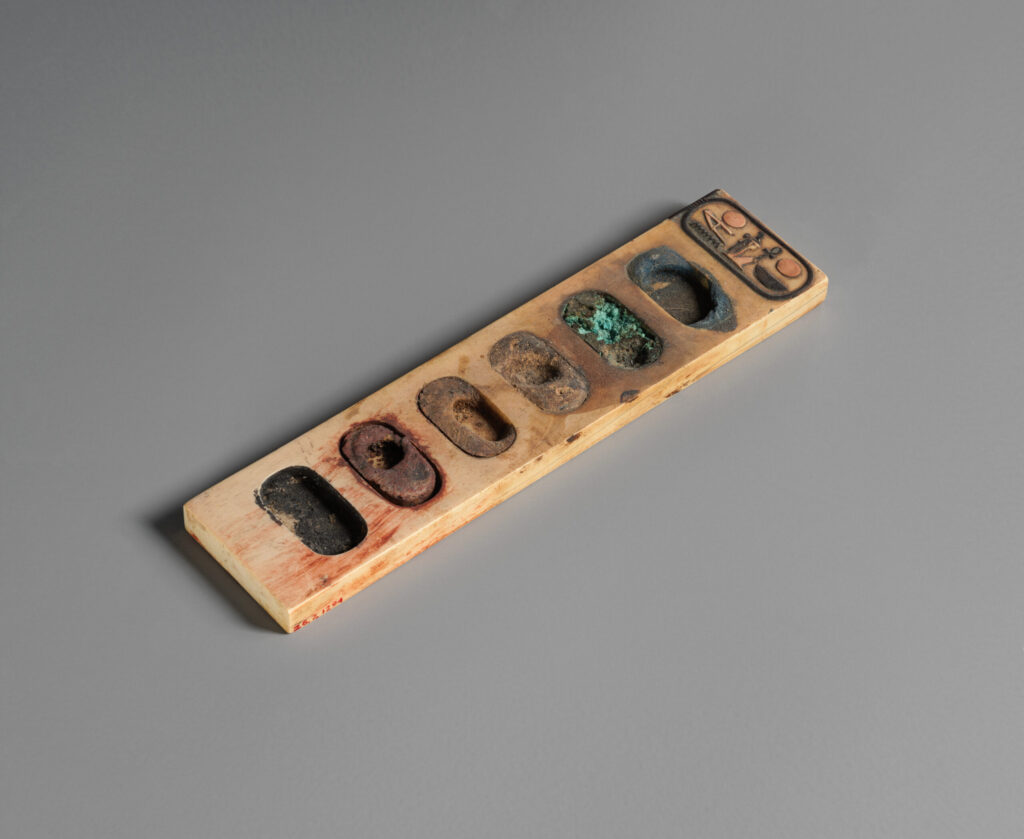
It’s a good bet that your first box of crayons or watercolors was a simple affair of six or so colors… just like the palette belonging to Amenemopet, vizier to Pharaoh Amenhotep III (c.1391 — c.1354 BC), a pleasure-loving patron of the arts whose rule coincided with a period of great prosperity.
Amenemopet’s well-used artist’s palette, above, resides in the Egyptian wing of New York City’s Metropolitan Museum of Art.
Over 3000 years old and carved from a single piece of ivory, the palette is marked “beloved of Re,” a royal reference to the sun god dear to both Amenhotep III and Akhenaton, his son and successor, whose worship of Re resembled monotheism.
As curator Catharine H. Roehrig notes in the Metropolitan’s publication, Life along the Nile: Three Egyptians of Ancient Thebes, the palette “contains the six basic colors of the Egyptian palette, plus two extras: reddish brown, a mixture of red ocher and carbon; and orange, a mixture of orpiment (yellow) and red ocher. The painter could also vary his colors by applying a thicker or thinner layer of paint or by adding white or black to achieve a lighter or darker shade.”
(Careful when mixing that orpiment into your red ocher, kids. It’s a form of arsenic.)