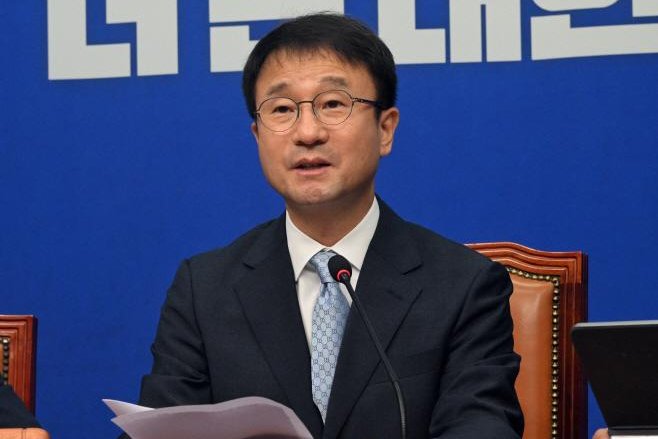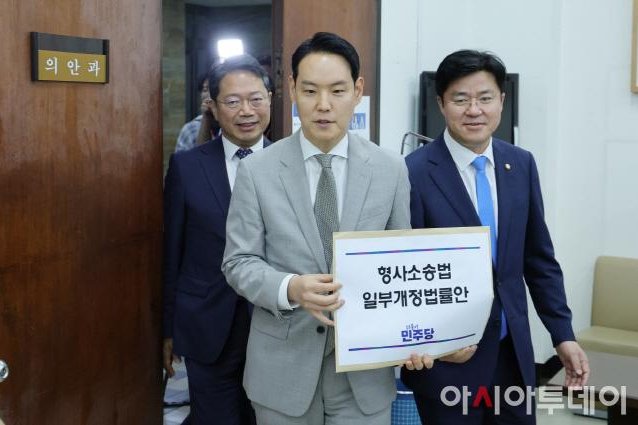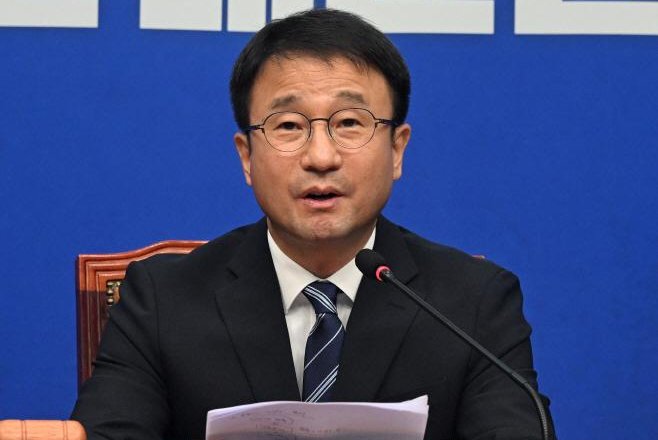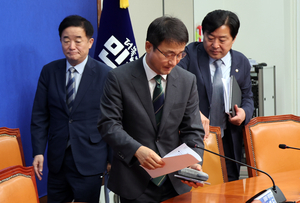
Rep. Han Byung-do (center), acting chair and floor leader of the ruling Democratic Party of Korea, arrives for a Supreme Council meeting at the National Assembly in Yeouido, Seoul, on Wednesday. (Newsis) The ruling Democratic Party of Korea is facing growing internal calls for caution over its push to abolish prosecutors’ supplementary investigation power, a key part of the prosecution reform agenda the party has pursued for years.The supplementary investigation power refers to prosecutors’ authority to conduct additional inquiries after police send a case to the prosecution, when prosecutors deem the initial investigation incomplete or flawed. It is separate from prosecutors’ direct investigation authority, which has already been sharply curtailed under previous rounds of prosecution reform.For the ruling bloc, abolishing the power is part of its broader plan to separate investigation from indictment. Under the envisioned system, investigations would be handled largely by police and a new serious crimes investigation agency, while prosecutors, or a planned public prosecution office, would focus on reviewing cases and bringing charges.Rep. Han Byung-do, the Democratic Party’s floor leader and acting party chief, reaffirmed the party’s stance Tuesday, saying the “complete abolition of supplementary investigation power is the Democratic Party’s firm principle” and that there was “no disagreement within the party.”But the debate has taken a more cautious turn after the case of Jang Yun-gi, who is accused of killing a high school student in Gwangju. Police initially sent the case to prosecutors on a murder charge, but prosecutors uncovered additional allegations during a supplementary probe. The allegations included attempted sexual assault and suspected efforts by Jang’s father, a police officer, to conceal or destroy evidence.Rep. Kim Gi-pyo, a Democratic Party lawmaker on the National Assembly Legislation and Judiciary Committee, said in a radio interview Tuesday that the case showed the need for safeguards.“If the supplementary investigation power is abolished, there needs to be an institutional supplement on how such issues can be screened,” Kim said, referring to the Gwangju case. He added that even without prosecutors conducting direct investigations, prosecutors could still ask police to investigate specific points again.Rep. Hong Kee-won also raised concerns Wednesday, saying the party should examine whether there is room to retain a limited form of the power to protect victims.“We should go through an in-depth deliberation process on whether there is room to leave in place a level of supplementary investigation power that minimizes the number of powerless and wronged victims, while eliminating the possibility of prosecutors abusing their authority,” Hong wrote on Facebook.Former Democratic Party leader Song Young-gil also warned last week that ordinary criminal cases should not be treated the same as politically sensitive investigations. He said the party should consider “how to control police incompetence and abuse of power” if prosecutors are barred from supplementing investigations in broader criminal cases.The opposition has seized on the controversy to attack the ruling party’s reform drive. Rep. Jeong Jeom-sig, floor leader of the People Power Party, said the power was “not for prosecutors, but ultimately for the public.” He warned that victims would suffer under a criminal justice system without it.Rep. Park Sung-hoon, the party’s chief spokesperson, said the Gwangju case proved that the power was “not a vested right of prosecutors, but the last safeguard for the public against unchecked police power.”Independent lawmaker Han Dong-hoon went further, asking on Facebook whether the Lee Jae Myung administration and the Democratic Party would “stand on the side of murderers.” He said the Jang case showed that countless victims could be left wronged if only the police were allowed to investigate.
Calls for caution over prosecution reform grow within ruling party
The ruling Democratic Party of Korea is facing growing internal calls for caution over its push to abolish prosecutors’ supplementary investigation power, a key
591 words~3 min read