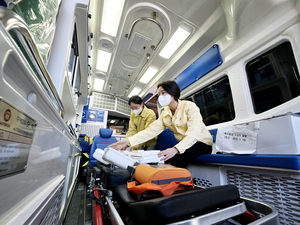
Patients who skip ambulances reach hospital later, which could affect treatment Government officials from Buk-gu district in Gwangju, some 300 kilometers south of Seoul, inspect the equipment inside an ambulance in this June 16 photo. (Yonhap) It takes stroke patients in Korea nearly four hours on average to reach a hospital after symptoms begin, a delay that has barely improved over the past decade despite the critical importance of early treatment, researchers said Wednesday.According to researchers in the neurology department at Seoul National University Bundang Hospital, stroke patients in 2023 arrived at a hospital an average of 3.9 hours after the onset of symptoms. Only 36.6 percent reached medical care within the first three hours.The study analyzed annual changes in the time from stroke symptom onset to hospital arrival between 2013 and 2023. The average arrival time remained virtually unchanged from 4 hours in 2013.The share of patients who arrived within three hours stood at 35.4 percent in 2013 and peaked at 38.2 percent in 2016, before falling back to 36.6 percent in 2023.The first 60 minutes after stroke symptoms begin is widely considered the most critical period for treatment, often called the “golden hour.” For some patients, the treatment window can extend up to 4.5 hours, but medical experts say it is crucial to administer clot-busting drugs as quickly as possible.The study found a sharp difference between patients who used ambulances and those who did not. Patients who did not use an ambulance arrived at the hospital an average of 9.8 hours after symptoms began, up from 7.9 hours in 2013.Patients who used an ambulance arrived in 2.3 hours on average, down from 2.5 hours in 2013. The study also found that 78.2 percent of stroke patients transported by ambulance were taken directly to hospitals capable of providing specialized stroke treatment, up from 55.8 percent in 2013.Ambulance use among stroke patients rose to 61.8 percent in 2023 from 55.4 percent in 2013, but the delay among patients who did not call an ambulance points to gaps in public awareness and emergency response.The researchers called for stronger public education so that people experiencing stroke symptoms immediately call 119 rather than trying to reach a hospital on their own.“A more detailed analysis is needed of the entire process from symptom onset to hospital arrival,” said Professor Kim Jun-yup, the study’s lead author. “This will help identify why some patients fail to arrive at the hospital in time.”
For stroke patients, calling 119 makes a big difference
It takes stroke patients in Korea nearly four hours on average to reach a hospital after symptoms begin, a delay that has barely improved over the past decade d
407 words~2 min read