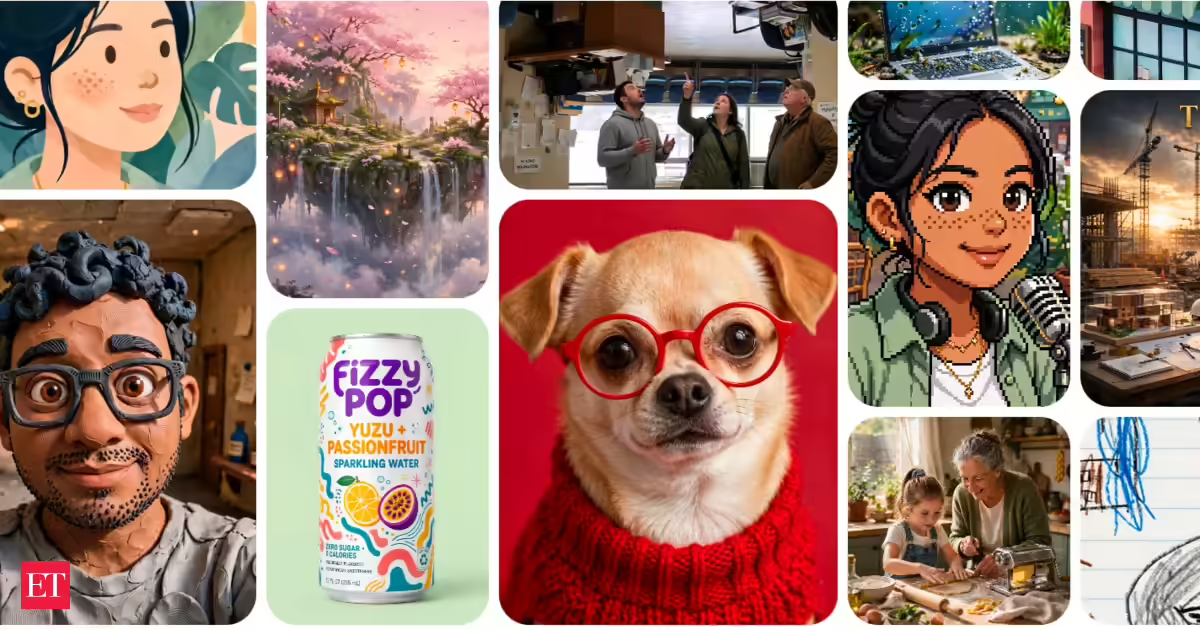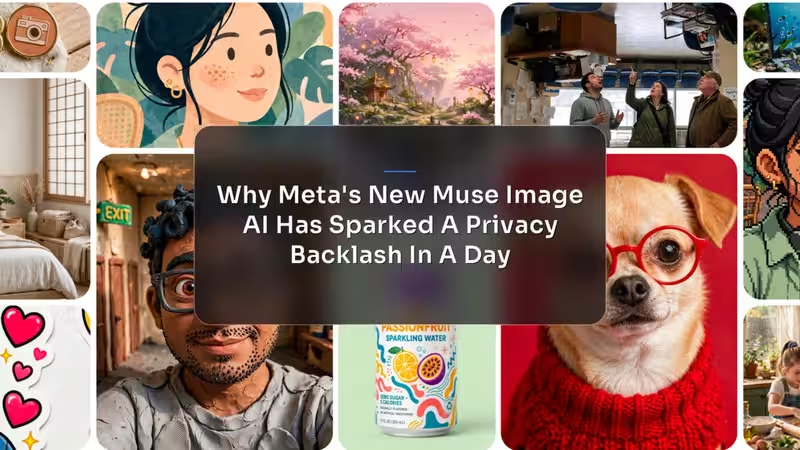
Meta launched Muse Image on 7 July 2026, its first in-house image-generation model from Meta Superintelligence Labs, free inside the Meta AI app, Instagram Stories and WhatsApp. It builds pictures from text, blends several photos, edits from a sketch, and renders clean text and QR codes. One feature turned the launch into a controversy within hours. Muse Image lets people pull the public photos of any open Instagram account into AI images by tagging the username, and that permission stays switched on unless the account holder turns it off.So there are two Meta stories here at once. The company has built a capable image generator and wired it into the apps billions of people already open every day, which is a real distribution win. It has also shipped a photo feature that treats your public Instagram pictures as raw material for other people's AI creations until you actively say no. The capability is the announcement. The default is the news, and it reaches India for reasons that have nothing to do with when the tool officially arrives here.This story is barely a day old. The launch details come from Meta's own newsroom post, and the privacy findings from multiple independent reports checked against Meta's policy language. It is moving fast, and every unconfirmed detail below is marked as such.What is Meta Muse Image?Meta's first image model built entirely in-house, and a sign of how far the company has shifted its AI strategy.Muse Image comes from Meta Superintelligence Labs, the unit assembled under Chief AI Officer Alexandr Wang. It was codenamed Mango internally, and it is the lab's second major release after the Muse Spark language model earlier this year. It went live on 7 July inside the Meta AI app and site, across more than 30 Instagram Stories effects, and in WhatsApp chats, with Facebook, Messenger and advertiser tools to follow later in the year.The features are what you would expect from a modern generator, with a few useful touches. It makes images from text, blends multiple photos into one, and lets you edit by drawing directly on a picture to mark the area you want changed. It renders readable text inside images and builds working QR codes, two things that have tripped up image models for years. It can also pull in outside context, so a photo of your room can come back with real furniture suggestions from Facebook Marketplace. Meta says the model reasons before it draws, working with Muse Spark to plan a layout, check real-time web context, and blend references across several steps rather than generating in one shot. That reasoning claim is Meta's own, and no independent test has confirmed it yet.Why is the Instagram photo feature causing a backlash?It makes other people's faces available for your AI images by default, and Meta's own policy admits they will not be told.Inside Meta AI, you can tag any public Instagram account with an @-mention, and Muse Image will use that account's public photos to build a visual. Meta presents it as a creative convenience, a way to design an invitation with a friend's picture or mock up a collaboration. The trouble is the setting behind it. The feature is opt-out, so it is on by default, and public profiles can be used as references unless the account holder switches it off.Meta's own words sharpened the reaction. Its policy says people may be able to create content with your Instagram content using Meta's AI features, and that you will not be notified when they do. Meta says users keep control through a setting that turns the behaviour off, though its help materials also indicate people may not be alerted when AI features use their content. Control that exists alongside silence that is guaranteed is what drew the criticism.The backlash grew because this fits a pattern. Meta shut down Facebook's facial-recognition system in 2021 amid lawsuits and regulatory pressure over biometric data. The two situations differ in law and mechanism, so the comparison has limits, but the instinct behind the criticism, that Meta reaches broadly into people's data unless they actively opt out, is a familiar one.How do you opt out?Change one Instagram setting, and it helps to do it before the feature reaches more countries.Instagram users can turn off the AI reuse or remix option in their settings to stop their public images being used for AI generation. Anyone who wants their photos kept out of other people's Muse Image creations should find that control and switch it off. The exact menu path may move as Meta updates its apps and as the feature rolls into new regions, so treat the setting name as the anchor and expect its location to shift. Every image the model makes carries an invisible watermark, and Meta says it has built guardrails to block content that breaks its rules, including child-safety protections.How good is Muse Image, really?Competent rather than class-leading, on Meta's own numbers, and that is the whole point of the strategy.Meta's internal benchmark tests put Muse Image behind OpenAI's latest GPT Image 2 model while generally ahead of Google's Nano Banana 2 on tasks such as editing. Those figures are Meta's own, with no independent check yet, so they read as a company claim rather than a settled result. The sharper point analysts drew is about strategy. Meta did not ship the best-scoring image model in the world. It shipped a good one and wired it into the most-used social and messaging apps on the planet. Distribution is the headline, not the leaderboard.That explains who the model is for. Muse Image is not built for the artist refining a Midjourney prompt for the tenth time, or the developer wanting a scriptable image API. It is built for the Instagram creator who wants a quick Story visual without leaving the app, the WhatsApp user editing a photo inside a chat, and the casual Meta AI user who would never pay for a separate tool but will happily type "make me a birthday card" into an assistant they already have open. For that audience, free and already there tends to beat best-in-class behind a subscription.Why does this matter for India, even before it launches here?Because India is one of Instagram's largest markets, and the default setting reaches Indian users' photos regardless of when the tool officially arrives.The availability facts come first, stated straight. At launch Muse Image is limited to the US and a set of English-language markets, with broader regions promised in the coming weeks and no India date announced. So the tool itself is not confirmed for India yet. That is the easy place to stop, and it misses the point.The part that matters is the setting. India has one of the world's largest Instagram user bases, so a very large number of Indian public profiles could become reference material for AI images the moment the feature expands here, under the same opt-out-by-default model. That control lives inside Instagram, so Indian users can find and disable the AI reuse option now rather than waiting for the tool to land. For a country where Instagram is central to how a generation shares its life, a default that treats public photos as material for strangers' AI images is worth raising early. Meta has published no India-specific enforcement detail, so this piece invents none. The durable point stands on its own: the default reaches Indian users through Instagram whether or not Muse Image has formally launched in the country.There is a second India angle on the business side. Meta plans to route Muse Image into its Advantage+ advertising tools, letting brands generate ad creative automatically. In a market where Meta's platforms carry a huge share of digital advertising, cheaper and faster AI ad creation will reach Indian advertisers and Indian feeds, which becomes its own story once the advertiser rollout lands.What is Meta actually trying to do here?Own its image stack end to end, and turn its user base into the advantage as its models cannot yet win on quality alone.For years Meta's public AI identity was open weights, the Llama family that anyone could build on, and for visual work it leaned on outside tools reported to include Midjourney and Black Forest Labs. Muse Image is a proprietary, closed model shipped as a product feature rather than a download. That is a real shift in posture, and it lines up with the reorganisation under Meta Superintelligence Labs and Wang's raised profile. Owning the stack cuts Meta's dependence on outside models for a feature used at massive scale, keeps generation cost and user data inside its own infrastructure, and opens a new surface to earn from through subscriptions and ads.The backdrop is less flattering, and it belongs in the picture. The launch arrives amid reported internal frustration over the pace and methods of Meta's AI push. The company reassigned thousands of engineers to data-labelling and related work, a move executives later admitted was handled poorly and that hurt morale, and it briefly used employees' work activity to gather AI training data before pausing the program after a privacy lapse left sensitive information broadly accessible inside the company. A firm moving this fast, under this much internal strain, shipping a photo feature that defaults to using people's images, is a pattern to watch rather than a single event to judge on its own.Muse Image is a strong distribution play built on a capable-but-not-leading model, and its most important feature on day one is a setting most users will never see. Meta has bet that free and everywhere beats best, and on adoption it is probably right. Whether it is right about consent is the question the default has already forced, and the answer will come from regulators, from users who find the opt-out, and from how loudly the rest choose to object. The picture the model makes is impressive. The one worth studying is the settings screen.Frequently Asked QuestionsWhat is Meta Muse Image?Muse Image is Meta's first in-house AI image-generation model, from Meta Superintelligence Labs, launched on 7 July 2026. It creates and edits images from text and photos, and is built into the Meta AI app, Instagram Stories and WhatsApp, with Facebook, Messenger and advertiser tools coming later in 2026.Is Meta Muse Image free?Yes, for everyday creation. Heavier use needs a Meta One subscription, which Meta launched in May 2026. Meta has not disclosed the usage limits or the subscription price for Muse Image, and there is no developer API at launch.Can people use my Instagram photos in AI images?If your Instagram profile is public, yes, unless you opt out. Muse Image lets users tag public accounts to pull their public photos into AI images, and the feature is on by default. Meta's policy says users may not be notified when this happens.How do I stop my photos being used by Muse Image?Turn off the AI reuse or remix option in your Instagram settings. It is an account-level control, so you can switch it off now, before the feature expands to more regions. Meta's exact menu path may change as its apps update.Is Muse Image available in India?Not confirmed yet. At launch it covers the US and a set of English-language markets, with broader regions promised in the coming weeks and no India date announced. The Instagram photo-reference default can still affect Indian public profiles as the feature expands, so the opt-out setting is relevant to Indian users now.Is Muse Image better than Google or OpenAI's image tools?On Meta's own internal benchmarks, Muse Image trails OpenAI's GPT Image 2 but beats Google's Nano Banana 2 on some tasks like editing. These figures are self-reported and lack independent verification. Meta's real advantage is distribution across its apps rather than top benchmark scores.end of article
Why Meta's New Muse Image AI Has Sparked A Privacy Backlash In A Day
Meta launched Muse Image on July 7, 2026, free on Instagram and WhatsApp. It can use public Instagram photos by default. What it does, and how to opt out.
1,961 words~9 min read