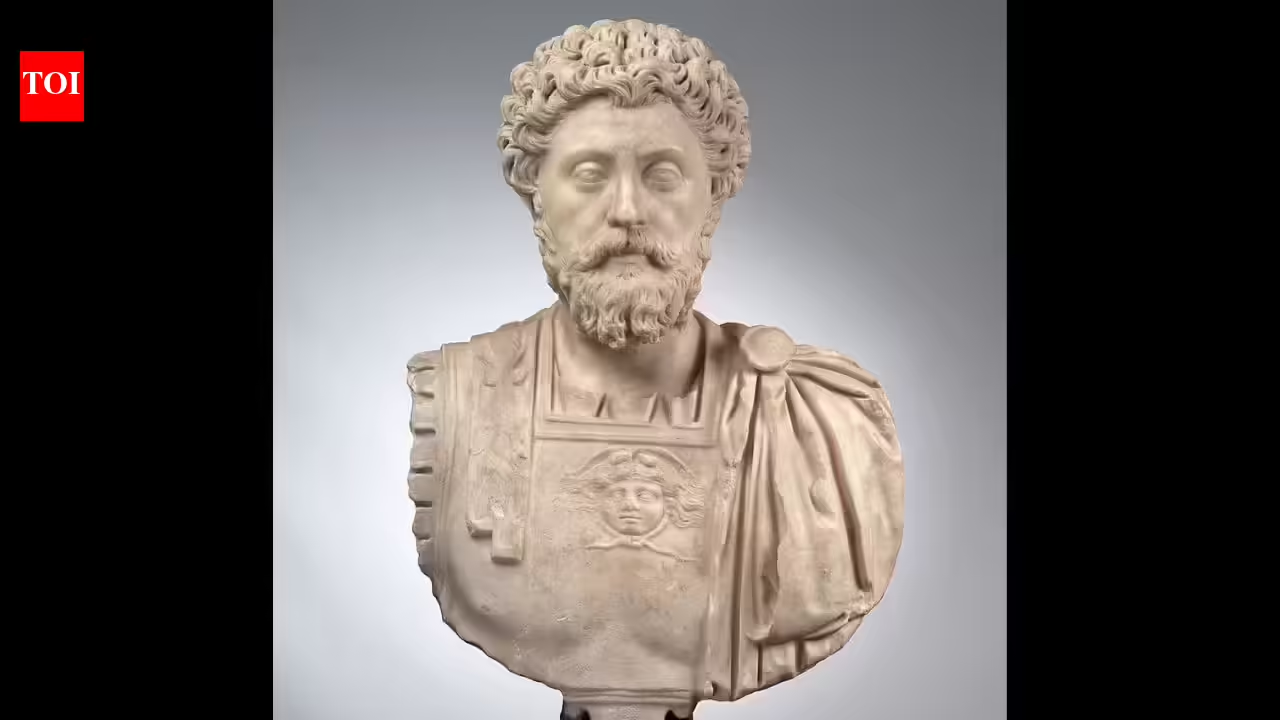
Today's Quote of the Day by Marcus Aurelius: Every day begins with uncertainty. You never know who will disappoint you, test your patience, or challenge your peace of mind. That is exactly why Quote of the Day by Marcus Aurelius continues to resonate nearly two thousand years after it was written. Instead of hoping people would always be kind or fair, the Roman emperor prepared himself for reality.Quote of the Day Today: Why Marcus Aurelius Began Every Morning This WayQuote of the Day by the Stoic philosopher-king Marcus Aurelius: "The people I deal with today will be meddling, ungrateful, arrogant, dishonest, jealous, and surly. They are like this because they can't tell good from evil." — Marcus Aurelius, Meditations, Book 2His words were not an expression of pessimism. They were a practical exercise in emotional resilience. In a world where workplace conflicts, online arguments, and daily frustrations can quickly drain our energy, this ancient reminder feels surprisingly modern.Stoicism is a school of philosophy founded in Athens around 301 BCE by a Phoenician merchant named Zeno, who came from the city of Citium in Cyprus. It was influenced by earlier Greek philosophers, particularly Socrates. By the time of Marcus Aurelius, Stoicism was a living tradition well over four centuries old.The Quote of the Day by Marcus Aurelius comes from the opening of Book 2 of Meditations, the private journal he never intended to publish. It was written as a conversation with himself before facing another demanding day as emperor of Rome. Rather than blaming others for their behavior, Marcus reminded himself that ignorance often lies behind cruelty, arrogance, jealousy, and dishonesty.By expecting difficult encounters, he believed he could respond with wisdom instead of anger. That lesson remains one of the most influential ideas in Stoic philosophy and continues to inspire psychologists, business leaders, athletes, and readers searching for greater emotional balance.As another Stoic teacher, Epictetus, observed, "People are disturbed not by things, but by the views they take of them." Marcus transformed that idea into a daily mental habit.Deeper Meaning of the Quote of the DayThe deeper message behind the Quote of the Day by Marcus Aurelius is that your peace depends more on your response than another person's actions.Marcus understood something modern psychology would later confirm through cognitive behavioral therapy: expectations influence emotional reactions. When people assume everyone should behave fairly, every rude comment feels like a personal attack. When they accept that flaws are part of human nature, disappointment loses much of its power.His words also reject revenge. Marcus never says difficult people deserve hatred. Instead, he argues they act from ignorance because they cannot clearly recognize good and evil. That perspective encourages understanding without excusing harmful actions.The Roman emperor ruled during wars, political conspiracies, family tragedies, and the devastating Antonine Plague. Even under extraordinary pressure, he repeatedly returned to the same principle: protect your character first. External events belong to the world. Your response belongs to you.Life Lessons From the Quote of the Day by Marcus AureliusRead closely, this two-thousand-year-old journal entry holds at least five life lessons that still apply on a Tuesday morning commute.First, expecting difficulty doesn't make you a pessimist; it makes you prepared. Marcus wasn't hoping for the worst. He was refusing to be blindsided by ordinary human friction so it wouldn't derail him.Second, other people's bad behavior is rarely a verdict on your worth. When someone is dismissive or unfair, it usually reflects their own confusion or stress far more than it reflects anything true about you.Third, anger is optional, even when provocation isn't. Marcus treats resentment as something you choose to pick up, not something forced onto you, which means you can also choose to set it down.Fourth, connection beats division, even with people who frustrate you. Viewing others as part of the same human effort, rather than as obstacles, makes cooperation possible even after a disagreement.Fifth, your morning mindset shapes your whole day. By deciding in advance how he would respond to difficult people, Marcus gave himself a kind of emotional armor before he ever needed it, a habit anyone can borrow before opening their inbox.Finally, recognize that every difficult interaction becomes an opportunity to practice patience, wisdom, and self-control. Marcus believed virtue grows through action, not comfort.These lessons explain why Meditations continues to be recommended in leadership programs, military academies, psychology discussions, and personal development circles across the Western world.Who Was Marcus Aurelius?Marcus Aurelius Antoninus ruled Rome from 161 to 180 CE and is remembered as the last of the "Five Good Emperors," a title later coined by the historian Edward Gibbon. Born into a wealthy Roman family in 121 CE, he began studying philosophy at the unusually young age of twelve and eventually devoted himself fully to Stoicism, a school of thought founded roughly five centuries earlier in Athens.Stoicism taught that living in line with reason and virtue mattered far more than wealth, status, or reputation, an idea that gave Marcus emotional steadiness through wars, plagues, and political betrayals during his reign. He never intended his private notebook to be published. The Meditations were personal reflections, written mostly during military campaigns, meant only to keep his own thinking honest. Centuries later, they became one of the most widely read works of self-improvement in existence, still quoted by therapists, coaches, and readers looking for calm in chaotic days.Modern audiences mostly recognize him through film, particularly Richard Harris's portrayal in Ridley Scott's Gladiator, but his real legacy lives in the connection between ancient Stoicism and modern psychology. Many of the core techniques used in cognitive behavioral therapy, the leading evidence-based approach in psychotherapy today, trace their roots directly back to Stoic ideas about how thoughts, not events, shape our emotions. Which means the emperor's morning pep talk to himself wasn't just ancient wisdom. It was, in a very real sense, an early form of therapy, written by a man trying to survive his own life with his character intact.Rather than promising an easier life, Marcus Aurelius offered something more enduring: the confidence that no difficult person has the power to define who you become.
Quote of the Day by Marcus Aurelius: "The people I deal with today will be meddling, ungrateful... They are like this because..." - powerful life lessons on emotional intelligence, patience, self-control, and why true peace begins with your own mind
Today's Quote of the Day by the Stoic philosopher-king Marcus Aurelius speaks to a challenge almost everyone faces—dealing with difficult people. His words are nearly 2,000 years old, yet they still offer a simple, powerful reminder: lasting peace begins with how you choose to respond, not how others behave.
1,013 words~5 min read