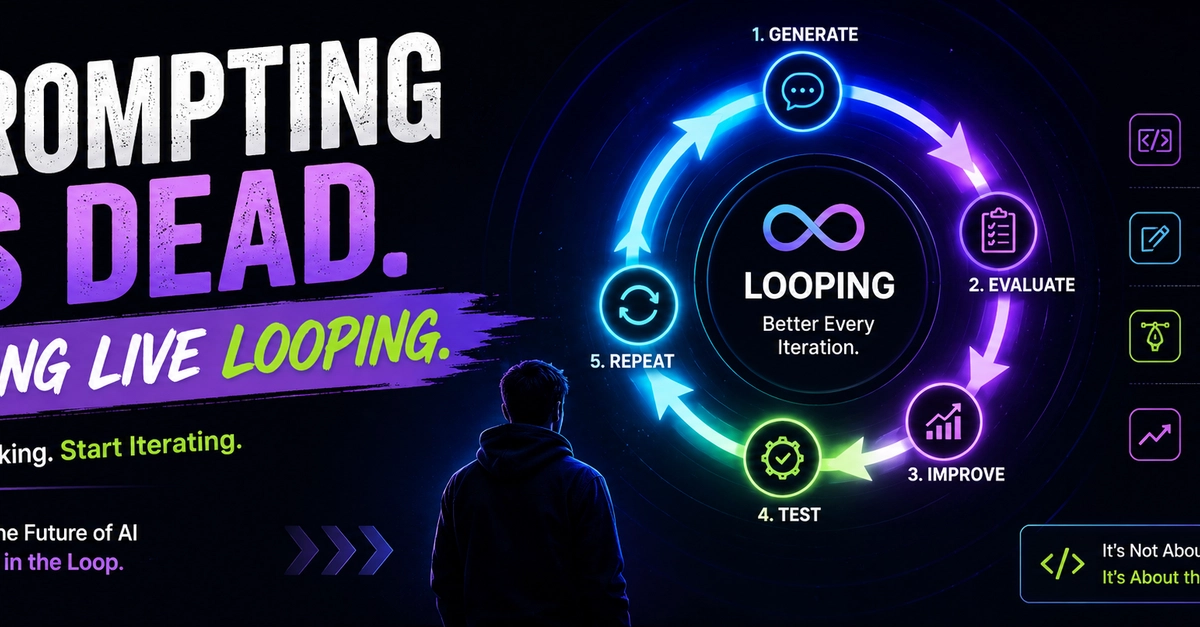
Most people using LLMs are still stuck in prompt mode. You craft a careful instruction, send it off, get something back, tweak the wording, try again. It works for single-shot questions but falls apart the moment you need anything that involves multiple steps, quality checks, or batch work.
Back in January OpenAI published a technical post called "Unrolling the Codex agent loop" where they broke down how Codex CLI actually works internally. The core concept is what they call the agent loop. The model receives input, runs inference, and either returns a final answer or requests a tool call. If it requests a tool call, the agent executes it, appends the result back into the prompt, and loops back to inference. This repeats until the model signals it's done.
A few months earlier Philip Zeyliger at Sketch.dev wrote "The Unreasonable Effectiveness of an LLM Agent Loop with Tool Use," a post that hit 447 points on Hacker News. His core implementation was 9 lines of Python. A while loop. Call the LLM, if it returns tool calls execute them and feed results back in, if it returns text you're done. Zeyliger described being genuinely surprised at how much mileage he got out of this simple structure. Tasks he used to handle manually, obscure git operations, merge conflict resolution, type error chains, he now lets the agent work through iteratively.