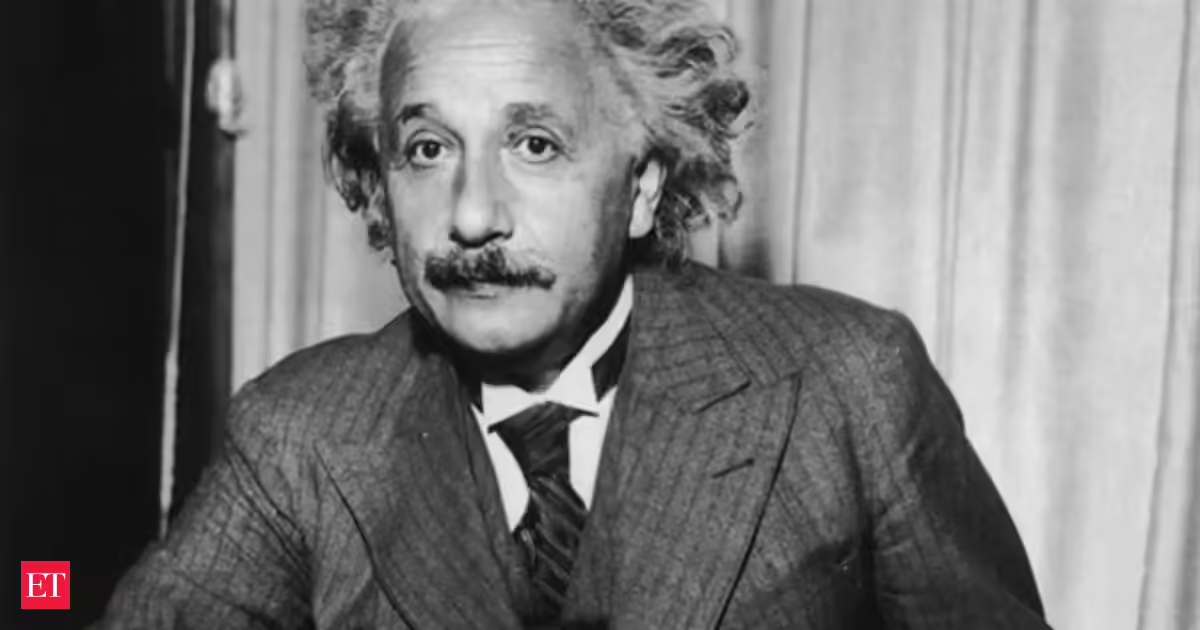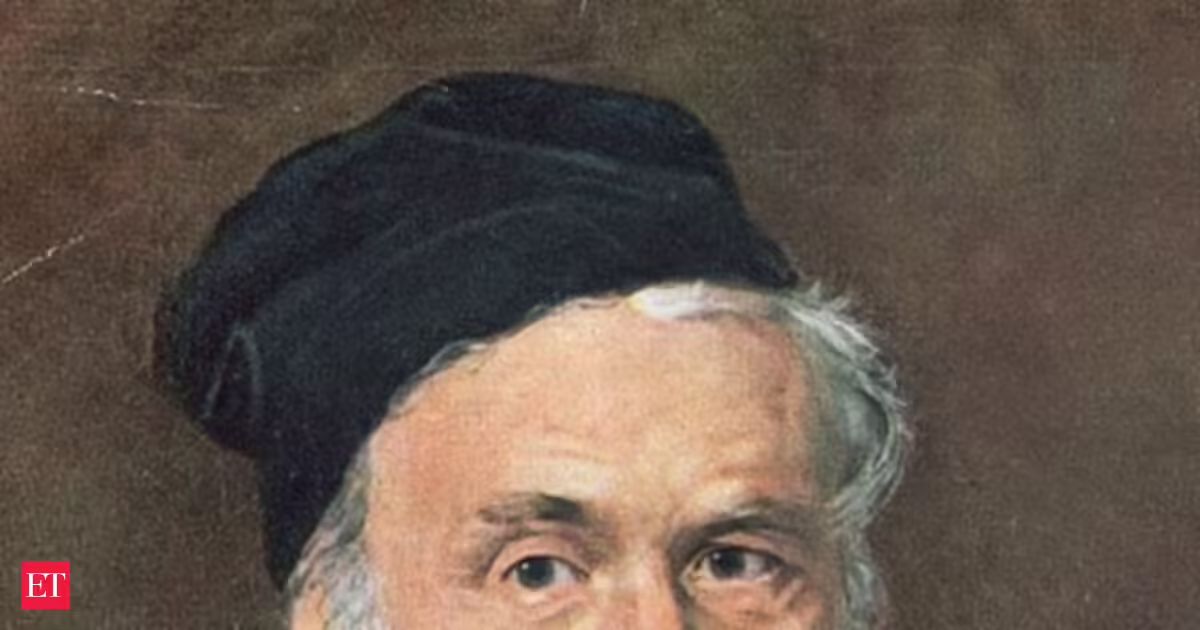
Quote of the day by Carl Friedrich Gauss: 'It is not knowledge, but the act of learning, not possession but the act of...' - German physicist and mathematian teaches life lessons on why learning brings more job than achievement and why you must stop chasing resultsSynopsisCarl Friedrich Gauss quote today: Carl Friedrich Gauss emphasized the joy found in the learning process itself. He believed the act of acquiring knowledge offers greater fulfillment than possession. Gauss, a renowned German mathematician, made significant contributions to various scientific fields.Global DeskCarl Friedrich Gauss quote today: People often spend years working toward goals, believing that happiness will arrive once they achieve success. Whether it is earning a qualification, building a career, or mastering a new skill, the destination is frequently seen as the ultimate reward. However, many of life's most valuable experiences happen along the way. Every challenge solved, mistake corrected, and lesson learned shapes a person's growth far more than the final achievement alone. Quote of the Day by Carl Friedrich Gauss: Why the Process of Learning Is More Rewarding Than the ResultCarl Friedrich Gauss once said, "It is not knowledge, but the act of learning, not possession but the act of getting there, which grants the greatest enjoyment," as per BrainyQuote.What Carl Friedrich Gauss' Quote MeansGauss explains that the excitement of learning is often more rewarding than simply acquiring knowledge. The process of exploring new ideas, solving problems, and developing skills provides a sense of purpose and fulfillment that lasts beyond any single achievement. Life Lesson From Carl Friedrich GaussThe quote teaches that growth comes from embracing the learning process rather than rushing toward the outcome. Every step forward, no matter how small, builds knowledge, confidence, and resilience. By enjoying the journey, people often discover that success becomes more meaningful when it is earned through continuous learning.Who Was Carl Friedrich GaussCarl Friedrich Gauss (April 30, 1777 – February 23, 1855) was a German mathematician, scientist, and astronomer widely regarded as one of the greatest mathematicians of all time. According to a Britannica report, he made major contributions to number theory, geometry, probability theory, astronomy, geodesy, and potential theory.You Might Also Like: Carl Friedrich Gauss' Early LifeBorn in Brunswick, Germany, Gauss displayed exceptional mathematical talent from an early age. With financial support from the Duke of Brunswick, he studied mathematics at the University of Göttingen from 1795 to 1798.Carl Friedrich Gauss' Major ContributionsGauss proved that a regular 17-sided polygon could be constructed using only a ruler and compass. In 1801, he published Disquisitiones Arithmeticae, a landmark work in algebraic number theory, as per the Britannica report. He also developed the method of least squares while calculating the orbit of the asteroid Ceres.Carl Friedrich Gauss' Scientific WorkGauss led the survey of Hanover, invented the heliotrope, researched Earth's magnetic field, co-developed the first electric telegraph with Wilhelm Weber, and made important contributions to cartography and potential theory, as per the Britannica report.Gauss received the Copley Medal in 1838. After his death, many unpublished discoveries further expanded his influence. His work continues to shape modern mathematics, astronomy, and science.You Might Also Like:You Might Also Like:Read More News on(Catch all the US News, UK News, Canada News, International Breaking News Events, and Latest News Updates on The Economic Times.) Download The Economic Times News App to get Daily International News Updates....morelessExplore More Stories
Quote of the day by Carl Friedrich Gauss: 'It is not knowledge, but the act of learning, not possession but the act of...' - German physicist and mathematian teaches life lessons on why learning brings more job than achievement and why you must stop chasing results
Carl Friedrich Gauss quote today: Discover the profound insights of Carl Friedrich Gauss on why the act of learning brings more joy and fulfillment than simply chasing achievements. Explore how embracing the journey leads to personal growth and deeper success.
555 words~3 min read