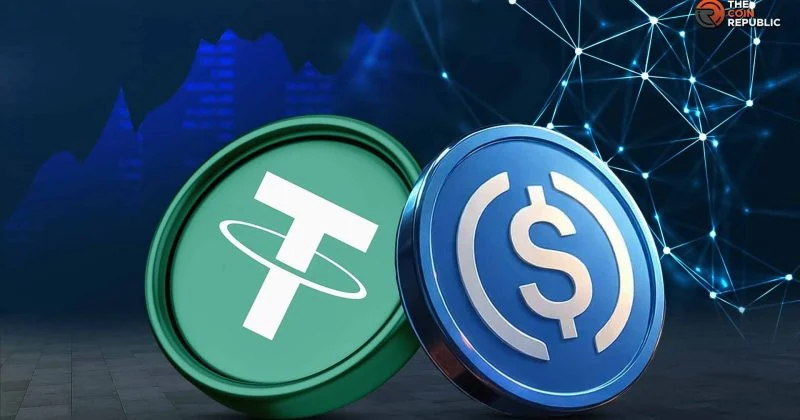
The stablecoin market has quietly crossed $320 billion in total capitalization, but the real story isn’t the size. It’s the fracture. Dune Analytics data reveals that USDT and USDC, the two heavyweights of the dollar-pegged world, have evolved into fundamentally different products serving fundamentally different users.
Tether’s USDT commands over 59% market share with a supply between $184 billion and $197 billion. Circle’s USDC sits at roughly $73 billion to $75 billion. On raw supply alone, this looks like a blowout. But flip to transaction volumes and the picture inverts dramatically.
The volume paradox
In January 2026, USDC processed $8.3 trillion in transfers. USDT handled $1.7 trillion. That’s nearly a five-to-one ratio, despite USDC having less than half the circulating supply.
The explanation lies in where each stablecoin lives. According to Dune’s data, 56% of all stablecoin transfer volume originates from DeFi liquidity pools. USDC has become the preferred settlement layer for decentralized exchanges, lending protocols, and automated market makers, particularly on faster networks like Layer-2 chains and Solana.