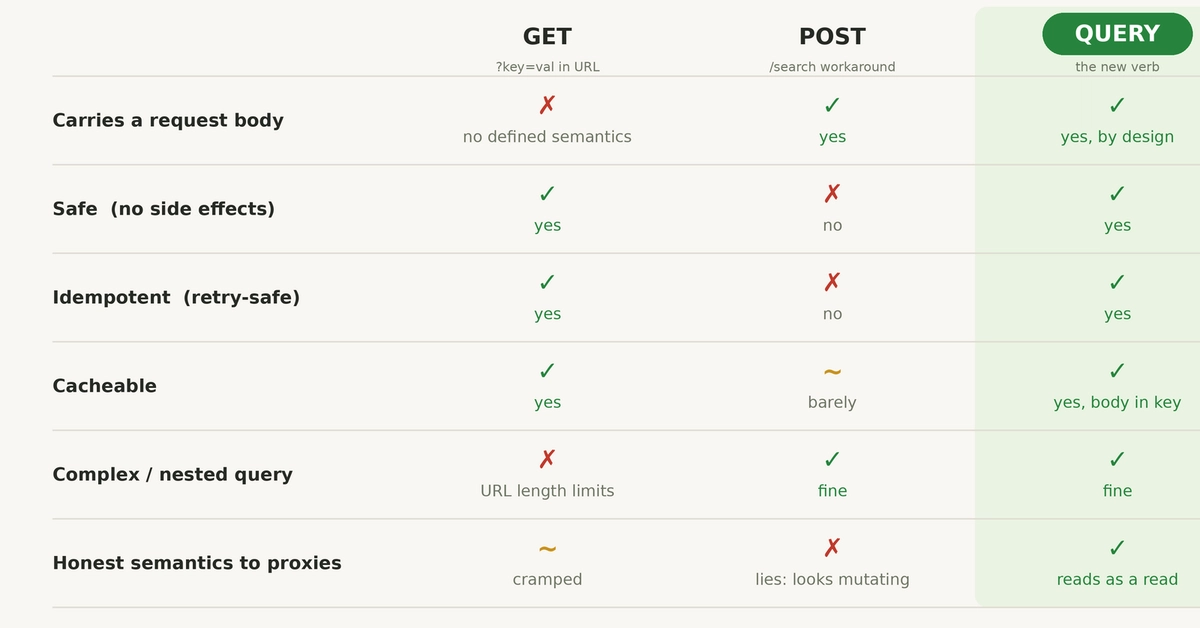
If you've ever built a search endpoint, you've hit this wall. Your query has filters, sort orders, a nested set of facets, maybe a geo bounding box. It doesn't fit in a URL, and cramming it into query string params is ugly and fragile. So you reach for POST /search, send the whole thing as a JSON body, and quietly accept that you've just lied about what the request does. It's not creating anything. It's a read. But POST is the only tool that lets you attach a body without fighting the platform.
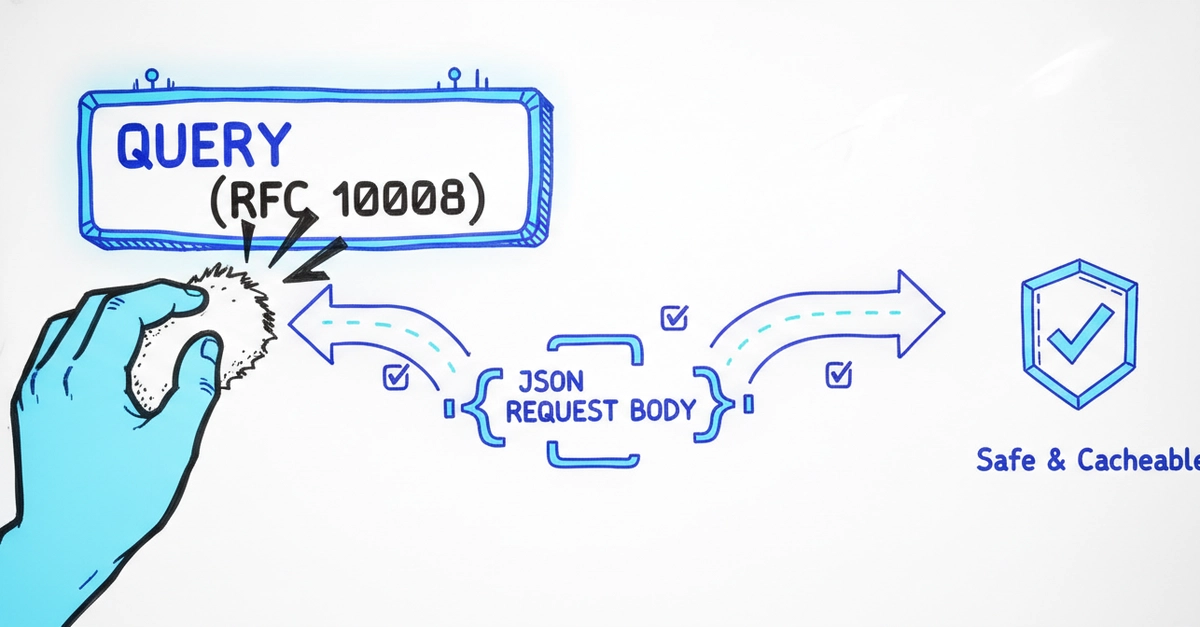
That gap finally got filled. In June 2026 the IETF published RFC 10008, which defines the HTTP QUERY method: a new verb built for exactly this case.
The two bad options
Every read that needs structured input has been stuck choosing between GET and POST, and both are wrong in their own way.
GET is the semantically correct choice. It's safe (the client isn't asking to change anything), it's idempotent (retrying it is fine), and it's cacheable. The problem is the body. RFC 9110 is explicit that content in a GET request has no defined semantics, and sending one may cause some implementations to reject the request. So your query has to live in the URI, where you run into unknown length limits across proxies and servers, encoding overhead, and the query landing in access logs and browser history.