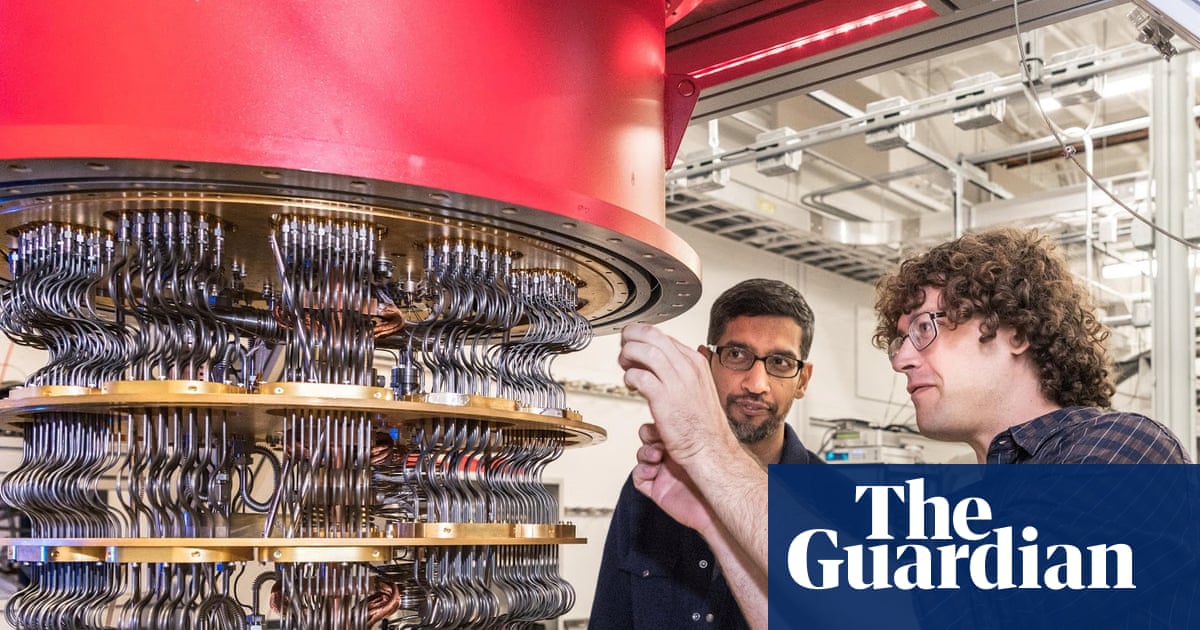
A quantum computer capable of breaking the codes that help secure today’s internet became dramatically more possible in March, when Google scientists and their colleagues unveiled new research. Usually, cybersecurity researchers share information about how attacks work to help prevent them. This group, however, believed its discovery posed enough of a security risk for them to use an unprecedented strategy to conceal how exactly to replicate their research. But in just three days, with the help of crowdsourcing and swarms of AI agents, Seattle-based research startup Eigen Labs not only matched the results of that hidden work, but surpassed them.In theory, quantum computers can quickly find answers to problems it might take classical computers eons to solve, which has made them especially interesting for code-breaking. Modern cryptography depends on the difficulty classical computers face when it comes to mathematical problems such as factoring huge numbers. Using an algorithm devised by mathematician Peter Shor in 1994, quantum computers could in principle rapidly crack such encryption.No quantum hardware capable of practical code-breaking currently exists. However, labs worldwide are striving to build quantum computers with enough qubits—the quantum equivalent of the bits underlying regular computing—to execute such attacks. The potential threat quantum computers pose has also led governments across the globe to begin migrating to post-quantum cryptography (PQC). U.S. federal agencies are required to transition high-value assets and high-impact systems to PQC for key establishment schemes by the end of 2030. The findings from Google and Eigen Labs, experts say, are a clear demonstration that migrating to encryption resistant to quantum computers should take place as rapidly as possible.Preparing for post-quantum cryptographyTo prepare for the era of cryptographically relevant quantum computers, scientists regularly probe into what resources such devices might actually require. For example, in 2025, Google Quantum AI research scientist Craig Gidney revealed a quantum computer with less than 1 million qubits, running Shor’s algorithm for less than a week could break 2048-bit RSA encryption, a common standard for securing online data. That was a 20-fold decrease in the number of qubits needed from previous estimates made in 2019.Gidney and others then investigated a different form of encryption involving elliptic curve cryptography (ECC). This approach underlies the security of cryptocurrencies such as Bitcoin and Ethereum and, with RSA, helps secure modern internet traffic.On 30 March, the Google researchers and their colleagues revealed they optimized Shor’s algorithm to break 256-bit ECC with 1,200 to 1,450 logical qubits. (Qubits are currently error-ridden devices; a cluster of many “physical qubits,” the kinds that researchers have developed to date, can make up one useful “logical qubit.”) The researchers noted these quantum computations could be encoded with less than 500,000 superconducting physical qubits, cracking 256-bit ECC in 18 to 23 minutes. This again marked a nearly 20-fold reduction in the number of physical qubits previously estimated. (To date, the largest superconducting processor—IBM’s Condor—has 1,121 qubits.)“I knew we could do better, but was not expecting that much improvement.” David Jao, University of Waterloo“The results were surprising to me,” says David Jao, professor and chair of combinatorics and optimization at the University of Waterloo in Canada, who did not participate in this work. “I knew we could do better, but was not expecting that much improvement.”However, instead of fully explaining how they accomplished this advance, the scientists released their work using a “zero knowledge proof,“ a technique with which they could verify to others than their attack works without revealing exactly how to carry it out. “To my knowledge, this was the first time that a result of this kind was released using a zero knowledge proof,” says André Schrottenloher, a researcher at the Inria Center at the University of Rennes in France, who did not take part in this study.In a blog post, Google noted it concealed their results in this manner after talks with the U.S. government. Most experts consulted saw little point to this. For instance, although he thought “it was a cute way to use a zero-knowledge proof,” Steven Galbraith, professor and head of mathematics at the University of Auckland in New Zealand, does not think cryptographically relevant quantum computers “are around the corner.”Others were more dismissive. “Zero-knowledge proofs for academic research are both useless and futile,” Jao says. “The purpose of the academic research enterprise is not merely to answer questions, but to inform the community and communicate those answers in a way that imparts understanding and allows other teams to build upon the results. A zero-knowledge proof does not convey or communicate understanding.”Replicating Google’s resultsAt Eigen Labs, 22-year-old engineer Gautham Anant was enrolled in an introduction to quantum computing course at the University of Washington, and wanted to see if he could replicate Google’s results. By analyzing the virtual machine Google built to verify its findings, Anant created software to test any quantum circuit in terms of the number of qubits and gates it needed to defeat 256-bit ECC. Anant then, with help from another young engineer, Gajesh Naik, set up AI agents to analyze scientific literature to automatically design quantum circuits and optimize them for this task.On their own, Eigen Labs researchers could not develop a circuit as efficient as Google’s. So on 1 June, they debuted a site where anyone could point their agent at Eigen Labs’ public repository to design better circuits, with these agents able to exchange notes with each other about their work. Eigen Labs engineers Gautham Anant (back) and Gajesh Naik (front) used crowdsourcing and AI agents to match Google’s results. Eigen Labs“We had essentially two classes of people working on this—the people building these agents … and quantum scientists,” Anant says. “The quantum scientists can understand the edits the agents have made, and they understand the science in ways that can help the agents incorporate changes much faster than they would on their own.”Within eight hours, this crowdsourcing effort matched Google’s results. In about 72 hours, it surpassed Google. As of the end of June, this open network can overcome 256-bit ECC with a circuit 47.5 percent more efficient than Google’s. “We absolutely did not expect to beat Google,” Anant says.Independently, at the same time Eigen Labs launched its crowdsourcing effort, Schrottenloher published results matching Google’s. It cited much of the same research the Google team likely did to achieve its findings. “I just put two and two together,” Schrottenloher says.It was obvious that the Google results would eventually be replicated, Schrottenloher says. “Cryptography and algorithms research is curiosity-driven, and the Google Quantum AI paper generated a lot of curiosity,” he notes.Sreeram Kannan, Eigen Labs’s founder, believes agents that contributed to Eigen Labs’ effort clearly saw Schrottenloher’s work and used it to significantly improve their results. “That’s the pace at which science can work with an open network—results built on others’ research in minutes instead of months,” he says.This mission to match Google’s results was almost a perfect test case for Eigen Labs’ approach, says Sam Jaques, an assistant professor in the Department of Combinatorics and Optimization at the University of Waterloo. “It makes sense that AI is good at micro-scale optimization,” says Jaques, who did not take part in any of these studies. “The thing about these quantum circuits is that there are a lot of places to boost efficiency here and there that may be hard for a person to see.”A test case for zero-knowledge proofsAll in all, using zero-knowledge proofs for research may not have much benefit. “There is almost no situation in research where one research group is so far ahead of all the other research groups that they can keep novel results secret for long,” Jao says. “Research is an extremely competitive environment, and no team stays ahead of the curve for very long. I believe even classified research labs no longer hold any significant advantage over the research community at large.”Given this experience, in a blog post, Gidney says that “I don’t think it’s the right strategy moving forward” to publish such results with zero-knowledge proofs. “The benefits are negligible, and the costs are many. We should just publish openly.”For Kannan, these new findings are the first major public proof-of-concept of Eigen Labs’ model of open agent-based science. “We want to create frameworks to help anyone innovate,” he says. “We see two pathways ahead—one where OpenAI and Anthropic use AI to do all of science, and the rest of us just consume the results, and another where we’re coordinating with agents and others to actively shape science with our ideas, skills, and expertise. The former just sounds so disastrous to me. We all want individual agency.”Eigen Labs sees their agent-based open science tackling far more than quantum AI. “We’ve lined up scientists in very different fields, such as materials science and biology, to tackle many different problems,” Kannan says. “We see the role of scientists as architecting the right problem for a community of agents to make progress on.”When it comes to the security implications of all these results, “even before these results, the need to migrate to the PQC algorithms was imperative,” says Dustin Moody, a mathematician at the National Institute of Standards and Technology in Gaithersburg, Maryland, who did not take part in this research. The new results from Google, Eigen Labs, Schrottenloher, and others “seem like they are helping some people be more convinced they can’t put this off, and should actually accelerate their migration plans. If an organization can migrate more quickly, it seems like a good idea to do so.”
Independent Labs Crack Google's Secret Cryptography Work
Using crowdsourcing and AI swarms, a startup surpassed Google’s results in 72 hours
1,575 words~7 min read