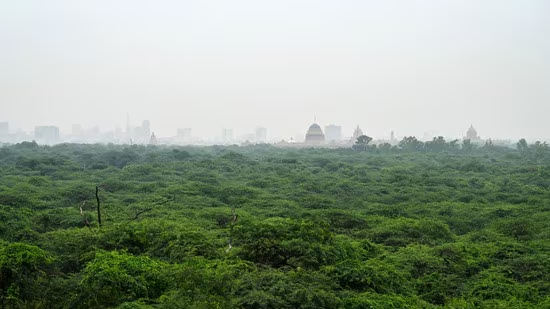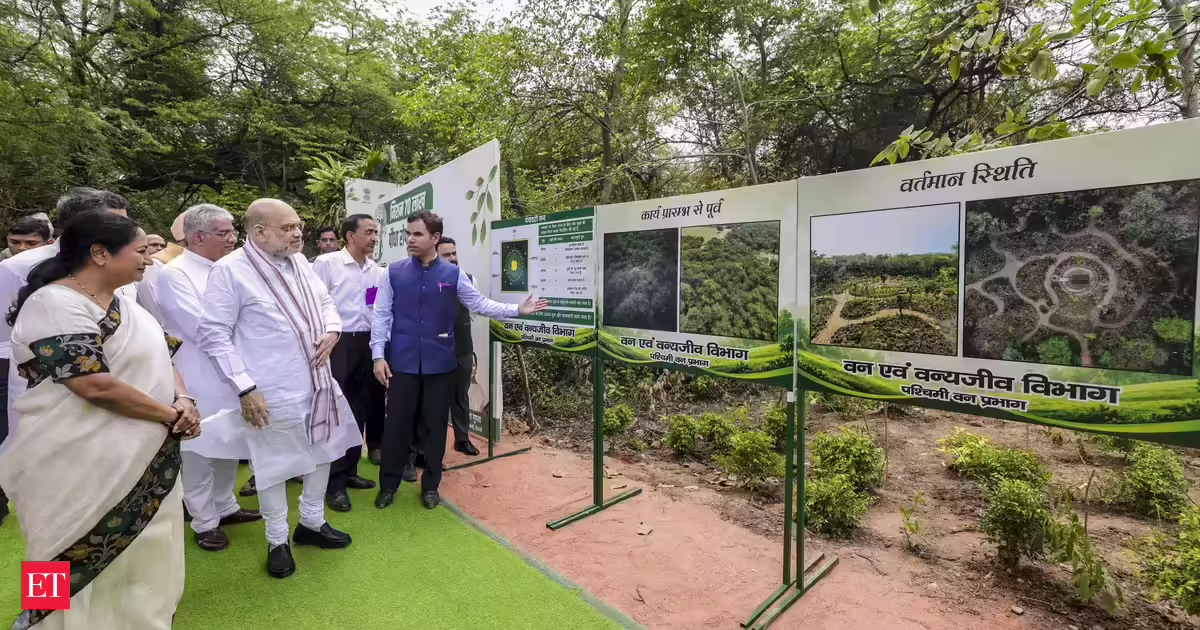
The Delhi government on Monday unveiled an ambitious Eco-restoration Plan (2026–2030) aimed at scientifically restoring the capital's Ridge ecosystems through large-scale plantation, biodiversity conservation and long-term ecological management. The programme, to be launched under the nationwide "Ek Ped Maa Ke Naam" campaign, envisages plantation of more than one crore native saplings across 6,303.55 hectares of Ridge forests over the next four years.Union Home Minister Amit Shah along with Delhi Chief Minister Rekha Gupta during a tree plantation drive carried out in the President's Bodyguard premises, in New Delhi. (@AmitShah)According to the government, the initiative has been prepared under the guidance of Union Home Minister Amit Shah and is based on Delhi's first-ever scientific Working Plan prepared by the Forest Research Institute (FRI), Dehradun. The Working Plan was approved by the Ministry of Environment, Forest and Climate Change in November 2025 and forms the basis for the city's first comprehensive eco-restoration roadmap.Officials described the programme as one of the largest urban ecological restoration exercises undertaken in Delhi, with the objective of strengthening biodiversity, improving ecosystem services and enhancing the city's resilience against climate change.Phased plantation and restoration programmeThe Eco-restoration Plan proposes plantation of over 35.51 lakh native trees and 64.96 lakh shrubs, climbers and bamboo, taking the total plantation target to more than 1 crore saplings between 2026 and 2030.During the first phase in 2026-27, around 28.56 lakh plants – including 14.27 lakh trees and 14.29 lakh shrubs, climbers and bamboo – will be planted across 1,490 hectares in the Southern and Central Ridge.The government said degraded forest areas would be scientifically restored through phased removal of invasive alien species such as Vilayati Keekar (Prosopis juliflora), Subabul (Leucaena leucocephala) and Safeda (Eucalyptus), followed by plantation of indigenous species better suited to Delhi's ecology.The plan also includes creation of eight new water bodies across the Southern and Central Ridge during 2026-27 to improve groundwater recharge, soil moisture conservation, wildlife habitats and climate resilience.Eight thematic forests – including Panchvati Van, Ritu Van, Rishi Van, Nakshatra Van, Bel Van and Qurani Vatika – will also be developed to combine biodiversity conservation with environmental education and India's cultural heritage.Mission Green Delhi and public participationComplementing the Eco-restoration Plan, the Delhi government has also launched Mission Green Delhi under the Green Action Plan 2026-27 with an overall target of planting more than 70 lakh saplings across the city.The programme includes plantation of over 20 lakh trees, 37 lakh shrubs and nearly 93,000 bamboo plants. Another 12 lakh saplings will be distributed free of cost to schools, Resident Welfare Associations (RWAs), institutions and citizens to encourage public participation.As part of the Dust Free Delhi Campaign, agencies including MCD, PWD, NDMC, CPWD, NHAI, DDA and IFCD will undertake plantations of around 24.35 lakh plants along roads, central verges and public spaces to help reduce dust pollution and improve air quality.The government has also proposed a Green Drive Portal that will allow citizens to book plantation slots, request free sapling delivery through "Vriksh Rath", locate government nurseries and register as volunteers for plantation drives.Officials said the Ridge Restoration Programme will be formally launched on July 7 with plantation drives at the President's Bodyguard Campus and Nanakpura Ridge before a public function at Central Park, RK Puram. Plantation activities across 51 locations in Delhi will be connected through live streaming as part of the citywide campaign.
Delhi unveils 2026-30 Ridge restoration plan, targets plantation of over one crore native saplings
Delhi's Eco-restoration Plan (2026-2030) aims to revitalize the Ridge ecosystems with the planting of over one crore native saplings.
555 words~3 min read