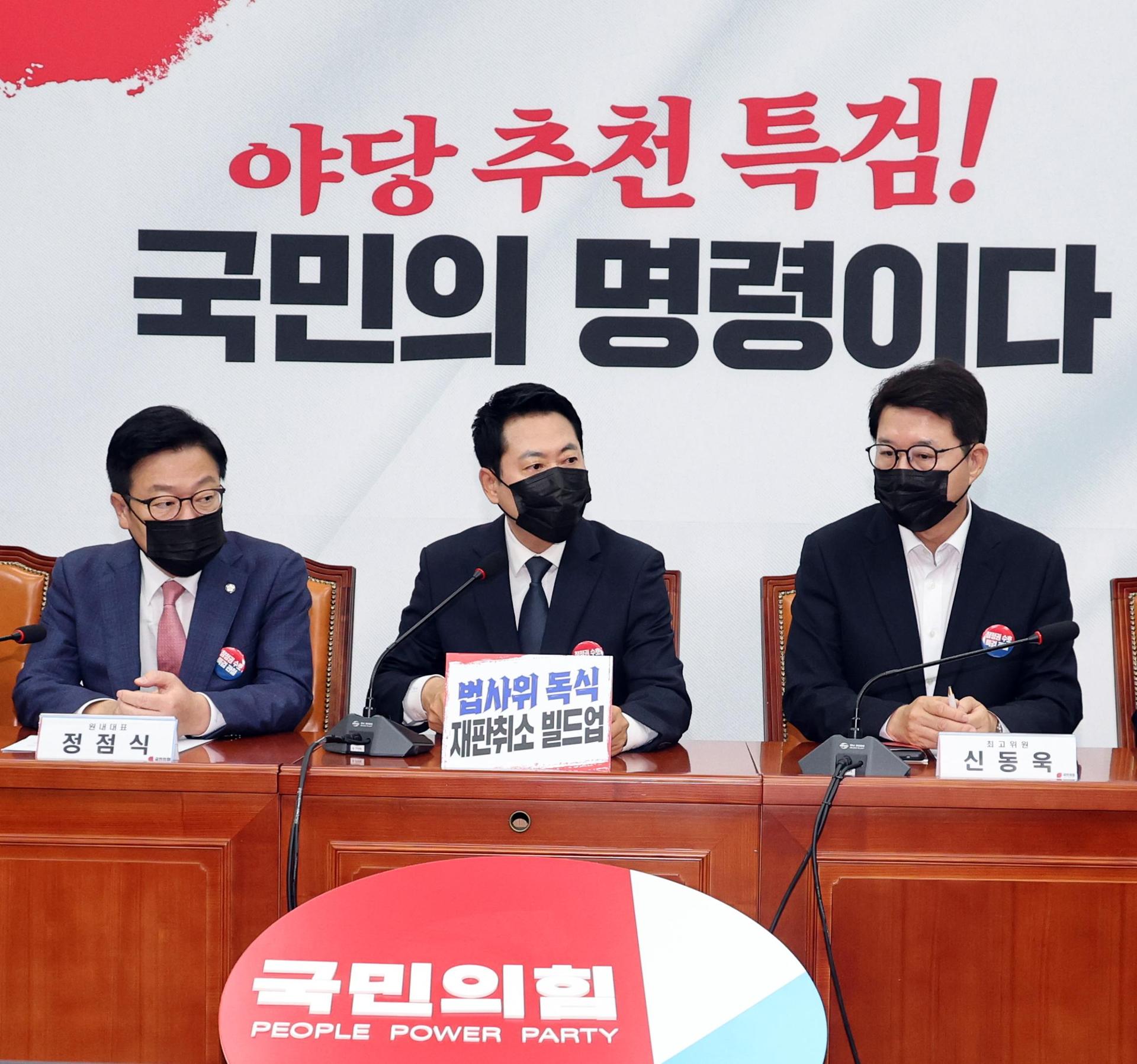
New rules allow punitive damages for malicious false information, but critics warn vague standards could chill journalism and public debate People Power Party officials wear black masks during a leadership meeting held at the National Assembly on Monday to protest an amendment to South Korea's information network law. (Yonhap) South Korea’s new disinformation law took effect Tuesday, introducing punitive damages and new platform obligations while fueling a widening clash over whether the measure will curb online harm or suppress legitimate criticism.The revised Information and Communications Network Act allows victims to seek compensation of up to five times the actual damages caused by maliciously spread false or manipulated information. It also requires major platforms to develop procedures for reporting and handling such content, along with hate speech and discriminatory posts.The ruling Democratic Party of Korea says the law is needed to address the social damage caused by disinformation, online hate speech and profit-driven “cyber wreckers” who spread sensational or false claims for advertising and sponsorship revenue.But the main opposition People Power Party, press groups and civic organizations argue that the law leaves a fundamental question unresolved: Who decides what is false?They warn that broad definitions and platform-based enforcement could lead to excessive takedowns, coordinated complaints against unfavorable criticism, and a chilling effect on journalism and public debate.What the law changesUnder the revised law, punitive damages apply to accounts with at least 100,000 subscribers or an average of at least 100,000 monthly views.Administrative fines are limited to “profit-seeking information publishers” who have posted false or manipulated information at least three times over the past three months and earned advertising or sponsorship revenue from the content.Large-scale platform operators with at least 1 million daily average users must establish procedures for reporting and handling false or manipulated information, hate speech and discriminatory content. They are also required to disclose the results regularly.The amendment was pushed through the National Assembly late last year by the Democratic Party, which holds a parliamentary majority.Ruling party calls law a safeguardSupporters say existing legal remedies have often failed to provide meaningful compensation to victims of malicious false information.They also point to the rapid spread of generative artificial intelligence, which has made it easier to produce doctored images, videos and other manipulated content.The Democratic Party says the revised law is a minimum safeguard against malicious disinformation and online hate speech, rather than a tool to suppress criticism.“Those spreading malicious false information have caused extensive damage while reaping unfair profits,” acting Democratic Party leader Han Byung-do said Tuesday. “The revised law is the minimum institutional tool needed to prevent the production and distribution of such false and manipulated information and hold perpetrators accountable.”Han accused the People Power Party of distorting the law as a tool of government censorship.“Where in this bill is there any gagging of speech or dictatorship?” he said.Warnings of a chill effectCritics say the core problem remains that the law does not clearly define who should determine whether content is false or manipulated.Under the law, platforms are expected to make such judgments based on their own operating policies. This has raised concerns that the same post could be treated differently depending on the platform, and that companies may err on the side of removal to avoid liability.The Seoul Foreign Correspondents’ Club, which represents foreign correspondents and international news organizations based in Korea, issued a statement on July 1 expressing concern over the law’s potential impact on freedom of expression.“We are concerned about the potential impact on freedom of expression, the free flow of information, and the work of journalists and news organizations posed by the amendments,” the SFCC said.“The board hopes that the government and the National Assembly will bear in mind that laws often outlast the administrations that enact them,” it added.Opposition vows legal challengeThe People Power Party has denounced the revision as a “super gag law” and plans to file a constitutional petition, meaning the legal and political battle over the measure is likely to continue after its implementation.At a party leadership meeting Monday, opposition officials wore black masks in protest. People Power Party leader Jang Dong-hyeok said the gesture was meant to show resistance to what he called an attempt to silence the public.“If the people’s eyes are covered, their ears blocked and even their mouths gagged, the result will be the completion of Lee Jae Myung’s dictatorship,” Jang said.Civic groups have raised similar concerns. People’s Solidarity for Participatory Democracy said after the bill’s passage that the concept of false or manipulated information was overly broad and that the standard of “infringing on the public interest” was too abstract, raising concerns that the law could violate the constitutional principles of clarity and proportionality.A National Assembly public petition calling for the withdrawal of the law reportedly gained more than 140,000 signatures within a month.
Disinformation law takes effect amid free speech backlash
South Korea’s new disinformation law took effect Tuesday, introducing punitive damages and new platform obligations while fueling a widening clash over whether
799 words~4 min read