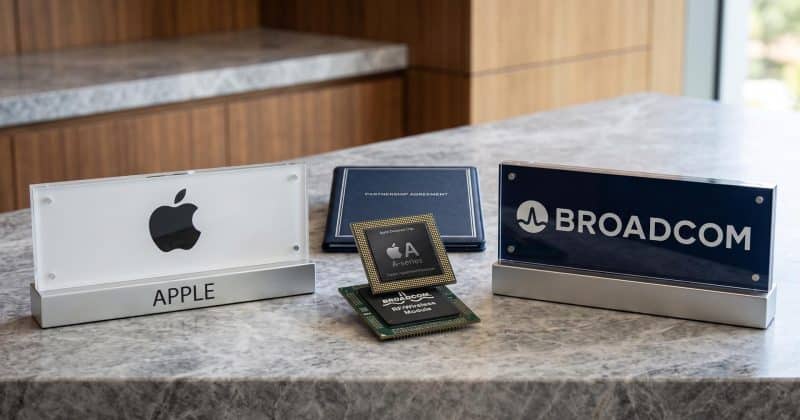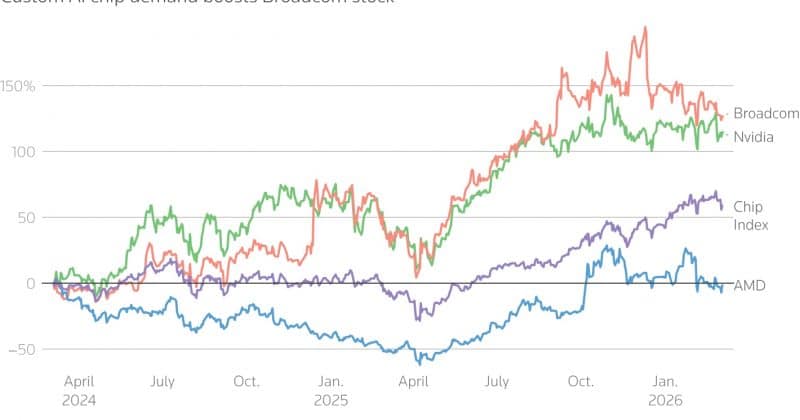
Apple has extended its chip supply agreement with Broadcom through 2031, a deal disclosed in a regulatory filing on 6 July that covers custom ASICs alongside the RF, Wi-Fi and Bluetooth components Broadcom has supplied for years. Broadcom shares rose about 5 per cent on the news; Apple added 1 per cent. Apple accounts for roughly 20 per cent of Broadcom's annual revenue, which makes this the chipmaker's single most important customer relationship, renewed for half a decade. Both companies kept financial terms private.On the surface, this is a supplier contract. Read the reporting around it and a far bigger story emerges. According to Bloomberg, Broadcom technology sits inside Baltra, Apple's first in-house AI server chip, targeted for rollout as early as next year. Baltra exists because Apple's current AI infrastructure is a patchwork of borrowed parts — Mac chips pressed into server duty, Nvidia GPUs rented inside Google's data centres, and a reported billion-dollar-a-year arrangement with its biggest rival. The 2031 deal is the paperwork; Baltra is the plot.Think of it the way Formula 1 thinks about engines. For a decade, Nvidia has been the sport's dominant power unit supplier, and every team on the AI grid has run its hardware. Now the big teams are going works, building their own engines, and Broadcom has become the engineering partner sitting in every rival garage at once.What the filing says, and what it leaves outStart with the confirmed layer. Broadcom's filing states it will develop and supply custom application-specific integrated circuits (ASICs, chips designed for a single defined job) for use across "multiple generations of Apple products". The extension builds on a multiyear, multibillion-dollar agreement the two companies signed in 2023, per MarketWatch, and continues a relationship in which Broadcom supplies the radio-frequency, Wi-Fi and Bluetooth silicon inside every iPhone.That connectivity layer matters more than it sounds. Apple debuted its in-house C1 modem in the iPhone 16E and has been working to shed external cellular suppliers ever since. Yet the company has struggled to move away from Broadcom for wireless and RF components, per Reuters, and 9to5Mac reads the deal's length as a signal: a full in-house takeover of cellular connectivity looks unlikely before 2031 at the earliest. Apple's silicon independence project, in other words, still has a Broadcom-shaped dependency at its core. Apple has now chosen to formalise it rather than fight it.The AI layer is where the filing turns interesting, and where the caveats begin. Wedbush Securities told clients the updated agreement "seems to suggest AVGO will be assisting with more compute oriented products", while noting it remains unclear whether those ASICs point at device-level edge AI or at data centre infrastructure of the kind Broadcom builds for Google, Meta and OpenAI. The filing itself stays silent on Baltra. The connection comes from Bloomberg's reporting, which pairs the extension with the server chip programme. Treat the "this deal is about AI at its core" reading as a strong inference with a named source, rather than a filed fact — because the evidence for it lives one layer down, in the mess Apple is trying to escape.The market context around the signature adds its own subtext. Broadcom stock has gained more than 30 per cent over the past year on AI demand, though it entered this week down from its June peak after a sharp early-July rout across semiconductor names, per market commentary that puts the shares roughly 23 per cent below their 52-week high. Check those figures against live prices before publish-day numbers go in. For a company navigating that volatility, a five-year commitment from a customer worth a fifth of revenue is ballast. For Apple, which watched memory prices spike as much as 98 per cent in early 2026 on AI data centre demand, locking in silicon supply through 2031 is insurance against a components market that has turned hostile to everyone assembling consumer hardware. Both sides had reasons to sign long.The rented brain: how Apple Intelligence runs todayHere is the uncomfortable arithmetic behind Apple's AI operation. When Apple launched Private Cloud Compute in 2024, the pitch was total control. Apple Intelligence queries too heavy for the iPhone would run on Apple silicon servers, in Apple data centres, under privacy guarantees outside researchers could verify. The company built that fleet on modified M2 Ultra processors, chips designed for the Mac Studio and drafted into server duty.The fleet then sat around waiting for work. In March this year, The Information reported, citing former Apple employees, that Private Cloud Compute servers were running at about 10 per cent of capacity on average, with some purchased hardware still sitting in warehouses, uninstalled. The report described a fragmented internal cloud, with teams running isolated technology stacks and a finance department frustrated at duplicate infrastructure costs. The Mac-derived chips, the same report said, lacked the muscle to run frontier-class models. Apple had built a private AI cloud that was at once underpowered and underused. A garage full of road cars, entered into a Grand Prix.Morgan Stanley put a number on the sunk cost. Apple avoids breaking out AI infrastructure spending in its earnings, but the bank's analysts estimated in a February note that the company had committed approximately $4.5 billion to Private Cloud Compute, a figure worth verifying against the original note, though its order of magnitude squares with the fleet The Information described. The irony is that renting was always Apple's habit at the storage layer: the company has ranked among Google's largest corporate cloud customers for iCloud since at least 2021, per prior reporting. Apple built its own AI servers to break that pattern, then found itself unable to fill them.The fix arrived at WWDC on 8 June, and it involved swallowing two decades of pride. Apple's third-generation Apple Foundation Models span five tiers: two on-device models, including the clever 20-billion-parameter AFM 3 Core Advanced that activates just 1 to 4 billion parameters per request, and three server models. Four of the five run on Apple silicon. The fifth, AFM 3 Cloud Pro, is the flagship that handles agentic tool use and complex reasoning. It runs on Nvidia GPUs hosted in Google Cloud.Spend a moment on that lineup, because it maps Apple's compute politics with unusual clarity. AFM 3 Core, a 3-billion-parameter dense model, handles the everyday on-device work. Core Advanced is the engineering showpiece: a sparse 20-billion-parameter model that fits on a phone by loading only the parameters a given request needs, built on a pruning technique Apple Research published in early 2025. AFM 3 Cloud is the server workhorse and ADM 3 Cloud the image model, both on Apple silicon in Apple data centres. A piece of system software Apple calls the orchestrator sits above all of them, routing each query to the cheapest tier that can answer it: on-device where possible, Apple's own servers next, and the Nvidia-in-Google-Cloud tier for the heaviest reasoning. Amar Subramanya, Apple's AI VP, told press at WWDC that Cloud Pro's quality sits in the class of Gemini's frontier models. The architecture is elegant. It is also a concession in five acts: the moment a Siri query gets hard, it leaves Apple's hardware.Apple's own security research blog confirms the architecture: the company extended Private Cloud Compute to third-party infrastructure for the first time, layering Nvidia Confidential Computing, Intel CPUs with TDX and Google's Titan security chip, with a cryptographically verifiable, append-only ledger of every Google Cloud machine in the fleet. Apple software VP Sebastien Marineau-Mes explained the logic at a post-keynote briefing: Apple wanted Nvidia's latest hardware, and recent confidential-compute advances let Apple and Google build a configuration where the servers' contents stay sealed even from their operators.Then there is the money flowing the other way. On 12 January, Apple and Google announced in a joint statement that Gemini technology would underpin the next generation of Apple Foundation Models and the rebuilt Siri. Bloomberg's Mark Gurman has reported the arrangement at approximately $1 billion a year, for a custom Gemini model of roughly 1.2 trillion parameters. Both companies have declined to confirm those figures; treat them as reported estimates. Apple's executives spent WWDC drawing careful boundaries around the arrangement. Craig Federighi put it in six words and a number: "The amount of the Google Assistant we use is none." Gemini serves as a teacher signal and a foundation for Apple's own training runs; the models shipping to iPhones are Apple's, refined with Gemini outputs rather than running Gemini itself.Add it up. Apple trains its models on Google TPUs; the original 2024 AFM paper disclosed training runs on 8,192 TPUv4 chips and 2,048 TPUv5p chips, and post-WWDC clarifications indicate the third generation trained on TPUs as well. It serves its most capable model on rented Nvidia GPUs inside a rival's cloud. It pays that rival, per Bloomberg's reporting, around a billion dollars a year for model technology. And its own server estate runs Mac chips at a tenth of their capacity. For a company whose entire identity is vertical integration, this is the qualifying lap run in someone else's car.Baltra: the works engine Apple is buildingWhich brings us to the chip the 2031 deal locks in without naming. Baltra is Apple's first server processor designed for AI from the ground up, developed with Broadcom, whose contribution, per The Information, which broke the story in December 2024, centres on the networking and interconnect technology that stitches thousands of accelerators into a functioning system. Networking is Broadcom's home turf, and in AI infrastructure it is the part that separates a pile of chips from a computer.The design brief, as reported, is inference rather than training. Apple has scaled back frontier-scale internal training (that is what the Gemini arrangement exists to replace), so Baltra's job is serving: running Siri requests, writing tools and Apple Intelligence queries at high throughput and low latency for a billion-plus devices. Bloomberg reports Apple is studying configurations with double, quadruple or eight times the processing units of a standard design, which hints at ambitions beyond a modest first attempt. A second high-end chip, codenamed Sotra, is also in development per Bloomberg via Tom's Hardware, with details unknown.What Baltra looks like inside remains educated guesswork, though the guesses come from informed corners. Analyst Max Weinbach has suggested Apple could adopt a cluster architecture in the mould of Nvidia's GB200-class systems, linking around 64 chips with high-bandwidth interconnects — the layer where Broadcom's contribution lives. The same analysis floats a memory strategy built on large-capacity LPDDR rather than the HBM stacks standard in AI accelerators, playing to Apple's decade of unified-memory expertise from the M-series. Apple's patent trail offers a supporting clue: a March 2024 filing describes an optical-based distributed unified memory system, the kind of plumbing a server fleet would need. All of this is speculation with a paper trail rather than confirmed design, and Apple has said zero about Baltra in public — the company has yet to acknowledge the chip exists.Timelines and manufacturing specifics have shifted across reports, and honesty demands the seams stay visible. The Information and Bloomberg place manufacturing on TSMC's 3-nanometre process — most reports cite the enhanced N3P node, while Taiwan's Economic Daily News has cited N3E. Mass production has been targeted for 2026, with deployment in Apple's data centres reported for 2027; Bloomberg's 6 July report describes rollout "as early as next year". Taiwanese reporting has Foxconn building the Baltra servers themselves, a detail from a narrower sourcing base. The composite most consistent with the reporting: production ramps this year, servers go live in 2027, and every date remains a target rather than a promise.The strategic logic needs little decoding. Google has TPUs. Amazon has Trainium and Inferentia. Meta has MTIA. Microsoft has Maia. Apple was the last hyperscale-class company still buying or renting its entire AI serving stack, and Baltra ends that. Each query served on Apple's own silicon is a query priced off Nvidia's margin sheet and moved onto Apple's cost curve — the same arithmetic that made Apple silicon the defining consumer chip project of the past decade, applied one layer up, from the phone in your hand to the data centre answering it. The privacy argument stacks on top: Private Cloud Compute's guarantees are easiest to enforce on hardware Apple controls down to the transistor, and the Google Cloud arrangement — however well sealed — will always be the harder story to tell.The Nvidia question: why the champion still holds the gridBefore the custom-silicon story runs away with itself, the counterweight deserves its section, because Nvidia's obituary has been drafted before and the company keeps lapping its mourners. The trade-off between an ASIC and a GPU is real and it cuts both ways. A custom chip like Baltra or Jalapeño strips out everything except its one job — industry veterans describe such designs as less flexible than Nvidia's GPUs, but cheaper, and tunable to specific AI tasks. Flexibility is the part that matters when the workload changes, and in AI the workload changes every six months. A GPU fleet retrains, reconfigures and absorbs whatever architecture research produces next; an inference ASIC designed around 2025's transformer serving patterns is a bet that 2028's models will still want what it offers.Meanwhile the performance bar keeps moving. Tom's Hardware notes that even if Jalapeño beats today's Nvidia Blackwell-class accelerators on efficiency, the relevant competition is tomorrow's Rubin generation and AMD's MI400 series — silicon that will be shipping by the time the custom chips deploy at scale. Nvidia also sells something the ASIC route struggles to replicate: the CUDA software stack, the networking, the racks, the reference designs, the ecosystem of engineers who already know the tools. Buying Nvidia is buying a finished Grand Prix car with a factory support contract. Building custom is designing your own power unit — cheaper per lap once it works, ruinous if it fails to.And even the defectors keep buying. Apple's flagship model runs on Nvidia GPUs today, by Apple's own published architecture. OpenAI's leadership has said the company will keep purchasing Nvidia hardware alongside Jalapeño, with the custom chip covering inference while training stays on GPUs, per coverage of the launch. The honest description of the custom-silicon exodus is diversification rather than departure: every hyperscaler wants a second engine supplier in the garage, priced against the first. Nvidia's grip loosens at the margin. The margin happens to be worth tens of billions of dollars, which is the exact sliver Broadcom has built its next act on.Broadcom: the session musician on everyone's recordNow widen the lens, because the most interesting company in this story is the one selling shovels to every prospector at once. Broadcom co-designs and supplies Google's TPUs — the chips Apple trains on. It is embedded in Apple's Baltra — the chip Apple will serve on. And on 24 June, it unveiled Jalapeño, OpenAI's first custom chip — the silicon ChatGPT's maker will serve on. In music terms, Broadcom is the session player whose name appears in the liner notes of every major album of the era: a different band on every record, the same hands on the fretboard.Jalapeño deserves its own paragraph because it shows the Broadcom method at full speed. OpenAI and Broadcom announced their partnership in October 2025 — a plan to deploy 10 gigawatts of custom accelerators, and delivered a physical chip to Sam Altman and Greg Brockman eight months later. The companies say Jalapeño went from initial design to tape-out in nine months, a cycle they claim may be the fastest ever for a high-performance ASIC, with OpenAI's own models used to speed the design work. It is an inference-only processor, paired with Broadcom's Tomahawk networking silicon and integrated into full racks with Celestica, targeting initial deployment by the end of 2026. Early performance claims arrive thin. Broadcom CEO Hock Tan has cited roughly 50 per cent lower cost against standard AI GPUs, without published benchmarks, memory specifications or third-party validation to support the number; file it as a vendor claim awaiting the promised technical report.The pattern across customers is the point. Every hyperscaler has reached the same conclusion: a custom ASIC tuned to your own workload beats a general-purpose GPU on cost and power, if you can get one built. Building one from scratch requires a chip design organisation few companies possess — so they bring the architecture and the workload knowledge. Broadcom brings the silicon implementation, the interconnect and the manufacturing relationships. Tan told CNBC that compute demand from the company's six custom-silicon customers is "simply insatiable", with elevated demand visible through 2028. Broadcom has confirmed few of those six names in public; Google, Meta, OpenAI and now Apple are the ones established through filings and joint announcements, and speculation beyond them stays speculation. Microsoft's Maia and Amazon's Trainium programmes, for contrast, run through other design routes — Amazon's Annapurna Labs unit chief among them — which keeps Broadcom's reach wide rather than total.Here is the custom-silicon grid as it stands, from confirmed and reported information:CompanyChipBroadcom's rolePrimary jobStatusGoogleTPU (multiple generations)Co-design and supplyTraining and inferenceDeployed at scale; Apple among its training customersAppleBaltraNetworking/interconnect co-development (per The Information, Bloomberg)Apple Intelligence inferenceMass production targeted 2026; deployment reported for 2027OpenAIJalapeñoSilicon implementation, Tomahawk networking (joint announcement)LLM inference for ChatGPT, CodexEngineering samples running; deployment from end-2026MetaMTIACustom ASIC collaboration (per multiple reports)Recommendation and AI inferenceDeployed, successive generations in progressNumbers underneath the pattern run large, with the caveat that they come from earnings commentary and analyst notes rather than audited breakouts. Broadcom exited its second fiscal quarter with an AI semiconductor backlog reported above $30 billion, of which roughly $10.8 billion had shipped, and has guided to approximately $56 billion in AI revenue for fiscal 2026; Tan has spoken of $100 billion in AI chip sales by fiscal 2027. Those figures deserve verification against Broadcom's own quarterly materials, and the next test arrives with results due 3 September.The business model runs deeper than chip design fees. Jalapeño ships as finished racks rather than loose silicon — OpenAI, Broadcom and Celestica are delivering integrated systems with boards, networking and serving infrastructure bundled in, which mirrors Broadcom's wider push into rack-scale sales that command higher revenue per deal and weld the company into its customers' deployments. The same logic applies to Baltra: whoever owns the interconnect owns the upgrade path, because swapping a networking partner mid-fleet is the data centre equivalent of changing a chassis mid-season. Broadcom's margins reflect the leverage — its first fiscal quarter delivered an EBITDA margin near 68 per cent, per market commentary, a figure worth confirming from the company's own filings but consistent with a supplier every customer needs and none can replace on short notice.One asterisk keeps the triumphalism honest. Macquarie downgraded Broadcom to neutral this month, projecting its share of Google's TPU orders could fall from roughly 95 per cent today to about 65 per cent by 2028, with MediaTek winning a slice of the business. The session musician model has a known weakness: every band comes to wonder, sooner or later, whether it could play the part itself or hire someone cheaper. Google is wondering out loud. The Apple extension to 2031 is Broadcom's answer: lock the biggest client into a five-year residency before anyone else auditions.The India bill: what this machine war costs at the checkoutFor Indian buyers, the custom-silicon arms race stopped being an abstraction on 26 June, when Apple raised prices across its India lineup by between Rs 5,000 and Rs 70,000 per device, per multiple reports of the revision. The MacBook Pro M5 jumped from Rs 1,69,900 to Rs 2,39,900; the MacBook Air M5 rose Rs 29,000 to Rs 1,49,900; iPads, the Mac mini, Apple TV and HomePod all moved upward. Apple's stated cause, quoted across coverage, was "an extraordinary surge in demand for memory and storage" driven by AI data centre expansion. That is the same buildout Baltra, Jalapeño and the TPU fleets exist to serve. DRAM and NAND prices have climbed as much as 98 per cent in early 2026 on data centre demand, per reporting around the deal, and India absorbed among the steepest increases of any major market once rupee depreciation, import duty and GST compounded the component inflation. The Financial Times has reported, via Reuters, that Apple is lobbying Washington for clearance to buy memory from China's CXMT to relieve the pressure. The squeeze, in short, has become tight enough to send Apple shopping on the Pentagon's blacklist.The deeper India story is a study in asymmetry. India now assembles iPhones at a scale that has made it central to Apple's manufacturing diversification, and those exports are a genuine industrial achievement. Yet every layer of the intelligence inside those phones lives elsewhere: models trained on Google TPUs in American data centres, served on Nvidia GPUs in Google Cloud, soon on Baltra chips fabricated by TSMC in Taiwan and assembled into servers by Foxconn. India builds the hardware you hold; the machine that answers you lives an ocean away in silicon India had little hand in.New Delhi understands the gap and is spending against it. The IndiaAI Mission, with an outlay of Rs 10,372 crore, has onboarded more than 38,000 GPUs onto its common compute platform per MeitY, offering startups and researchers subsidised access — reported rates run as low as around Rs 65 per GPU-hour, among the cheapest anywhere. The mission's third procurement round added a telling wrinkle: alongside Nvidia H100s and H200s, it empanelled Google Trillium TPUs for the first time — the same chip family, co-designed by Broadcom, that Apple trains its models on. Even India's sovereign compute stack now routes through the session musician.The government's own press material carries a franker line. GPUs, it notes, are "primarily manufactured in one country". That single sentence is India's version of the anxiety driving Apple, OpenAI, Google and Meta to Broadcom's door: dependence on one supplier for the era's defining resource is a strategic exposure, whoever you are. The difference is capability, and experts quoted by Business Standard have pressed the point — subsidised access solves the entry price while reliability guarantees, datasets, power capacity and frontier research talent remain open questions. The hyperscalers can commission escape hatches on TSMC's 3-nanometre node; India's first fabs, rising in Gujarat and Assam, target mature nodes generations away from that class. For now, India participates in the custom-silicon economy the way most of the world does — as a buyer of its output and a payer of its price rises.What to watch as the grid forms upThe next 18 months hand this story a series of checkable milestones. Baltra's mass production window is now, per Bloomberg's reporting, with deployment reported for 2027; watch TSMC-adjacent supply chain reporting for confirmation the ramp is real. Jalapeño's first racks are due by the end of 2026, with a technical report promised in the coming months that will either substantiate or embarrass the 50 per cent cost claims. Broadcom reports earnings on 3 September, the first read on whether the Apple extension and the $30 billion-plus backlog translate into raised guidance. And the rebuilt Siri ships with iOS 27, the demand event Apple's entire infrastructure bet is priced against. That is the moment those 10-per-cent-utilised servers either fill up or become the industry's most secure paperweights.The bigger question sits above all of them. If Baltra works, does Apple wind down its Google Cloud tenancy and bring AFM Cloud Pro's successors home? Or does the split settle in, Apple silicon for the everyday and rented Nvidia for the frontier? The first outcome completes the vertical integration thesis; the second concedes that even Apple, at a $3 trillion-plus scale, rents the very top of the stack. Either way, Broadcom gets paid: it built the TPUs Apple trains on, the networking inside the chip Apple hopes to escape with, and the accelerator OpenAI is betting its economics on. Bands rise, bands break up, sounds go in and out of fashion. The session player books the next studio.FAQWhat is Apple's Baltra chip? Baltra is Apple's first in-house AI server chip, developed with Broadcom, which contributes the networking and interconnect technology, per The Information and Bloomberg. It is designed for AI inference — running Apple Intelligence queries such as Siri requests — rather than model training, and is intended for Apple's internal use.When will Baltra launch? Reports place mass production on TSMC's 3nm process in 2026, with deployment in Apple's data centres reported for 2027. Bloomberg's 6 July report describes rollout as early as next year. Dates have shifted across reports and remain targets; Apple has confirmed none of them.What did Apple and Broadcom announce in July 2026? Broadcom disclosed in a regulatory filing on 6 July 2026 that its supply agreement with Apple now runs through 2031, covering custom ASICs plus RF, Wi-Fi and Bluetooth components for multiple generations of Apple products. Financial terms stayed private. Apple contributes roughly 20 per cent of Broadcom's revenue.Does Apple use Nvidia chips for Apple Intelligence? Yes, for its top model. Apple states that AFM 3 Cloud Pro, its most capable foundation model, runs on Nvidia GPUs in Google Cloud under an extended Private Cloud Compute architecture. Its four other AFM 3 models run on Apple silicon, and training has used Google TPUs.What is OpenAI's Jalapeño chip? Jalapeño is OpenAI's first custom AI chip, unveiled with Broadcom on 24 June 2026. It is an inference-only processor, co-developed to tape-out in nine months and targeted for initial deployment by the end of 2026. Performance claims await a published technical report.Why did Apple raise MacBook and iPad prices in India? Apple revised India prices upward by between Rs 5,000 and Rs 70,000 per device in late June 2026, per multiple reports, citing surging memory and storage demand from AI data centre expansion. Rupee depreciation, import duty and GST compounded the increase for Indian buyers.end of article
Why Apple Is Building Baltra With Broadcom: Its AI Runs on Rented Nvidia Chips in Google Cloud
The five-year extension reads like a component supply story. Underneath it sits Apple's plan to build the machine that runs Apple Intelligence — and Broadcom's quiet takeover of the entire custom AI chip economy.
4,295 words~20 min read