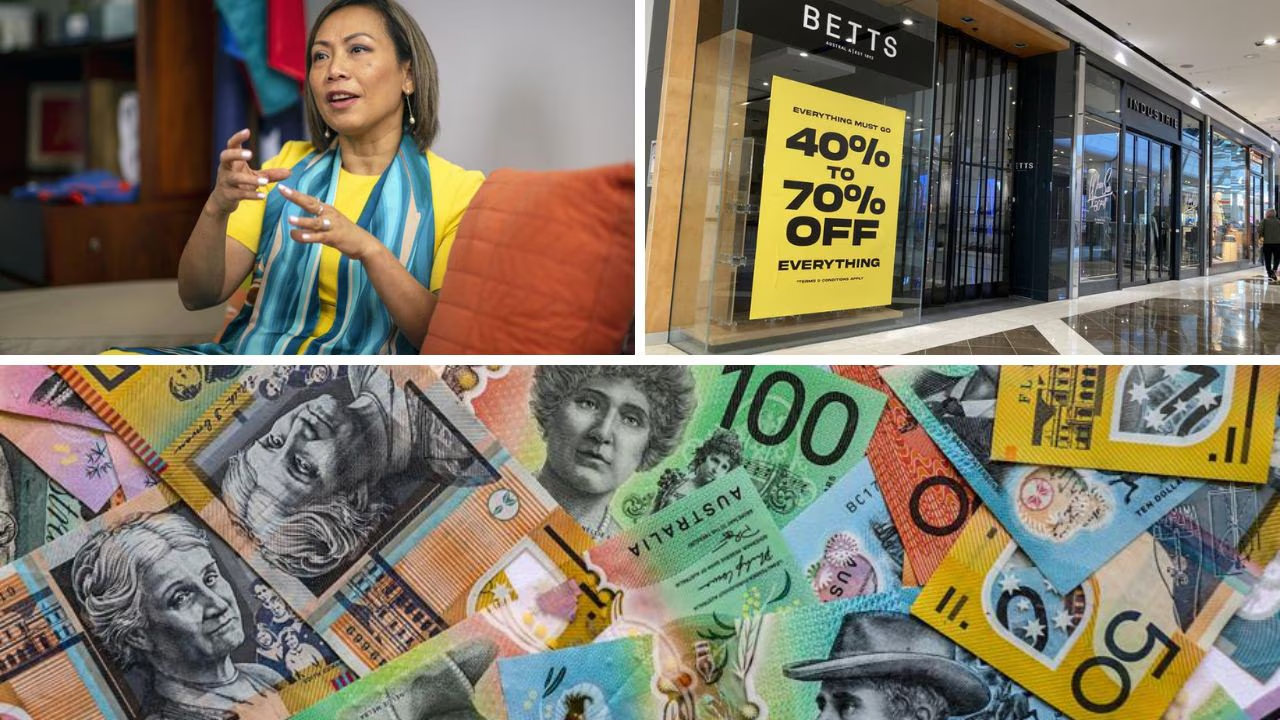
Governments have been accused of ignoring Australian businesses across the retail and manufacturing sectors, struggling under rising prices, huge tax burdens and soaring energy costs.In a grim call, federal independent MP Dai Le warns Australian businesses are under the pump, as cost-of-living pressure also extends to them.Ms Le told NewsWire Australian companies that have been around for generations are simply trying to hang on for as long as they can and are going to extreme lengths – including not paying themselves a wage – just to survive. “There are these long-term family businesses that are trying to stretch for as long as they can but I don’t think governments are listening to these businesses,” Ms Le said. “My fear is that eventually we will just completely rely on everything being imported.”Ms Le points to a raft of rising costs and how the government’s current cost-of-living plans, including the three hour free power, is only targeted at residential properties. “There’s nothing for businesses, nothing at all to support them with energy costs,” she said.“Insurance costs have gone up, the cost of supplies have gone up. “We are not really encouraging businesses, particularly family-run businesses, as costs are just going through the roof.” Ms Le says while official inflation figures show Australia’s costs have gone up by 4.2 per cent this year, businesses she talks with think that figure is closer to 10 per cent when factoring in all costs.List grows of Aussie brands collapsingThe economic crunch hitting Australian manufacturing businesses has also hit retail businesses, with a number of high profile businesses collapsing in the last month. Australian shoe retailer Betts has announced it will close 20 of its 35 retail stores as part of a massive restructure, after the business entered voluntary administration last week.Betts has become the fourth major retailer in Australia to go under this month, as businesses face inflation and slowing consumer demand.In early June, Barbeques Galore announced it would shut down 62 stores across Australia, impacting 500 jobs after a rescue plan failed.The brand went into voluntary administration in February this year.Aussie craft and fabric retailer Lincraft will close all of its physical stores across Australia and New Zealand, affecting dozens of stores after more than 80 years in operation.In mid-June, Glue stores also officially shut down after the fashion retailer was unable to find a buyer.The retailer had been on the ropes since mid-2024 when half of its nationwide stores were shut. In February, owner Accent Group announced the remaining 16 outlets would be shut if no buyers stepped forward.Two weeks ago, Glue’s website was stripped and the last few bricks and mortar shops were closed. The brand’s store at Melbourne’s Emporium will be the last to shutter, on Sunday.“If big businesses can’t survive, I don’t know how small and medium sized companies can survive in the long-run,” Ms Le said.“What will that mean? It will mean we have to import everything which is an issue the government needs to prevent.”Calls for the government to step upMs Le has also ramped up the pressure on the Albanese government to back local businesses, by requiring at least 30 per cent of goods used in Commonwealth projects to be made in Australia.As part of her push for Australian manufacturing, Ms Le introduced a private members Bill last week which would amend the Public Governance, Performance and Accountability Act to give domestic suppliers greater preference in the public procurement system.“Australia was built in its factories, its workshops, its fabrication yards and its cutting rooms,” she said in a speech to parliament at the end of June. “The men and women who worked for them, they did not just make things, they made this country.“That industry is still here, still employing Australians and is still worth fighting for.” This is similar to calls in the NSW parliament that would give local jobs, skills and content a 30 per cent weighting in major government.Ms Le also took aim at the $22.7bn Future Made in Australia federal investment plan designed to revitalise domestic manufacturing and help transition the country into a clean energy superpower over a decade. “Not a single dollar of that $22.7bn has been directed to the industries that should sit at the very heart of a future made in Australia – the steel fabricators, the textile workers, the clothing and footwear makers,” she said. “It has gone instead to green hydrogen, to critical minerals and renewable energy technology. “Those may well be the industries of tomorrow, but the industries that were built yesterday still has a future if we choose to give them one.”
‘Import everything’: MP’s dire warning
Governments have been accused of ignoring Australian businesses across the retail and manufacturing sectors, struggling under rising prices, huge tax burdens and soaring energy costs.
766 words~3 min read