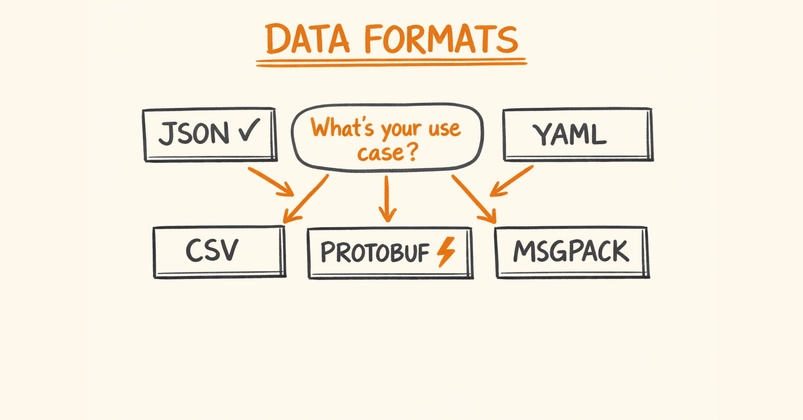
Software spends a surprising amount of its life just moving structured data around: an API returns JSON, a config file is written in YAML or TOML, a report is exported as CSV, a spreadsheet wants tabular rows. These formats are not interchangeable — each was designed for a particular job, and using the wrong one creates friction. Knowing the strengths of each makes you faster and saves you from a category of frustrating bugs.
JSON: the lingua franca of APIs
JSON (JavaScript Object Notation) is the default for data exchange between systems, especially web APIs. It represents nested objects and arrays cleanly, every programming language can parse it, and its rules are strict enough to be unambiguous. That strictness is also its main friction for humans: no comments are allowed, every string needs double quotes, and a single trailing comma makes the whole document invalid. JSON is excellent for machine-to-machine communication and data storage; it is merely tolerable for files humans have to edit by hand.
YAML: configuration humans edit
YAML was designed to be readable and writable by people. It uses indentation instead of braces, supports comments, and drops most of the punctuation that makes JSON noisy. This makes it popular for configuration in tools like CI pipelines and container orchestration. Its strength is also its danger: because structure is defined by indentation, a single misplaced space can silently change the meaning of your file or break it entirely. YAML also has surprising type-coercion quirks (the classic example: the word "no" being read as the boolean false). Use YAML for human-edited configuration, but validate it.