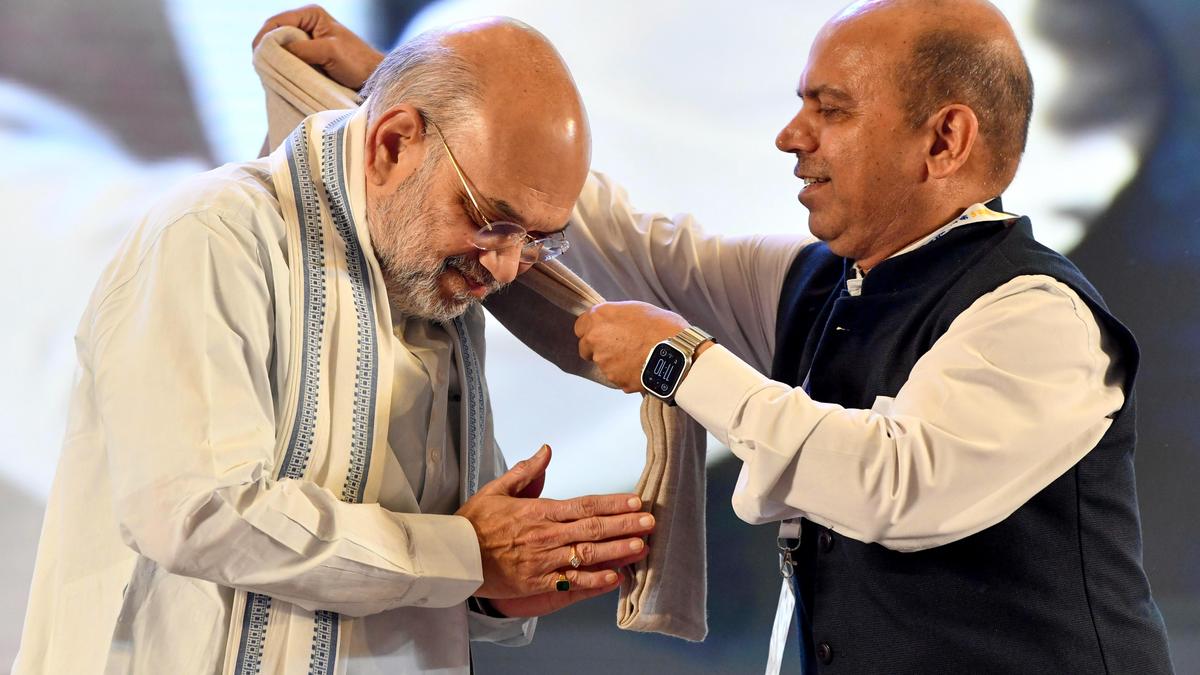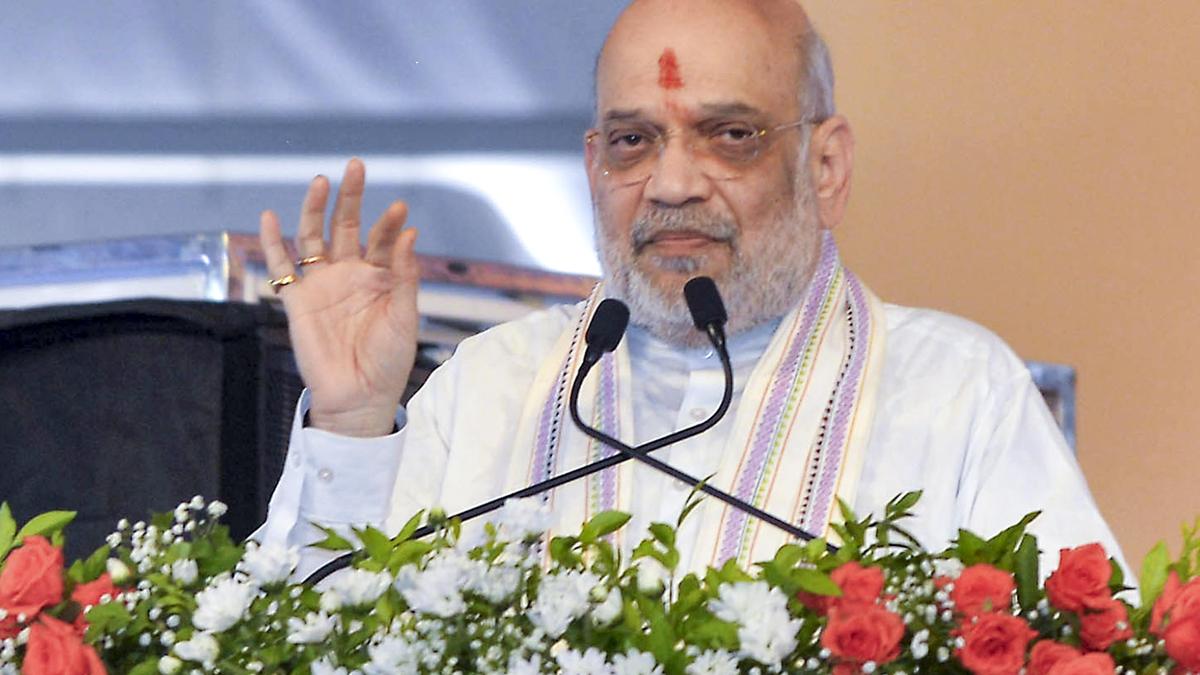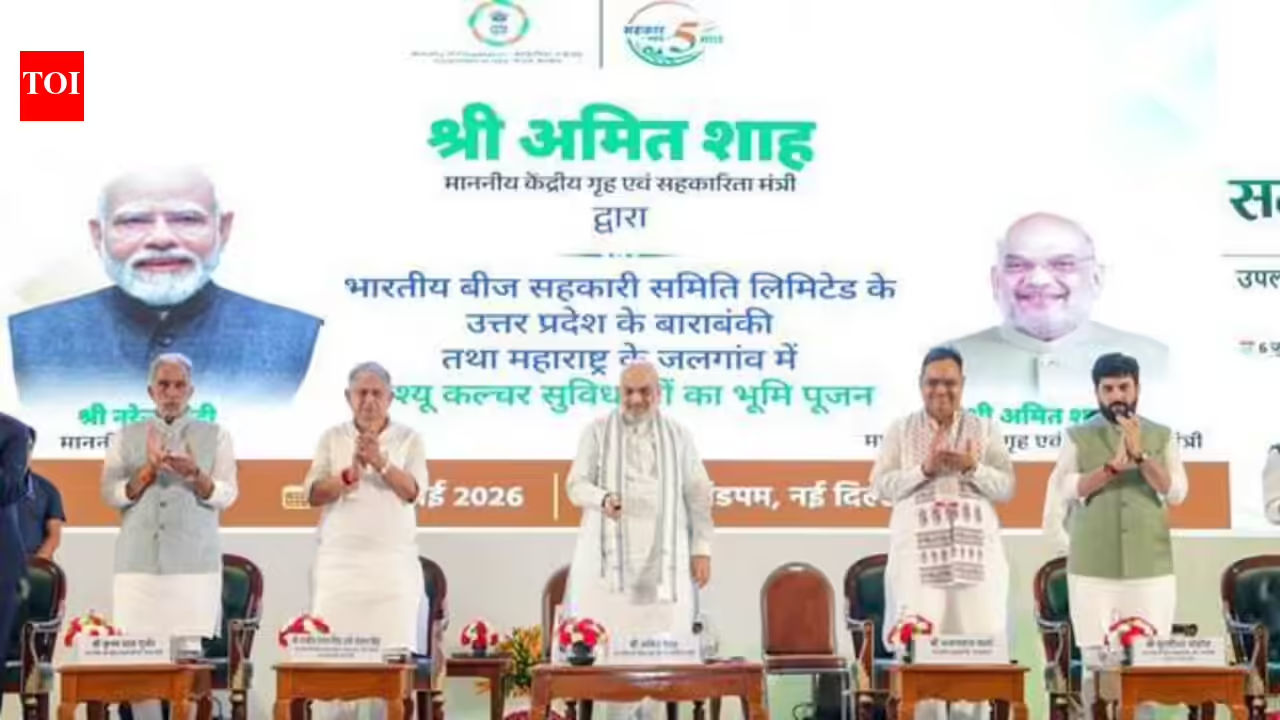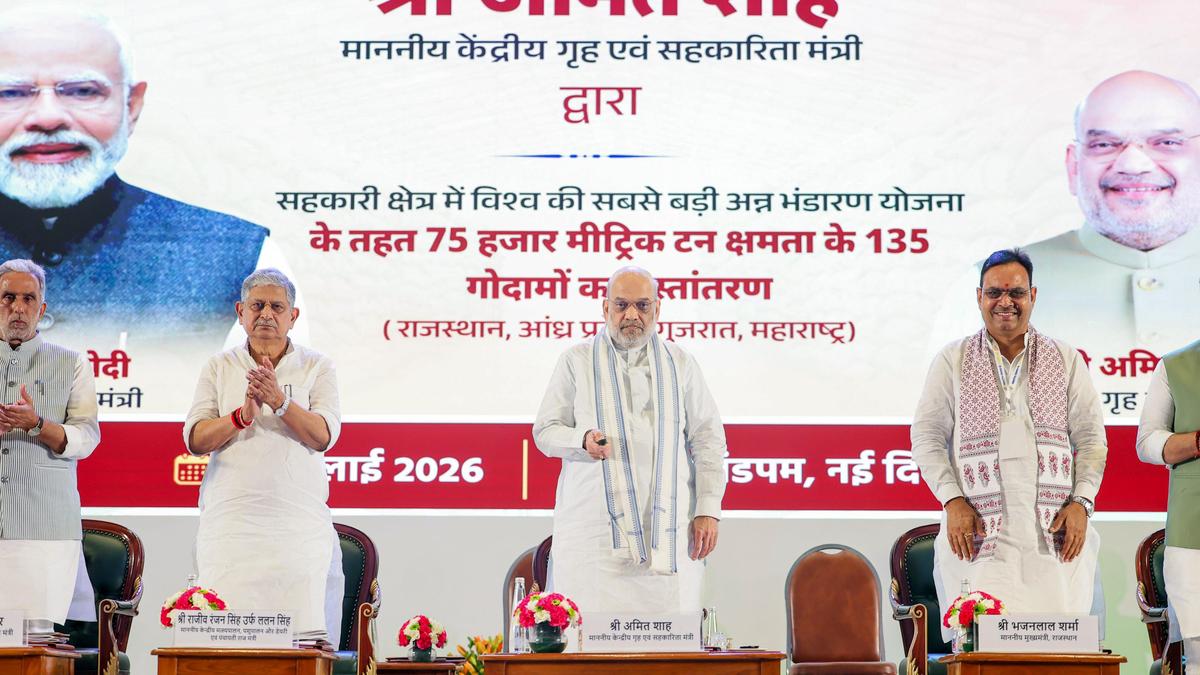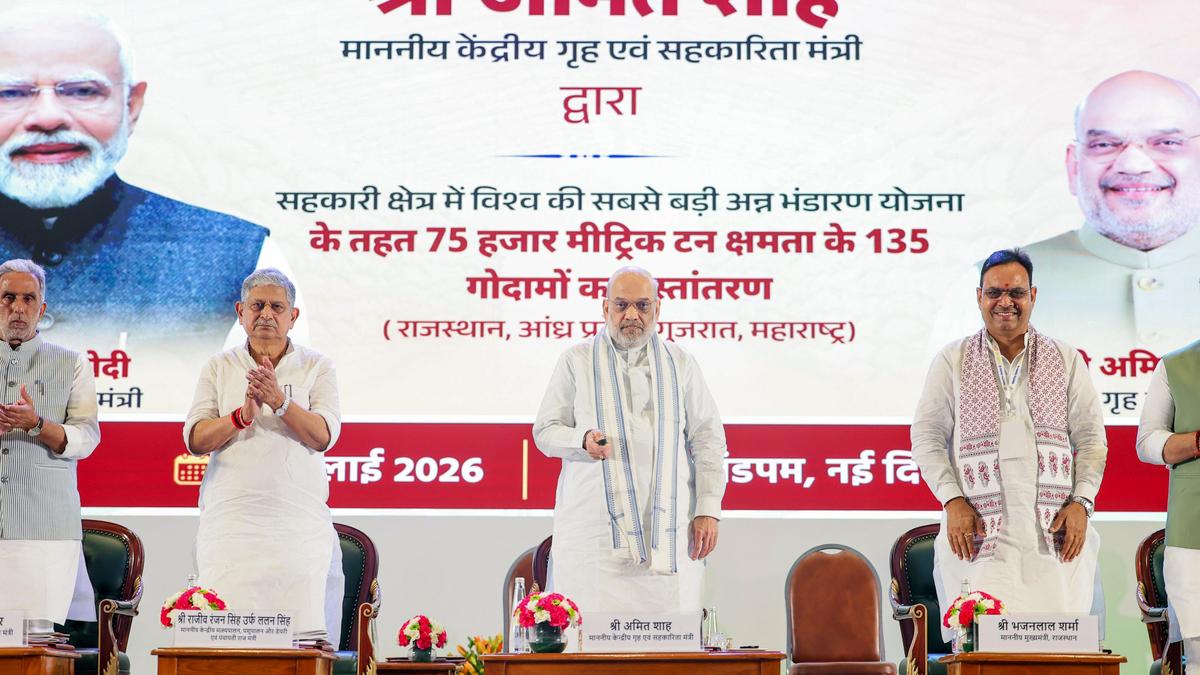
Union Home and Cooperation Minister Amit Shah at the Cooperation Ministry's 5th Foundation Day Ceremony in New Delhi on Monday. Rajasthan Chief Minister Bhajan Lal Sharma, Union Fisheries, Animal Husbandry and Dairying and Panchayati Raj Minister Rajiv Ranjan Singh (Lalan Singh), and MoS for Cooperation Krishan Pal Gurjar are also seen.
| Photo Credit:
Union Cooperation Minister Amit Shah on Monday announced that a pan-India co-operative life insurance company will soon be established. This will mark the fifth national-level co-operative body launched by the NDA government, following the recent setup of dedicated entities for exports, seeds, organic products and taxi services.Addressing an event on the 5th Foundation Day of the Ministry of Cooperation, Shah said: “On the line of Bharat Taxi, we will develop utility aggregator co-operatives in the coming days. Like the IFFCO-Tokio successful model, we are going to set up a co-operative life insurance company which will help boost the insurance sector in the co-operative sector.” He also said Bharat Taxi has been doing well and would be expanded to over 500 cities in the next two years.Sources said that work has started on the formation of a co-operative LIC for which the Ministry would seek approval of the Insurance Regulatory & Development Authority of India (IRDAI) and the final operation may begin in 6-12 months.Alleging that co-operatives were a neglected movement during the Congress rule, Shah said establishment of the Ministry has given a new ‘lifeline’ to India’s co-operative sector. After many years, thanks to the Ministry of Co-operation’s initiative, nine national-level co-operative societies have been created, combining three national-level co-operative societies. Through these nine societies, co-operation has been integrated into nine different sectors, from the countryside to the villages, he said. The Minister also said that just as IFFCO, Kribhco, Amul, and National Dairy Development Board (NDDB) — all created before 2014 — have established the co-operative movement and established it globally, the nine national-level cooperative societies will also become major global entities.Shah credited leadership and professionalism for the successful performance of IFFCO, KRIBHCO, Amul and NDDB and hoped that Tribhuvan Cooperative University (formerly Institute of Rural Management Anand) would prepare trained professionals in banking, dairy, marketing, agriculture, fertilizers, and other co-operative sectors. “A study of these (successful) institutions revealed that while their leadership was in the hands of people associated with co-operatives, their administration and governance were run professionally,” he said.“Our goal is to implement professional management in a phased manner, from primary co-operative societies to apex institutions. This will increase transparency in appointments, improve efficiency, and effectively curb corruption in recruitment,” he said, adding the biggest concern in the co-operative sector has always been leadership and institutional sustainability.Amendments in ActHighlighting that the Centre has made 50 important amendments in the Multi-State Cooperative Societies Act 2002 after creation of a separate Ministry, he said the entire co-operative system has become more transparent and democratic.Appealing chemical fertilizer manufacturers to start producing organic manure, Shah said it is crucial to promote organic production today. “We are also concerned about the health of our 1.4 billion population and people around the world. Indian farmers should increase organic production. It is a misconception that eliminating the use of chemical fertilizers will reduce production. It has been proven in the last five years that reducing the use of chemical fertilizers does not reduce production, but rather increases it and also conserves land,” he said.Stating that by implementing a 100 per cent circular economy in the sugar and dairy sectors, an indigenous fertilizer alternative to DAP will be created which will be cheaper and better in quality, the minister asked farmers to embrace the new product.He also launched the Gomay Sahakari Samiti Ltd, and hoped that it would advance the entire circular economy in the dairy sector through animal feed, animal health, artificial insemination, dung management, organic fertilizer, and renewable energy production. He stated that the seed production co-operative — Bharatiya Beej Sahakari Samiti Ltd (BBSSL) — will become India’s largest non-governmental seed production company in next three years. The minister also said by providing high-yielding, uniformly sized potato seed varieties to farmers, India would be able to attract the global chip industry.Published on July 6, 2026