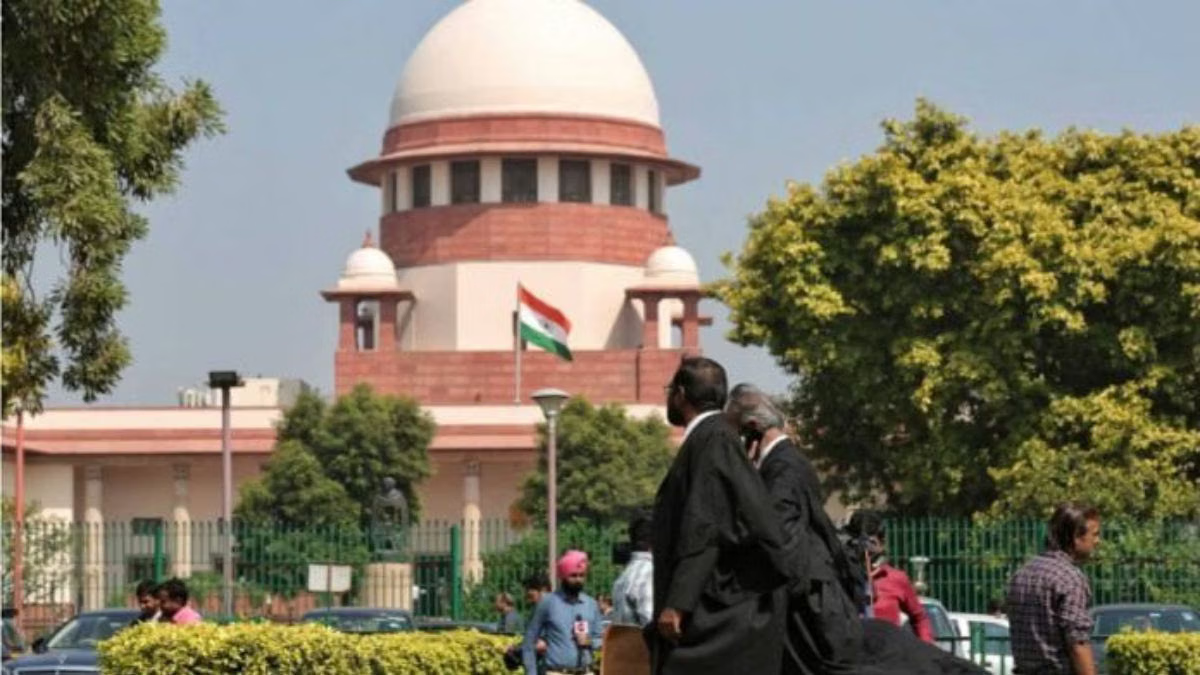
India’s e-Courts project is the most ambitious judicial digitisation programme any democracy has attempted. Over 99.5% of court complexes are connected to wide area networks. The National Judicial Data Grid tracks 27.64 crore orders and judgments in real time. More than 3.38 crore cases have been heard through video conferencing. Virtual courts in 21 states have processed 6 crore traffic challans and collected over ₹649 crore in online fines. The infrastructure that successive phases of the project have built, from Phase I’s hardware installation through Phase II’s litigant-centric platforms to Phase III’s AI-powered case management, represents a transformation that most comparable judicial systems have not even begun.E-court (File photo)The achievement is real. So is the gap it has exposed. India has digitised its courts. It has not yet democratised access to them.India’s Constitution recognises 22 scheduled languages. Its courts operate overwhelmingly in two: English and Hindi. Supreme Court proceedings are conducted exclusively in English. High Court proceedings are conducted in English, with limited exceptions in a handful of states. District courts operate in the state’s official language, but orders, judgments, and digitally generated summons are frequently issued in English or in a register of Hindi that a semi-literate litigant in Assam, Tamil Nadu, or Meghalaya cannot parse.The e-Courts portal, which is the public-facing interface of the entire project, is available in English and Hindi. A farmer in Madurai checking the status of a land dispute, a fisherwoman in Mangalore tracking a consumer complaint, a daily wage worker in Dimapur trying to understand why he has been summoned, all of them encounter an interface designed for a user who reads English or formal Hindi. The system that was built to bring justice closer has, in its digital iteration, preserved the language barrier that physical courts always imposed.Phase III acknowledges this. The project’s design document explicitly identifies language barriers as a limitation of Phase II and proposes AI-assisted translation of judgments into vernacular languages. The e-Committee of the Supreme Court has recommended that court websites be made accessible in local languages. The intention is documented. The implementation has not yet matched it.The e-Sewa Kendras, established at court complexes to assist litigants who lack digital access, are the government’s institutional answer to the digital divide. Over 1,394 are operational across district and High Courts. They provide support for e-filing, virtual hearings, and case status enquiries. For a litigant who has never used a computer, the Kendra is the bridge between the court’s digital infrastructure and the citizen’s analogue reality.The challenge is coverage and capacity. A single e-Sewa Kendra serving an entire court complex of 30 courtrooms handles hundreds of enquiries daily. The staff are often contractual, undertrained, and managing technology that updates faster than their training cycles. A litigant from a tribal village who has travelled three hours by bus to reach the district court finds a Kendra queue that is itself a barrier to access. The infrastructure exists. The human layer that makes it usable for the most vulnerable litigants remains thin.Of the 54 million cases pending across Indian courts, a significant proportion involve litigants who have never received a communication from the court that they fully understood. Court summons, the most basic instrument of judicial communication, are generated by the Case Information System in a standardised format. That format is legible to a lawyer. It is rarely legible to the person being summoned.A summons that arrives in English to a household in rural Bihar where nobody reads English is not a communication. It is a source of anxiety. The recipient knows it is from the court. She does not know what it says, what it demands, or when she must appear. She will need to find someone who can read it, pay for an interpretation, and hope the translation is accurate. In a system that can track 27 crore orders in real time, this is the last mile that technology has not yet reached.The e-Courts project is not failing. It is incomplete. The distinction matters, because the foundation that has been built is stronger than what most countries possess. The NJDG is the world’s largest real-time judicial database. The video conferencing infrastructure proved its value during the pandemic when Indian courts continued functioning while many Western judicial systems shut down entirely. The virtual courts processing traffic challans represent a model that several countries are now studying.Completing the project requires three extensions of the existing framework. First, the AI-assisted translation capability proposed in Phase III must be deployed at scale, not as a pilot, but as a default feature of every digitally generated court communication. Every summons, every order, every case status update should be available in the language the litigant speaks. The technology exists. The National Language Translation Mission has produced models for all 22 scheduled languages. Integrating these into the Case Information System is an engineering task, not a research challenge.Second, the e-Sewa Kendra model needs the staffing density and training investment that matches the ambition of the infrastructure it supports. One Kendra per complex is a start. One trained facilitator per courtroom cluster, drawn from the local community and fluent in the local language, would convert the Kendra from a help desk into an access point.Third, court communications must be redesigned for the citizen, not the lawyer. A summons should tell a person, in her language, in plain words, what the case is about, when she must appear, what happens if she does not, and whom she can call for help. This is not a technology problem. It is a design choice that the judiciary has not yet made.India built the digital highway for justice. The on-ramps are still missing. Building them does not require a new project. It requires finishing the one that has already achieved more than any comparable democracy has attempted. The last mile is the hardest. It is also the one that determines whether digital courts serve every Indian or only the Indians who already had access.(The views expressed are personal)This article is authored by Adarsh Ashok, public policy consultant and Satyam Mishra, advocate, Delhi Courts.
The challenges of utilising digital courts
This article is authored by Adarsh Ashok, public policy consultant and Satyam Mishra, advocate, Delhi Courts.
1,011 words~5 min read