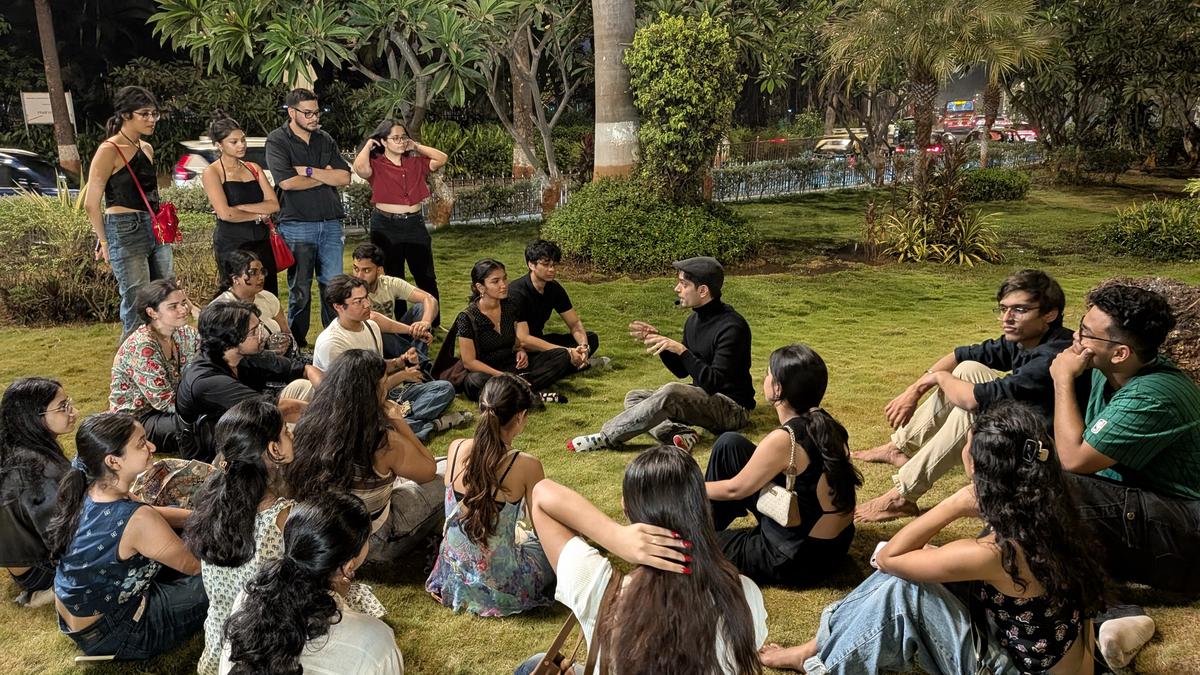
The Indian judiciary is continuously in the process of digitising itself, with Covid providing the necessary push. Along with this, new High Courts are being built, the latest design being that for a new Bombay High Court. The technology push has led to the possibility of e-filings, online case documentation, streaming of live proceedings and virtual hearings. While the court is updating its ways, the classrooms where future lawyers are trained remain largely unchanged - rows of students, a screen/board at the front, pages of cases and statutes to be absorbed and reproduced. If the reform of the justice system (in any form) is to be envisaged, we simultaneously must start by reforming how we teach the students who will occupy these spaces in the future.(Sign up for THEdge, The Hindu’s weekly education newsletter)Legal education in India has long operated on a transmission model: knowledge flows from professor to student, doctrine is prioritised over context, and the court is only spoken of in theory but not visited or understood in reality. There is a well-documented gap between legal training and legal practice. But there is another gap that receives less attention - between the law as it is written and the law as it is experienced by those it is meant to serve.Experiential and interdisciplinary learningExperiential and interdisciplinary approaches to legal education attempt to close both gaps. Rather than treating law as a self-contained system, they situate it within the social, spatial, and cultural contexts that shape how justice is accessed and perceived. Therefore, studying only the black letter of the law is never sufficient. Subjects like sociology, anthropology and psychology are not only subjects for the degree certificate to be completed - but they are also lenses through which students begin to understand why a courtroom that works on paper may fail the litigant who walks through its doors.In an elective course I designed for law students, I began with a simple question: how does the space where you learn affect what and how you learn? We held classes under trees on campus, in a highway dhaba, in the library, and in the canteen. We rearranged the classroom so that the last row became the first. Students who had never thought about the architecture of pedagogy began to think about the architecture of courts. If the room in which they sat changed how they thought and spoke, what did it mean then for litigants who always had to look up at a judge elevated above them? What did it then mean that courts did not permit photography, and left the public to imagine courts through, maybe, popular culture references?These questions led to two exercises in class. First, each student visited a court in a different part of the country on a working day, as an observer - students were tasked to feel the law: the noise, the wait, the spatial arrangement of power, the dignity or indignity of the dock. Second, they were asked to build a 3D model of an ideal courtroom, drawing on their observations, readings, and conversations.What emerged from the students was striking. Not a single model reproduced western symbols of justice. Many inverted Bentham’s Panopticon, placing the judge under scrutiny rather than the accused/litigant. One group designed a tiffin-box courthouse - a vertical, Indian structure offering mediation first, arbitration second, and litigation last. A colosseum-style design gave the public a circular view of proceedings. Several models created dignified waiting areas. A rape tribunal incorporated a one-way screen at the victim’s request. Two students designed a courtroom shaped like a peepal leaf, its veins carrying constitutional values, with Satyamev Jayate inscribed in all twenty-two scheduled languages. Ideas of an ideal courtroom also included making courts completely virtual and giving open access to military tribunals.When students bring clarityThe exercise revealed something that doctrinal instruction rarely does or tries to do – when given the tools to think spatially and socially, law students can bring a moral clarity that academic texts often obscure. Every design placed the litigant, not the judge or the process, at the centre. Students had absorbed, without being told, that access to justice is not merely a legal question. It is a question of design, dignity, and belonging.This is what interdisciplinary legal education makes possible. When law is taught alongside judicial iconography and architecture, the student understands that a courtroom is not a neutral space. When it is taught alongside sociology and anthropology, the student sees that the theatre of the court communicates power before a word is spoken. When students are sent into courts to observe rather than argue, they return with questions no textbook has taught them to raise.The implications extend beyond pedagogy. At a time when India is making consequential decisions about the physical infrastructure of its courts, the profession needs lawyers trained to ask not just whether a law is correct, but whether the system that applies it accounts for the person it has been created for. That kind of lawyer is not produced by doctrine alone. They are produced by classrooms willing, occasionally, to move outside - under the trees, to the dhaba, into the world the law is meant to serve.(By Rahela Khorakiwala Assistant Professor, BITS Law School)
Training lawyers to see justice as it is lived
Transform legal education by incorporating experiential learning to bridge the gap between law theory and real-world justice experiences.
870 words~4 min read