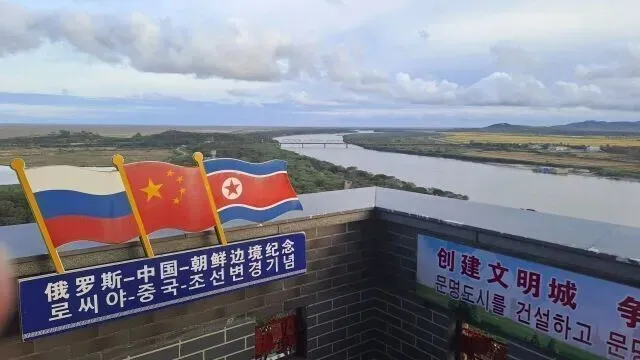
The Tumen River as seen from Fangchuan Observation Tower in China. In the distance, past the Sino-Korean Friendship Bridge, the river leads to the East Sea. For 16.93 kilometers, the river forms the border between North Korea and Russia, excluding China from access to the sea. (Lee Je-hun/Hankyoreh)
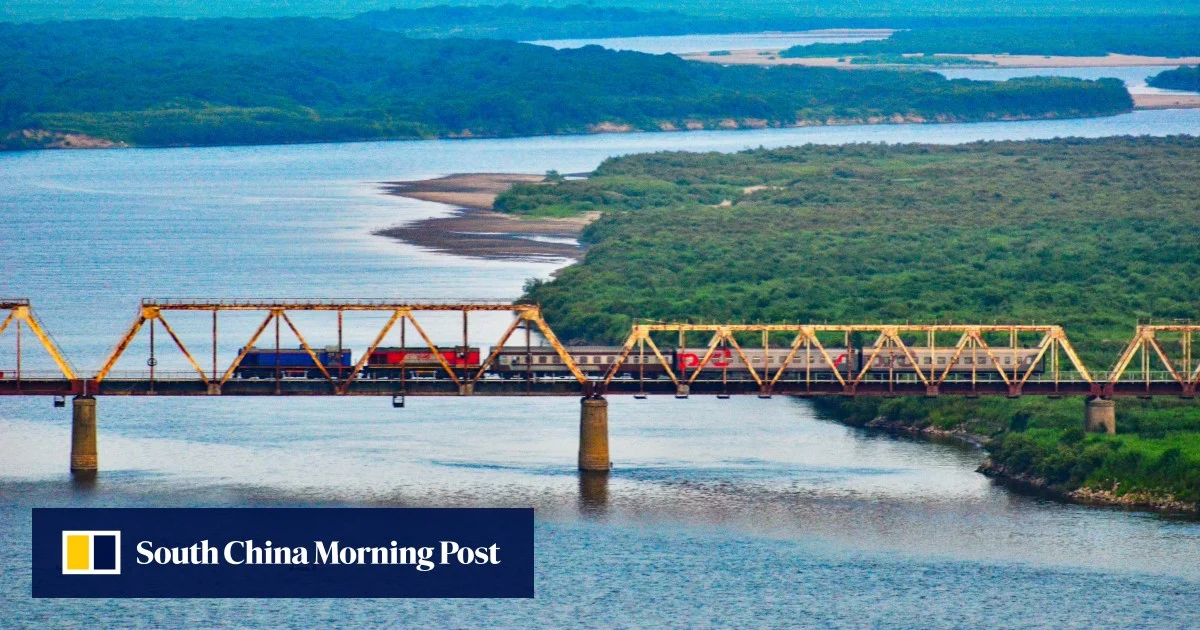
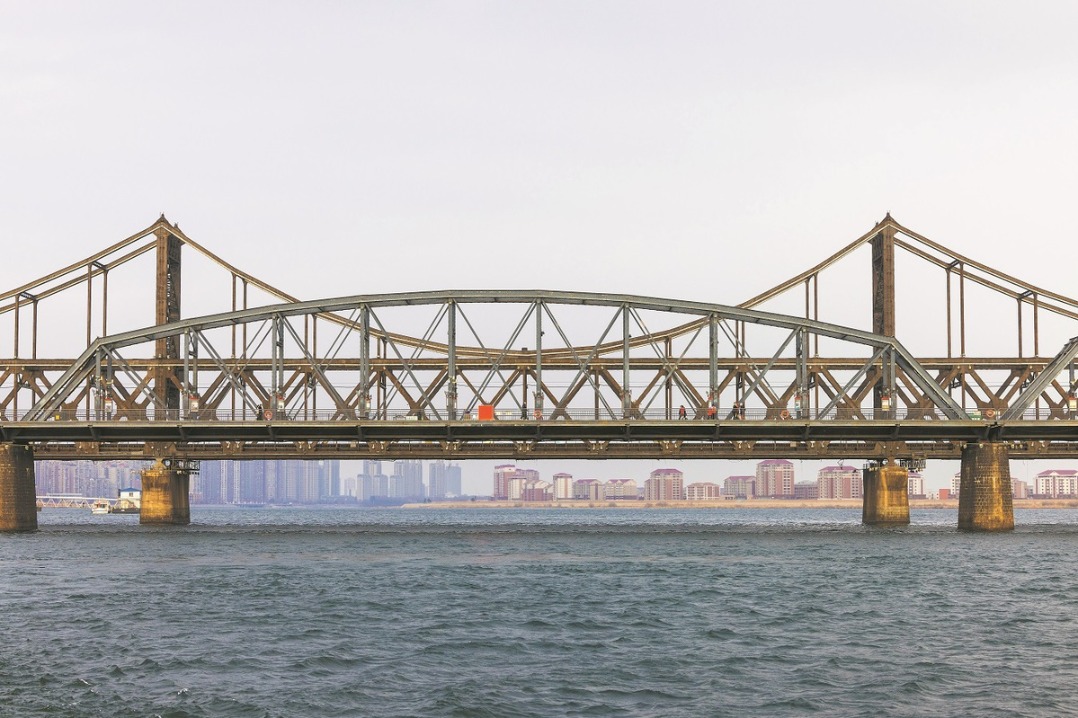
By Choi Pil-soo, professor of Chinese trade and commerce at Sejong UniversityThe Yalu and Tumen are both familiar rivers to Koreans — known locally as the Amnok and Duman, respectively — but they carry quite different associations.The Yalu serves as a major transportation corridor, and its basin is home to a large population, having undergone basic development during the Japanese occupation. Its upper reaches are home to the Supung Dam, which was once Asia’s largest. Thanks to excellent dredging, it is navigable even by large vessels.At the time of its construction, the Yalu River Bridge was a state-of-the-art structure with a rotating gate system. It was used by trains originating in Busan on their way to the larger continent.Even today, a train from Pyongyang can travel over the bridge to reach Dandong by way of Sinuiju. As vividly described in the book “The Yalu River Flows Differently” by Gang Ju-won, Dandong is a major setting for North Korea-China trade — which amounted to US$7 billion annually in 2014 — as well as a cultural anthropologist’s dream location, where the grass roots of two peoples (Korean and Chinese) and three countries (South and North Korea and China) live intertwined.In comparison with the Yalu, the Tumen is very quiet.When the Qing dynasty conceded Primorsky Krai to Russia with the Convention of Peking in 1860, its route to the East Sea was also cut off. While China was confined inland by a distance of just 15 kilometers, control over the Tumen’s mouth was assumed by Russia, which had no real interest in developing the region.Later, the same area was occupied by Japan, which deliberately drove piles into the bed to prevent navigation for military reasons. When the Korea-Russia Friendship Bridge was built in 1959, it did not reflect the same consideration for vessels as the Yalu River Bridge. The same was true for another bridge built in 2025.In effect, the inland infrastructure choked off the maritime infrastructure. Because neither North Korea nor Russia was seriously seeking to develop the region, the sights at the Tumen’s mouth remain similar to the olden days of paddling boatmen.Beyond China’s hopes for access to the sea, the Tumen’s situation also attracted the notice of the United Nations Development Programme. In 1991, the Tumen River Area Development Programme was formulated.That program would later be upgraded in 2005 into the Greater Tumen Initiative, or GTI. But the rise of the North Korean nuclear issue would lead to Pyongyang — the main party involved — pulling out in 2009, leaving the initiative in limbo ever since.It was only very recently that the isolated Tumen began showing subtle signs of change.A joint declaration adopted at a May 2025 China-Russia summit included plans for transforming the GTI into an independent international organization. Another China-Russia summit in June of this year included references to pursuing trilateral negotiations with North Korea on issues related to the Tumen. An additional China-Russia summit shortly afterward featured mention of the full-scale reopening of the “frontier trade zone.”Moscow and Pyongyang have reasons for presenting more forward-thinking stances on the Tumen’s development.Russia hopes to bring its war with Ukraine to an end and use economic development to effect a transition in its policy agenda. Promoting GTI activity would be helpful not only in terms of relations with China — which would contribute to ending the war — but also economic development in Russia’s far eastern region.North Korea, for its part, has followed up its announced completion of nuclear armament by announcing plans to modernize 20 cities and countries per year over the next decade. This puts it in the position of needing to accept help from China.Chinese tourists are especially crucial if the North hopes to promote activity at its ambitiously developed international tourism area in Wonsan’s Kalma region. Developing the Tumen could also become a source of synergy with the Rajin-Sonbong development zone in Hamgyong Province.Taken together, the current developments strongly hint at changes to come for the Tumen River. If North Korea, China, and Russia work together, the Tumen could transform into something like the Yalu.