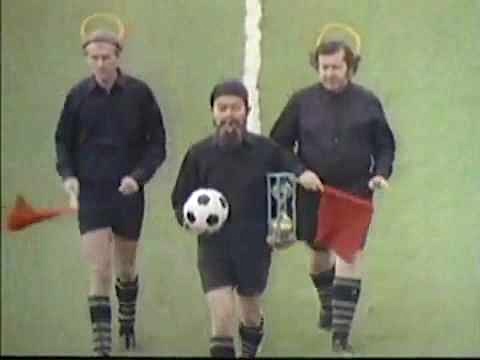
Philosophy and soccer don’t spring to mind as natural cultural bedfellows. There are notable exceptions, though. One example is the glorious Monty Python sketch, known as “International Philosophy”, featuring a match between Germany and Greece, comprising most of the best-known philosophers each country has produced. The teams are captained by Georg Wilhelm Friedrich “Nobby” Hegel and Heraclitus, with Leibniz and Plato in goals. The action is overseen by referee Confucius, himself assisted by saintly linesmen Aquinas and Augustine. Another moment of crossover that struck me was (former Manchester City and Newcastle United player) Joey Barton’s enthusiasm for citing the great men of letters in his prolific activity in the early days of Twitter, once sharing the Nietzsche quote “the demand to be loved is the greatest of all arrogant presumptions”. Given Barton’s record for violence on and off the pitch, it’s fairly clear he wasn’t a fan of people’s demands around bodily integrity either.That’s not to say there isn’t great depth of thought in soccer or association football; anything that the human population spends as much time doing and observing as football will invariably have libraries full of analysis devoted to it. One philosopher who thinks philosophy and football (and sports, more generally) belong together is David Papineau, professor of Philosophy at King’s College London. His book Knowing the Score begins with the premise that sport and philosophy are strongly mutually illuminating, and serious reflections on one often benefit the other.Papineau’s affection for the World Cup is palpable. He believes football, “an unbelievably skilful game that almost everyone has played a version of”, can make a form of excellence available to us. That the game is, in principle, extremely simple makes this excellence especially transparent. The best footballers are not drawing on much more than running, kicking and highly refined perception. But even with all the time in the world, most of us could never get a ball to submit so perfectly to our intentions as the game played at the top level requires.He says some lessons on equality are on offer too. “It brings people together and shows that any people have a right to win if they play well”. Football, despite the incredibly high salaries and a fairly notorious governing body, is one of the harder sports in which to put a finger on the scale and it has remained comparatively accessible at the higher levels. The simple demonstration of rules-based parity that international football matches provide can serve as valuable reminders, especially to populations who might see themselves as exceptional. The US, Papineau notes, doesn’t do international sport in the way most other nations do. Its biggest sport is American football, which nobody else really plays. And though it is dominant in global basketball (its second most popular domestic sport), Americans consider their own national leagues more important than international competition, which is often even framed as something of an administrative headache for the major teams.Papineau wonders if the US’s limited experience in ordinary international sporting competition might feed into some of its geopolitical issues. “Exceptionalism on the sports field encourages exceptionalism off it. A country that shies away from international sport can be tempted to stop thinking of itself as one nation among others,” he says.“A powerful section of the American right supports the exceptionalist theory that their country is entitled to bypass the rules that apply to other nations, just as they bypass those nations on the sports field. Maybe the rise of soccer in the States will in time put pressure on this exceptionalist thinking. Even if you view the United Nations as a tiresome constraint on your world power, it is hard to take the same attitude to the World Cup.”Here’s hoping.[ Ireland vs England in philosophy: Who would win a World Cup of ideas?Opens in new window ]Other philosophers have taken a very different attitude to international football. George Orwell maligned a culture of “blah-blahing about the clean, healthy rivalry of football”, suggesting that “serious sport has nothing to do with fair play. It is bound up with hatred, jealousy, boastfulness, disregard of all rules and sadistic pleasure in witnessing violence: in other words it is war minus the shooting.”Noam Chomsky was equally scathing, dismissing sport as “an area which has no meaning and probably thrives because it has no meaning, as a displacement from the serious problems which one cannot influence”. Papineau thinks this is snobbery, plain and simple, and does little more than demonstrate that these individuals have had no personal experience of the joy and profundity available from athletic achievement.And perhaps there is no better moment than now to appreciate these two polarities of football. In the months leading up to the tournament, scepticism predominates: this time, we say, we won’t pay it much attention, citing our distaste for the government of the host country, the corruption of the governing body, or the general flavour of moneyed spectacle. But as things move to the knockout stage, we – or at least I – cannot help being drawn in by the excellence on display, the stories, the passion of the supporters, the grand narrative of nations competing in a forum where any hierarchy can be overturned, where Paraguay can overcome Germany and the Democratic Republic of Congo can come agonisingly close to ejecting England.For some, it will remain a pointless, thuggish distraction; for others, it’s everything, a defining passion of their lives. For my part, I’ll keep watching. Clare Moriarty is a Research Ireland Enterprise Fellow, working at University College Dublin and the National Library of Ireland
Clare Moriarty: If you think football is ‘just football’, you’re missing out
Unthinkable: For some, football is a pointless, thuggish distraction; for others, it’s everything
927 words~4 min read