Skip to content
When light reflects off a surface, not all of it reflects off at the same wavelength; some photons impart a portion of their energy to raising the vibrational energy of the surface’s molecules, and are thus scattered away at a lower energy and longer wavelength. This is called Raman scattering, and the precise wavelength shifts are characteristic of the particular molecule being illuminated. It can therefore be used in Raman spectroscopy to identify molecules; these spectrometers are normally elaborate, expensive instruments, but [Allegedly Science] was able to build a simple system with surprising sensitivity.
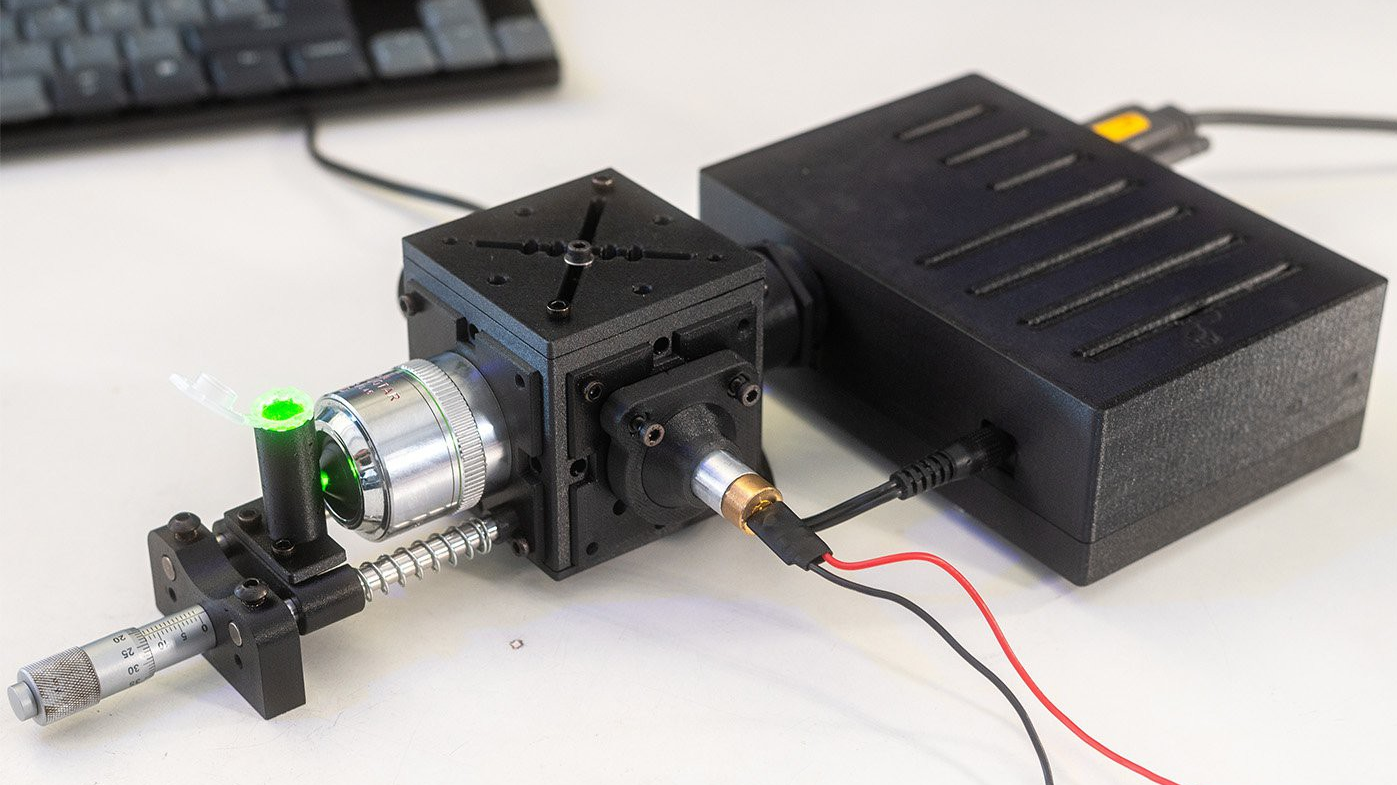
The system is named the CubeRaman, after the cube-shaped body containing the main optical path. It uses a cheap 532-nm laser module as a monochromatic light source, with a bandpass filter to eliminate stray infrared light. The beam then reflects off a 45-degree dichroic mirror and passes through a microscope objective onto the sample. Raman-shifted light then scatters back through the objective, passes through the dichroic mirror and a long-pass optical filter, and is focused by an achromatic lens onto the slit of a spectrometer. The entire housing is 3D-printed, as are most parts of the kinematic mounts; the kinematic mounts use adjustment screws running through inserts in the mount, with the tips of the screws held in place by magnets.