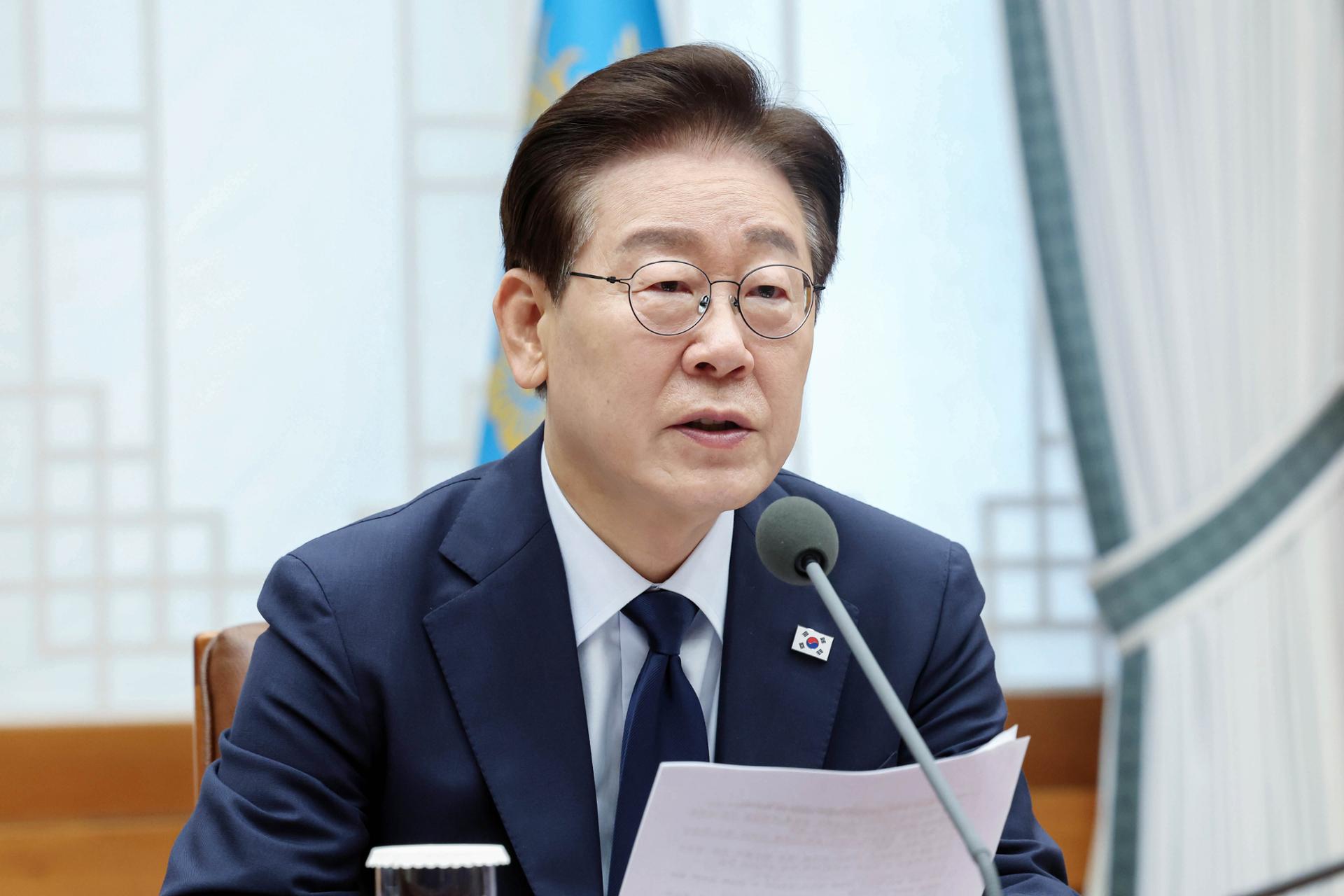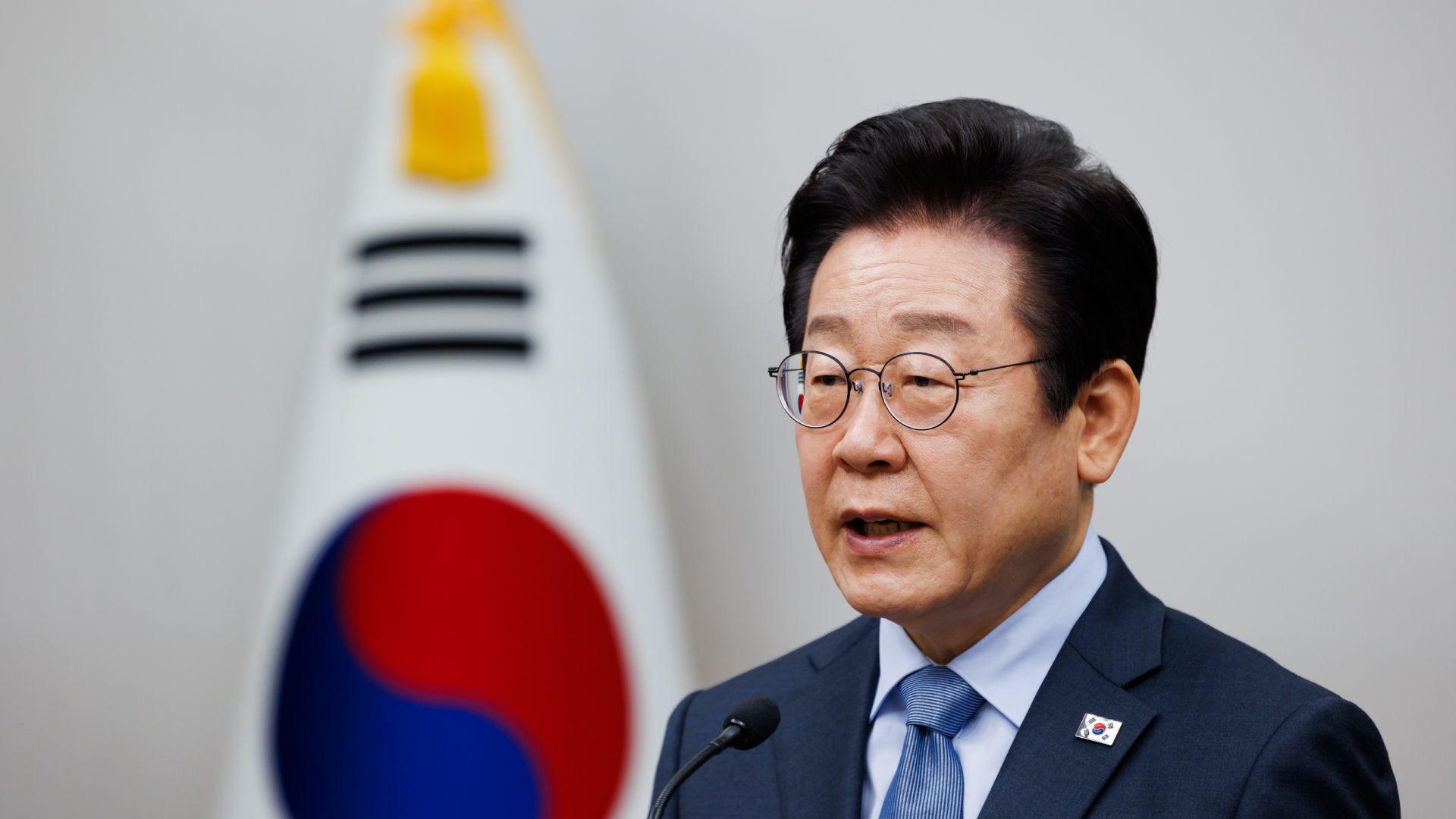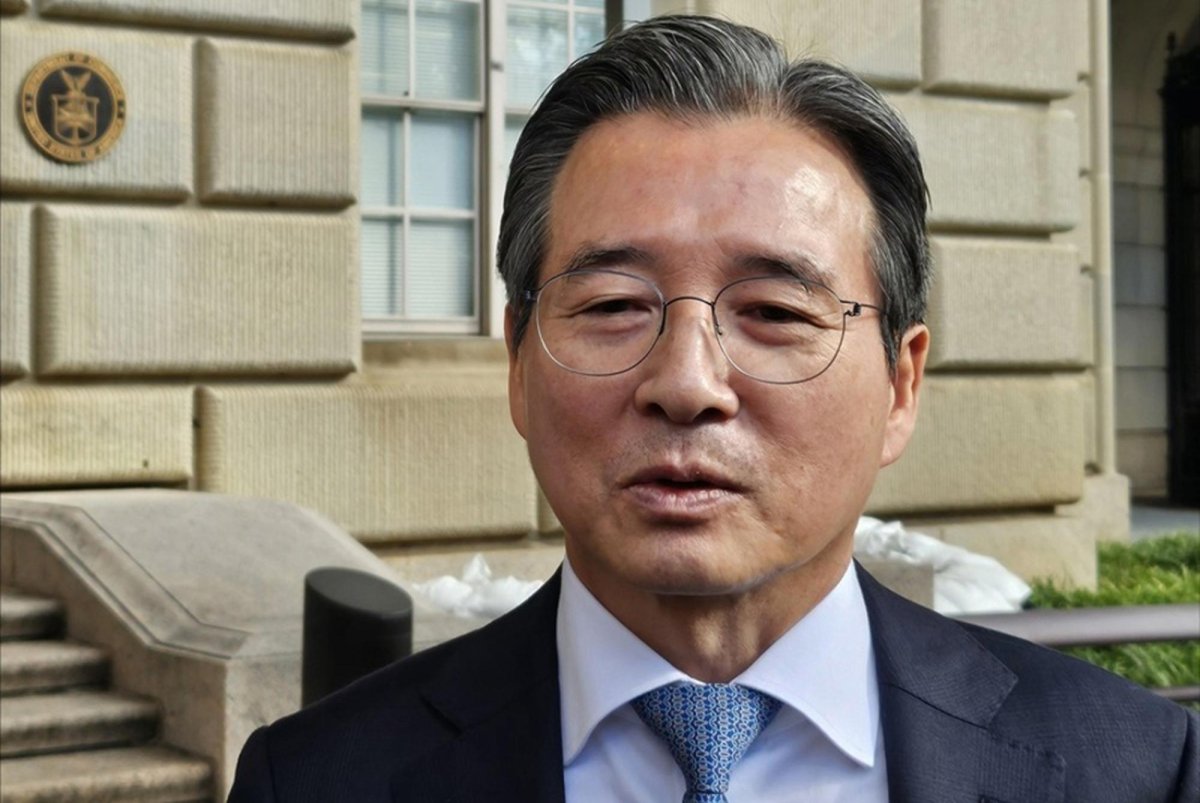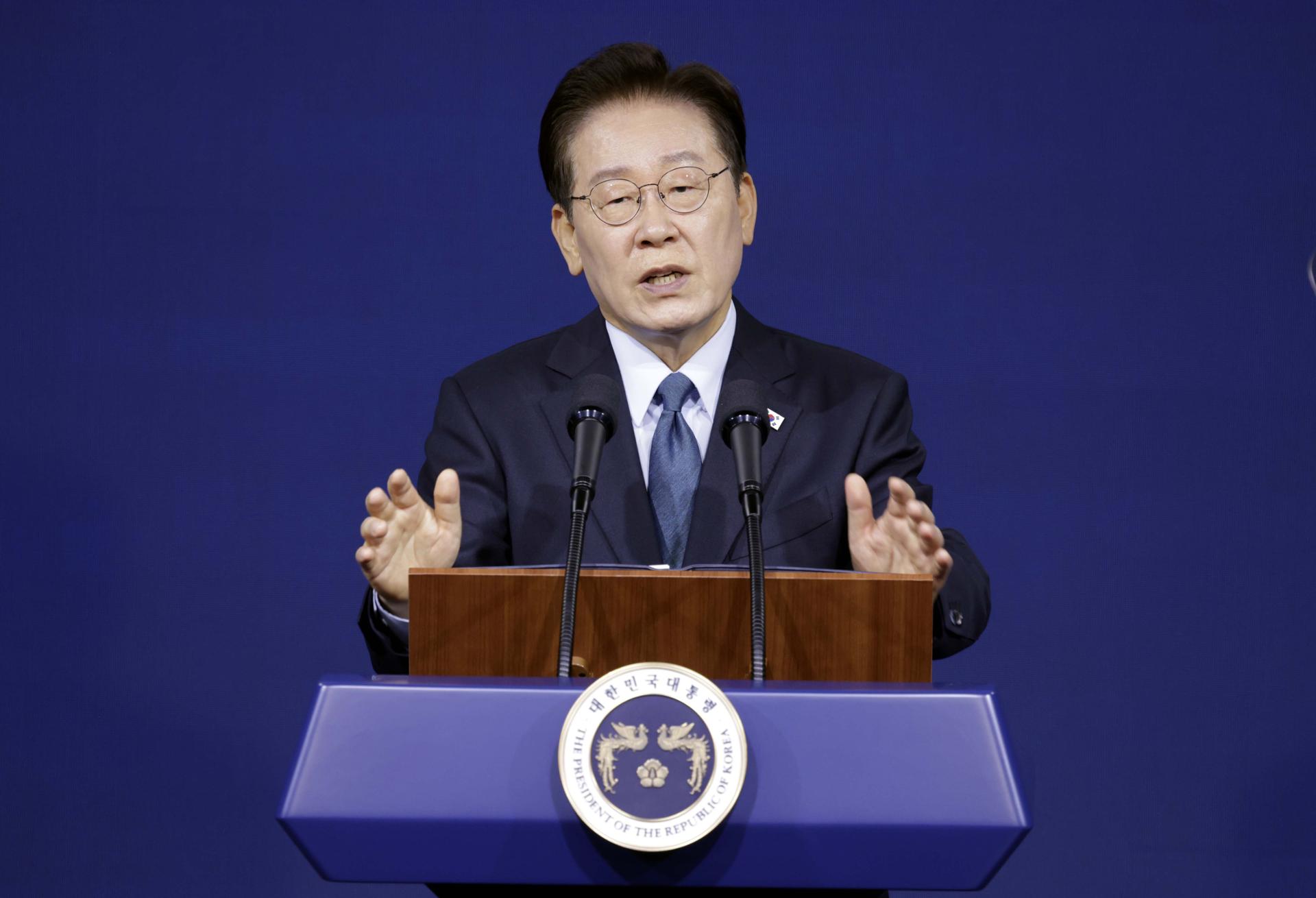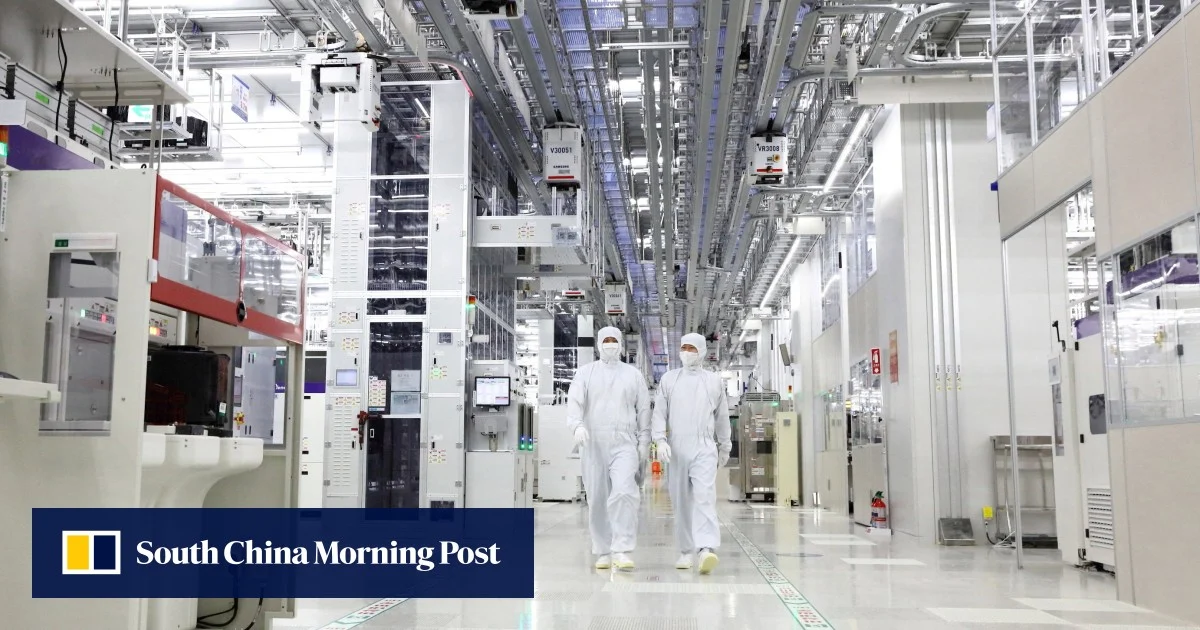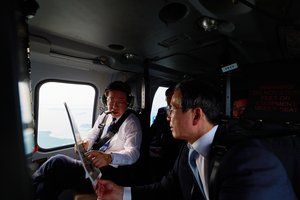
President Lee Jae Myung talks with presidential policy chief Kim Yong-beom during an aerial inspection of candidate sites for an industrial complex in South Korea’s southwestern region on June 30. (Cheong Wa Dae via Yonhap) Cheong Wa Dae is positioning President Lee Jae Myung’s three mega projects — spanning semiconductors, AI data centers and physical AI — as a state-led strategy to build South Korea’s production base for the AI era, amid growing criticism from the opposition bloc.The presidential office has rejected criticism that the projects are political showpieces for favored regions, saying they are instead a plan to build the national production system behind AI — from power and water to chips, data centers, supply chains and skilled professionals.Kim Yong-beom, President Lee’s chief policy adviser, said Sunday that the role of the state in the AI era “becomes even greater.” This includes building production infrastructure, reproducing production capacity and channeling production gains back into future growth, he added.“Companies can build AI,” Kim wrote in a Facebook post. “But building power grids, creating industrial sites and organizing supply chains are the work of the state.”Kim underlined that the current industrial policy “is not about the state running the market in its place,” but about “organizing the entire country into a single production platform.”“The essence of AI does not lie in a more advanced algorithm. It lies in creating a new mode of production, changing the balance of the macroeconomy and redefining the role of the state," Kim said."The AI production revolution will make the country that organizes the most advanced production system the center of the next era," he added.The opposition bloc has ramped up criticism of the Lee administration’s investment roadmap, first unveiled on June 29, which centers on large-scale private-sector investment in regional industrial hubs beyond the greater capital area.The plan includes 896 trillion won ($585.6 billion) in investment for the southwestern region, led by Samsung Electronics, SK hynix and Amkor Technology Korea; about 392 trillion won for the central Chungcheong region, involving Samsung, SK hynix and Celltrion; and 312 trillion won for the southeastern Yeongnam region, with participation from major conglomerates including Hanwha, Hyundai Motor Group, Samsung, SK, Doosan and LG.Opposition parties have accused the administration of using the projects as political showpieces, arguing that they disproportionately benefit politically favorable regions, particularly the southwestern Honam region, a long-standing stronghold of the ruling Democratic Party of Korea.The People Power Party on Sunday criticized the government’s mega projects as a “hollow fireworks display,” saying the administration should prepare measures to respond to a downturn in the semiconductor cycle.“The government and the ruling party must immediately stop misleading public opinion with mega projects that have no substance,” Rep. Choi Bo-yun, the party’s senior spokesperson, said in a statement.Choi added that the Lee administration should carry out a “full reestablishment of effective measures to respond to the semiconductor downturn cycle.”Rep. Na Kyung-won pointed out that the mega projects were announced after the June 3 local elections and before the Democratic Party of Korea’s Aug. 17 national convention to elect a new party leader.“Had the administration announced astronomically large investments concentrated in a particular region before a nationwide election, it would obviously have faced fierce backlash from other regions,” Na said Sunday.Na further claimed that the mega projects were “brought out in line with the Democratic Party convention schedule, where party members from a particular region account for an overwhelming share.”“It is a deceptive political show,” Na said.President Lee, however, wrote on X on Saturday morning, “If the three mega projects were a political means to manage approval ratings, we would have started them before the local elections.”The People Power Party rejected Lee’s rebuttal.“President Lee’s push to channel semiconductor investment into Honam is nothing more than a typical politically driven quick fix, with political calculations taking precedence over industrial competitiveness and market logic,” Rep. Park Sung-hoon, the People Power Party’s senior spokesperson, said in a statement.Ha Joon-kyung, senior presidential secretary for economic growth, countered that criticism by framing the projects as a broader industrial strategy to reorganize South Korea’s production base for the AI era, not regionally motivated spending.“If the industrialization of the Park Chung-hee era was the first industrialization, this is now the second industrialization,” Ha said Saturday on the Roh Moo-hyun Foundation’s YouTube program.He further explained that “the past was unbalanced industrialization, but this time it is balanced industrialization.”“While past industrialization was a catch-up model aimed at following advanced countries, this time it is a leading model in which Korea moves ahead.”
Lee’s office says AI era demands ‘bigger state role’ amid mega project backlash
Cheong Wa Dae is positioning President Lee Jae Myung’s three mega projects — spanning semiconductors, AI data centers and physical AI — as a state-led strategy
753 words~3 min read