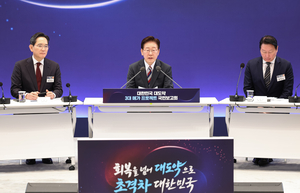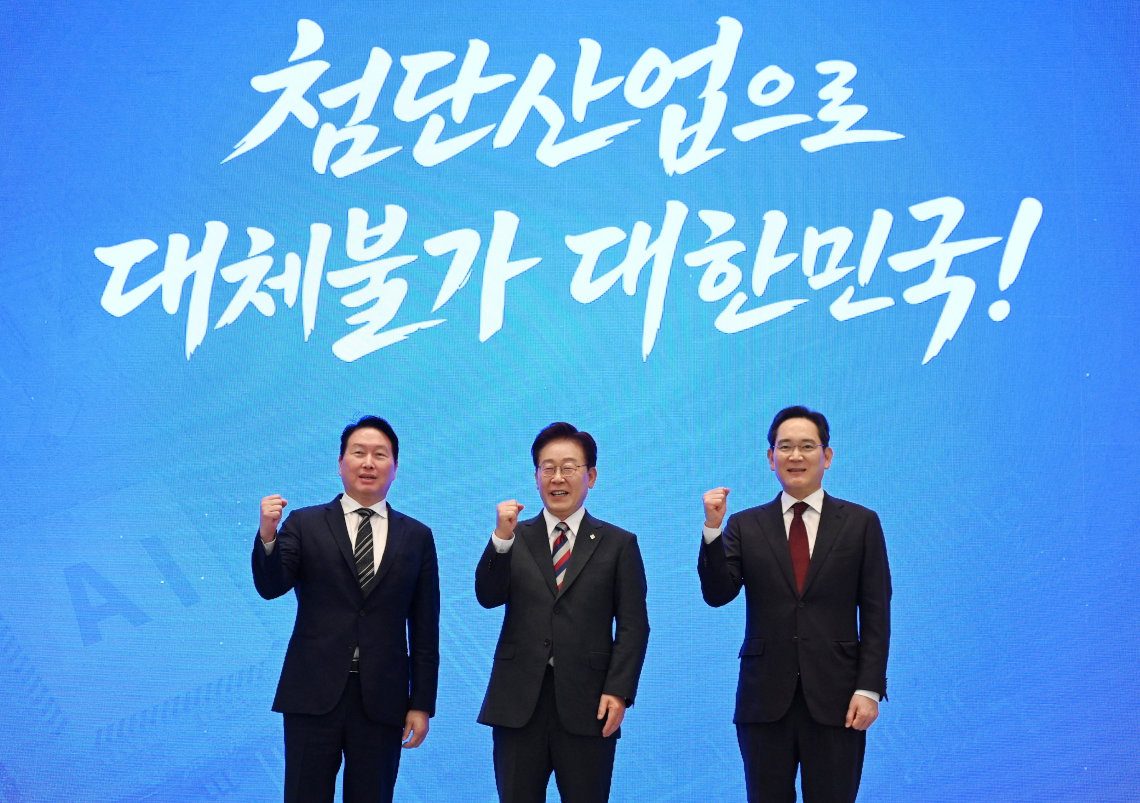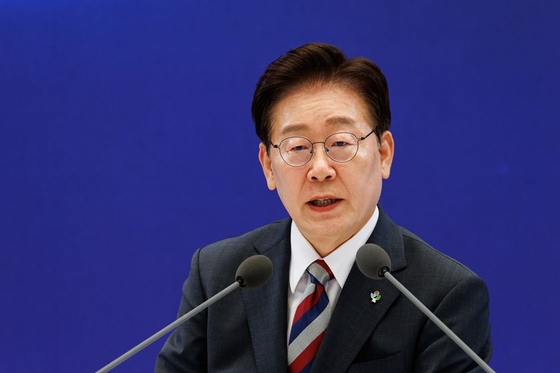
President Lee Jae Myung (center) joins hands with SK Group Chairman Chey Tae-won and Samsung Electronics Chairman Lee Jae-yong at an announcement of three “megaprojects” from the Blue House on June 29, 2026. (pool photo)
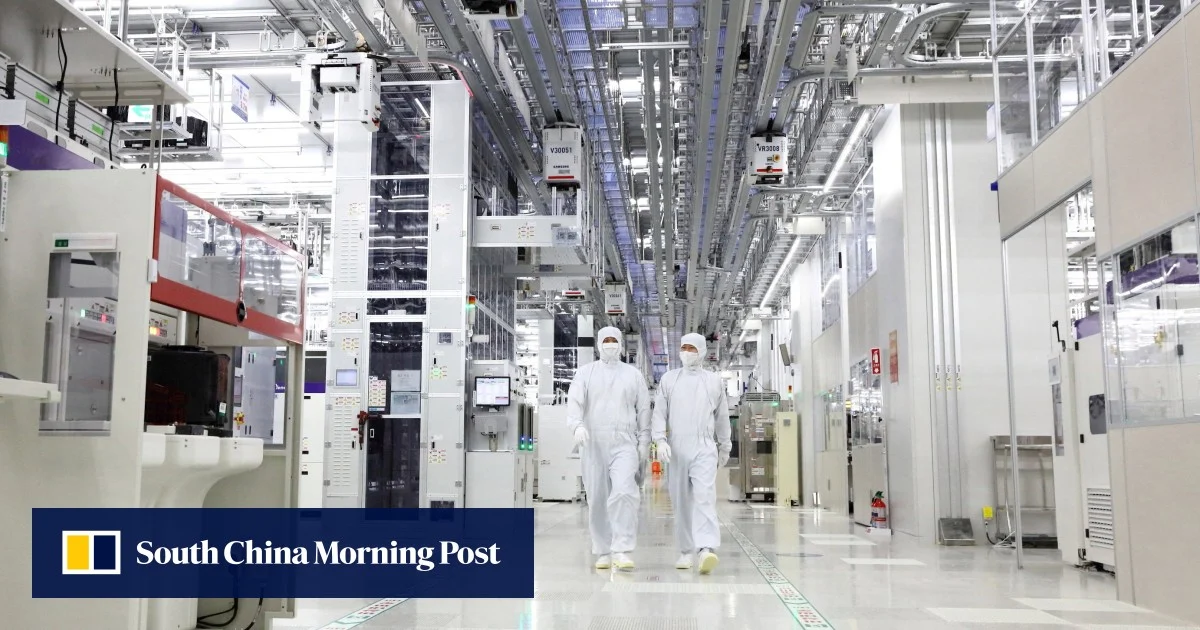
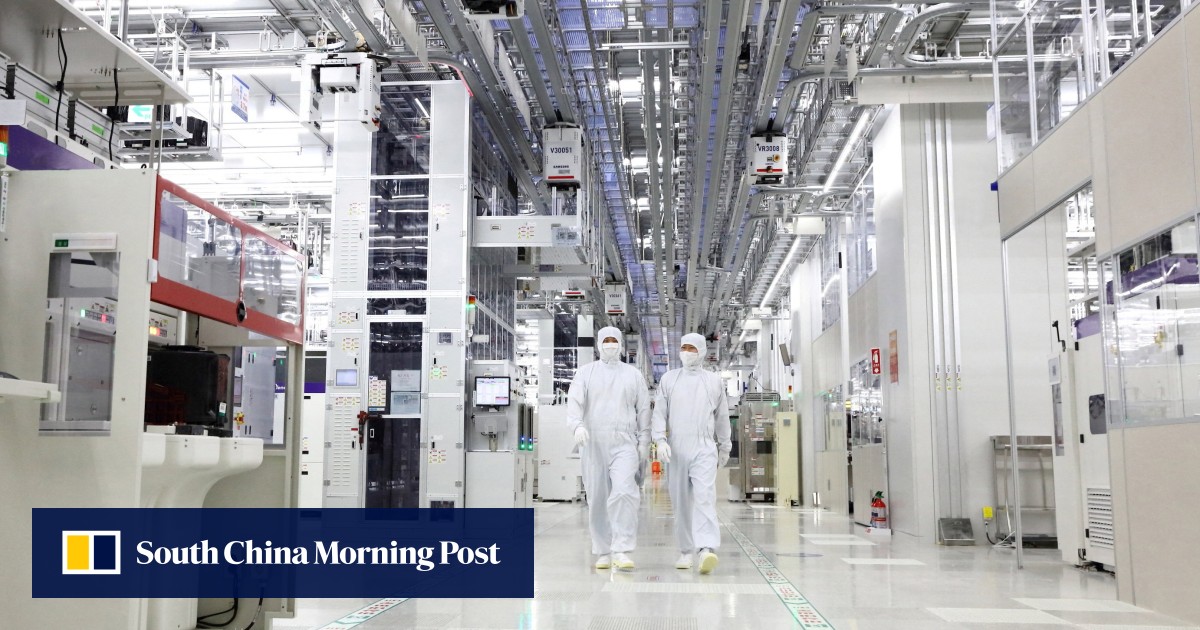
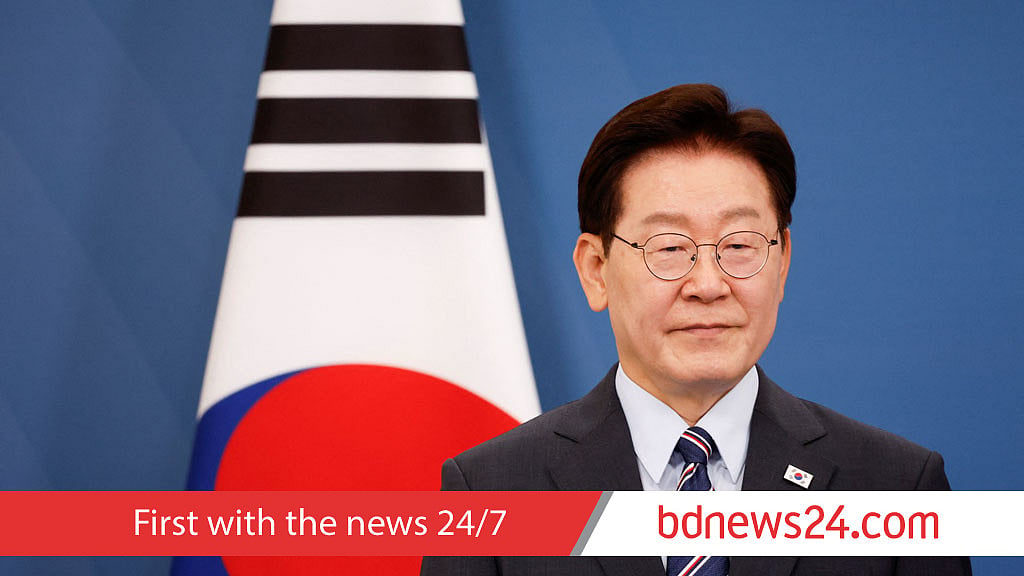
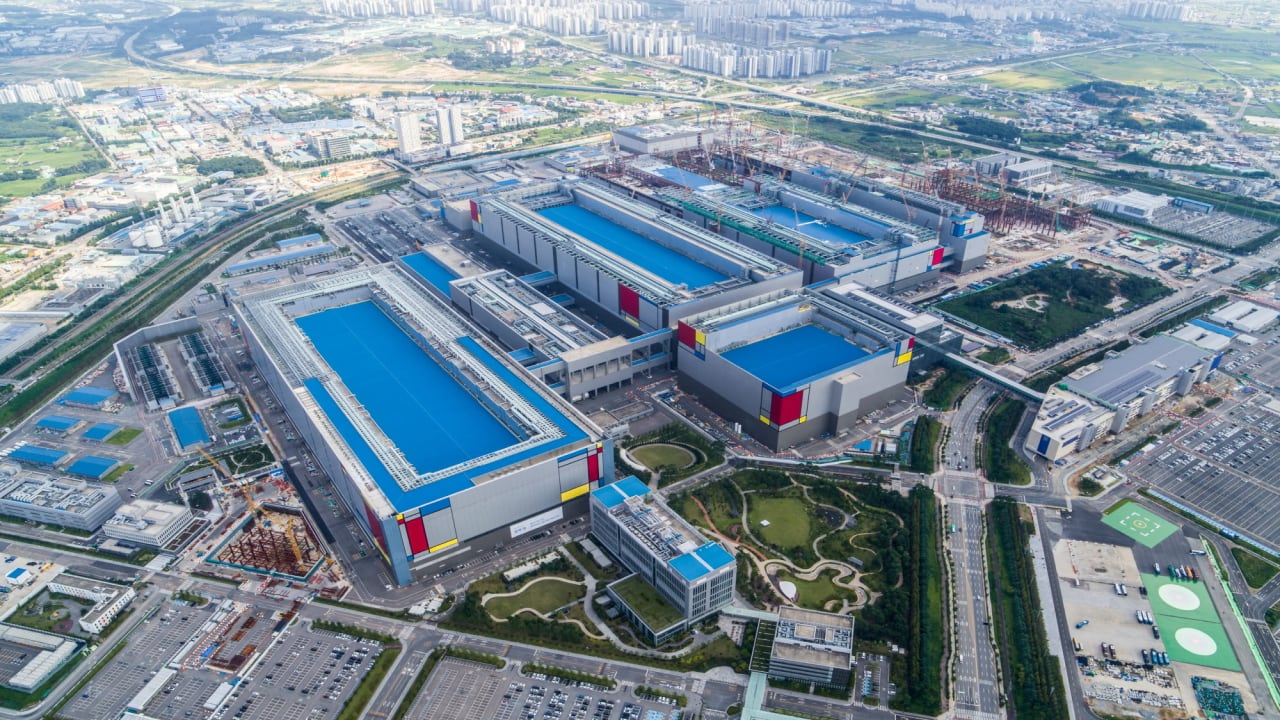
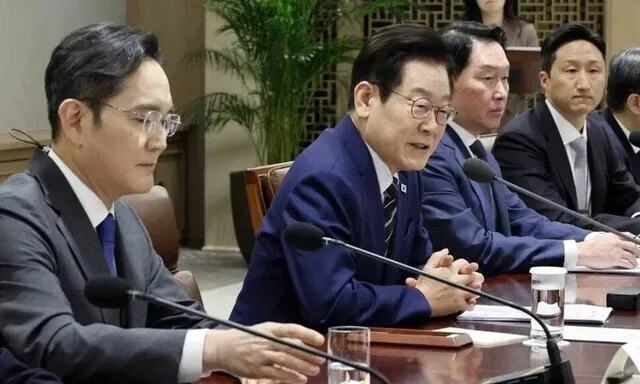
President Lee Jae Myung on Monday said the country’s three “megaprojects” spanning semiconductors, artificial intelligence data centers and physical AI will shape Korea’s economy over the next 20-30 years. The Blue House called the three ventures the Lee administration’s “signature projects” and pledged to fully utilize the nation’s resources to pursue them.Lee views these three projects as essential to securing Korea’s dominance in future growth engines such as chips while simultaneously achieving balanced national development, which he called a “core survival strategy” for the country. In a televised briefing on the ventures, the president stressed the crucial nature of taking this quantum leap to becoming a “super gap industrial power” — that is, an uncontested powerhouse in key advanced technologies. “This will be the starting point for achieving this momentous task,” he said. The emphasis on the goal of becoming such a powerhouse reflects the administration’s intent to secure a competitive edge in chips amid the AI transformation, which is now part of the global technological competition.This aligns with the administration’s long-standing strategy for balanced national development through the designation of five mega-regions and three special autonomous provinces.“During our industrialization, scarce resources forced us to adopt a policy of concentration in the Seoul capital region. In today’s terms, this was the adoption of a so-called ‘all-in’ strategy,” the president said. “But inefficiency due to overconcentration has recently intensified, pushing the capital area toward the verge of explosion and the provinces toward the brink of extinction.”The president also pledged his support for the setup of a second semiconductor base in the country’s southwestern region, known as Honam.“The Honam region has long been marginalized in development, but this actually creates a potential opportunity,” he said. “The southwestern coast has abundant water resources, particularly abundant renewable energy.”The same day, Samsung Electronics and SK Group announced a combined investment of 800 trillion won (around US$517 billion) to build four memory fabs in Honam.Pundits say the project could be a make-or-break moment for the Lee administration. Given the large-scale private investment needed, the pace of execution and the extent to which tangible results are achieved will inevitably affect the administration’s ability to pursue its policy agenda going forward. This is also considered a bold move by the president as he enters his second year in office.Kang Hoon-sik, the Blue House chief of staff, said Monday, “The three mega-projects are signature initiatives representing the administration as well as historic tasks, so we are firmly determined to ensure their success.”The president said he would personally take the helm to drive the projects forward, pledging to name a dedicated official within the presidential office to directly oversee operations to ensure swift execution.“You’ll see President Lee personally and frequently check on the projects’ progress,” Kang added. “Once the special act on semiconductors takes effect in August, a special committee on increasing semiconductor competitiveness chaired by the president is scheduled to launch.”In addition, Samsung Electronics Chairman Lee Jae-yong and SK Group Chairman Chey Tae-won on Tuesday are set to announce their respective investment plans in Gwangju, the country’s No. 6 city. The Samsung chairman on Thursday will also host an investment briefing at Samsung Display’s plant in Asan, South Chungcheong Province.“What companies want isn’t empty verbal promises from the government, but semi-permanently institutionalized support measures — such as special laws or designation of special zones — to ensure this policy’s sustainability beyond this administration,” said Kwon Seok-joon, a professor of chemical engineering at Sungkyunkwan University in Seoul. “Various infrastructure like the supply of electricity and industrial water, human resource training, creation of livable conditions and development of housing districts must be set up simultaneously,” he added. “To do this, the complex institutional hurdles entangled across government ministries must also be resolved.”By Seo Young-ji, staff reporter; Jeong Hye-min, staff reporterPlease direct questions or comments to [english@hani.co.kr]