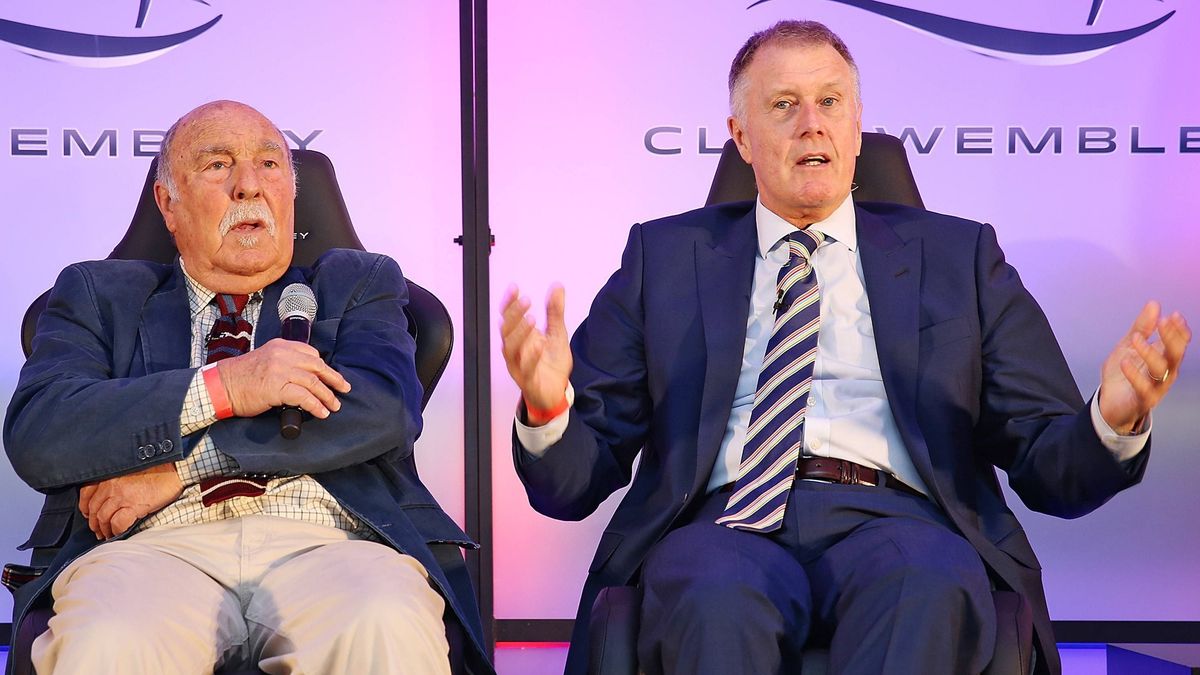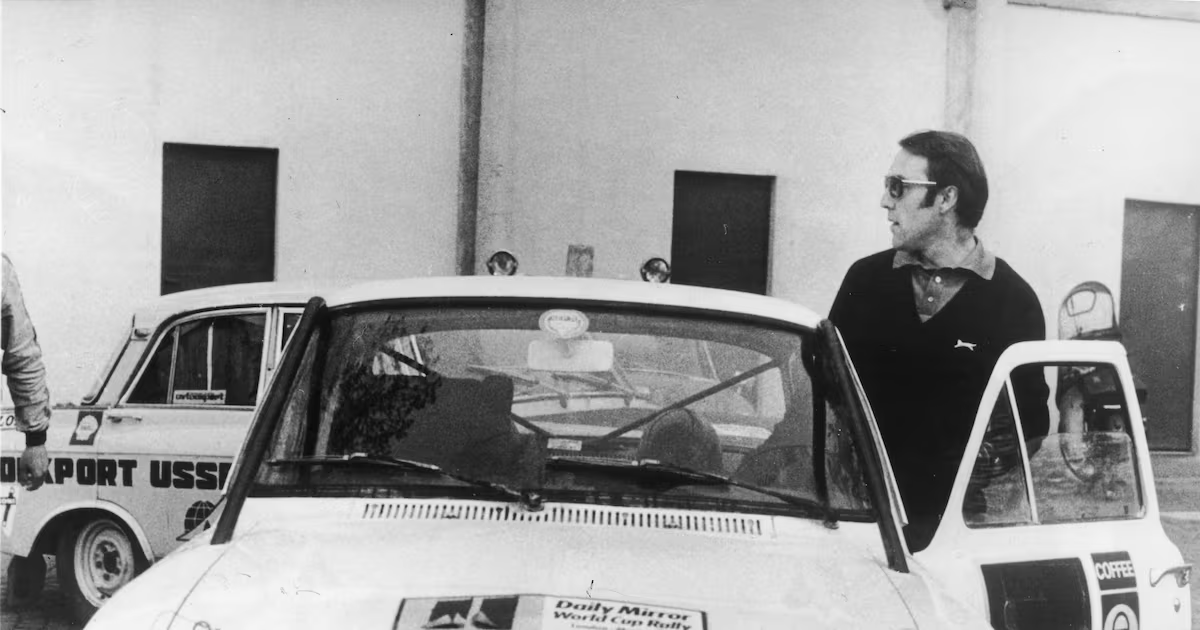
On April 19th, 1970, Alf Ramsey and Bobby Moore were at a quarter-full Wembley Stadium and there was not a football in sight. The England manager and his captain were participating in a symbolic ceremony, a weird take on the passing of the Olympic flame, where they placed recently dug-up pieces of the famous turf in the trunks of cars about to participate in the 16,000-mile (25,750km) London-to-Mexico World Cup Rally. As official starter, Ramsey then waved a giant Union Jack and flagged the 96 vehicles away at two-minute intervals.The loudest cheer of the day greeted the departure of a Ford Escort GT 1850 Mark 1 driven by Tony Fall and Jimmy Greaves. At just 30 years old, his international career having already been ended by Ramsey, Greaves opted to take this rather circuitous route to attending the tournament. The curious 1970s equivalent of Harry Maguire working on a podcast because he wasn’t picked. Through pals of his working at Ford in Dagenham, the Londoner had been inveigled to participate in this nice little earner, dreamt up by the car company’s marketing department and sponsored by the Daily Mirror. Just a month earlier, Bill Nicholson called time on the striker’s flagging Spurs career by sending him to West Ham United in a deal that saw Martin Peters move to White Hart Lane. The manager thought he had been distracted by his new hobby; the player always argued he only got serious about driving after being dropped.“It was probably my first big step towards retirement,” Greaves said. “Football was pushed down my list of priorities and I began to think more and more about making a complete break from the game. I took the rally so seriously that Bill Nick read it as a sign that I was losing my appetite for football.”Instead of preparing to defend the Jules Rimet Trophy alongside Moore, Geoff Hurst et al, Greaves took his place alongside a host of the world’s best rally car drivers, including Ireland’s Paddy Hopkirk and Rosemary Smith, and a slew of celebrity participants like Prince Michael of Kent. All were going to spend five weeks traversing continents and oceans competing for a first prize of £10,000. Fall, a serious contender, had been persuaded to team up with Greaves and train the neophyte properly for the task by Ford offering him and his wife a two-week holiday in the Caribbean. The Austin Maxi car drove by Prince Michael of Kent, Gavin Thompson and Nigel Clarkson at the starting line of the 1970 London-to-Mexico World Cup Rally at Wembley Stadium. Photograph: Evening Standard/Hulton Archive/Getty Images “They introduced us and we got on very well, but before we started planning for the World Cup Rally, we went on a short trip in the car to Yugoslavia to see if we could get on over a long period of time,” said Fall. “It was here I realised just how famous Jimmy was. My first taste of his celebrity came just after we set off for Dover. We got to the docks and the car was mobbed as soon as people realised who was in it. Even the customs office emptied.”Although Greaves wrote a piece for The Sunday People detailing how many pairs of disposable paper underpants he was bringing, the World Cup rally was a serious affair. Apart from one car getting stopped for speeding almost as soon as it departed Wembley, the rest sailed from Dover that day and began criss-crossing Europe. There were stops in France, Germany, Austria, Hungary, Bulgaria, Yugoslavia, Italy and Spain before they sailed for the southern hemisphere from Lisbon. On some of the more arduous off-road legs, Greaves had to go 55 hours without sleep.In a way, that will be familiar to one-time readers of Martin’s Marvellous Mini, the Tiger comic strip. The epic nature of the event caught the public imagination, daily newspapers across the world tracking the progress of teams driving everything from Rolls-Royce Silver Shadows to Vauxhall Victors to Porsche 911s. A British Leyland 1800 entry carrying three female journalists from Woman magazine was dubbed the “Beauty Box”. Other distaff drivers were labelled “bird drivers”.By the time the crews sailed from Buenaventura, Colombia to Panama City on May 22nd, Fall and Greaves were in an impressive sixth place, 10 hours behind the race leader and eventual winner, the Flying Finn Hannu Mikkola. Embarking on the final 2,000-mile run to the Azteca Stadium in Mexico City, just 26 of the original cars, including Smith in her Austin Maxi that won the women’s classification, remained.Drivers Alice Watson, Ginette Derolland and Rosemary Smith of the Evening Standard team ahead of the London-to-Mexico World Cup Rally in 1970. Photograph: Evening Standard/Hulton Archive/Getty Images Of course, as Greaves was fixing punctures 12,000 feet above sea level in La Paz, his former England teammates had been encountering problems of their own. Upon arriving in South America for their title defence, scandal beset their preparations when Moore was arrested in Bogotá, Colombia and accused of stealing jewellery. Following an international incident and the intervention of UK prime minister Harold Wilson, he eventually made it to Mexico City for the tournament.“Mooro wouldn’t take a liberty, never mind a bracelet,” said Greaves, when asked about the story by reporters.Once he and Fall crossed the finish line in sixth place, Greaves went boozing and decided to find his old pal, by then domiciled in a secure house belonging to the British Embassy. Through the years, he spun various yarns about how he got past security. Shimmying up a tree. Clambering over a wall. Jimmying some French windows. Sometimes all of the above. Each version culminated in happening upon Moore, tracksuited, drinking a lager and reading a newspaper, and immediately asking him, “Where did you hide the bracelet?”World Cup Wallchart
Jimmy Greaves’s 25,000km spin to Mexico in 1970 puts England’s challenges into perspective
The famous striker knew his playing days were winding down when he agreed to take part in the World Cup Rally
964 words~4 min read