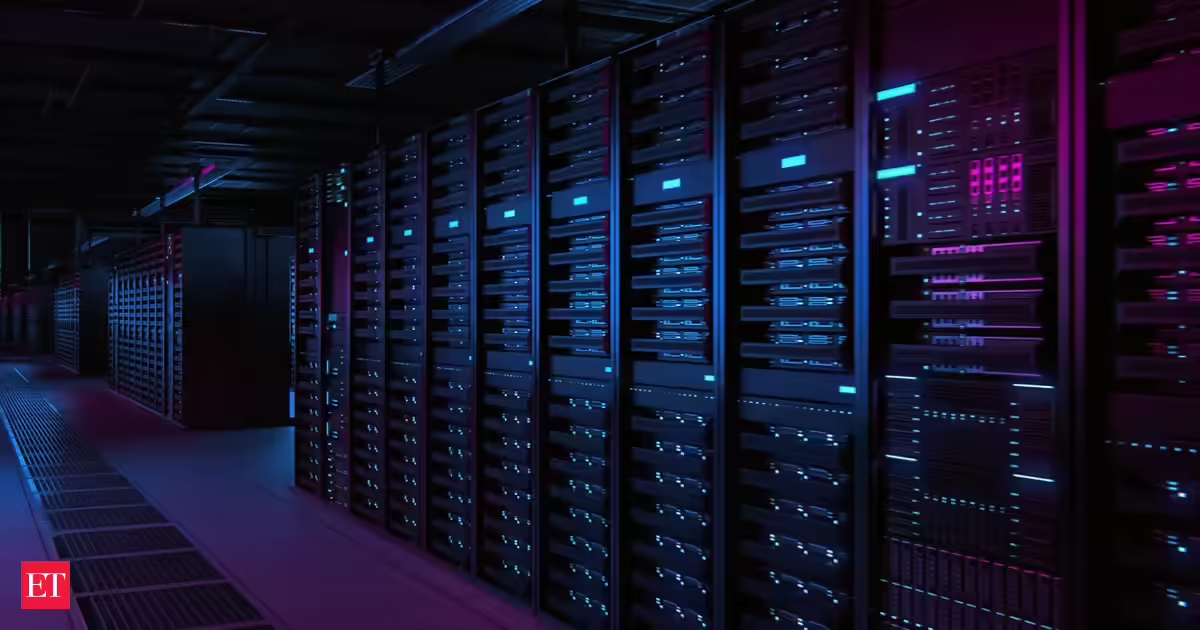
For the last decade, the tech world has been obsessed with feeding massive static datasets into larger and larger models. It worked brilliantly for classifying images and generating text. But when you step onto an industrial R&D floor, the limitations of pure, data-driven AI become glaringly obvious.AI (iStock)We don't operate in a world of static datasets. Whether we are balancing the volatile charge/discharge cycles of a utility-scale battery energy storage system or managing dynamic grid loads, the physical environment is chaotic and unforgiving. Let's be clear: in these domains, prediction isn't enough. We need control.This is where the industry is now putting their money. Since last few years, engineers and scientists are connecting the hype of machine learning with the rigorous, time-tested principles of control engineering and reviving the theme industrial cybernetics. Machine learning is fantastic at pattern recognition and mapping the kind of messy, non-linear system behaviors that traditional physics-based models struggle to capture. But you simply cannot let an unconstrained neural network manage megawatt power flows or aerospace actuators. Control theory—state machines, feedback loops, and stability criteria—provides the essential guardrails. We are moving toward a hybrid intelligence where ML identifies the patterns, but control engineering ensures the system doesn't tear itself apart.This necessary convergence is why digital twins have finally transitioned from a marketing buzzword to a critical piece of engineering infrastructure. And I'm not talking about a pretty 3D dashboard. I mean high-fidelity, computational surrogate models built through rigorous system identification. By continuously fusing live sensor data with underlying physics, we can simulate an asset's behavior throughout its lifecycle. We can safely push a system to its theoretical limits, simulating thermal runaways or mechanical failures in a virtual space long before the hardware ever sees the field.But here is the catch that the software-only crowd often misses: embedding this intelligence into the physical world is an absolute beast computationally. Autonomous systems operate under strict, millisecond-level time constraints. You are simultaneously processing massive sensor streams, running predictive simulations, and executing real-time control actions. That requires serious iron. Advanced, accelerated computing infrastructure is no longer just an IT concern; it is the fundamental bottleneck for R&D innovation.This is why Hardware-in-the-Loop (HIL) validation and testing are still the backbone of modern-day testing and validation frameworks. HIL simulators take the actual physical controllers, trick them into thinking they are connected to the real-world asset using digital twin based on low-rank approximation of high-fidelity simulation models, and hit them with extreme edge-case scenarios. It is the only way to transition theoretical AI behaviors into deployed, safe industrial systems without risking millions of dollars of equipment.Ultimately, the next frontier in AI isn't going to be a single algorithmic breakthrough in a server farm. It will be defined by the engineering ecosystems we build—the high-performance computing, the HIL rigs, edge, on-prem, fog and cloud computing resources along with the surrogate models, digital twins —that allow us to seamlessly merge code with steel. We must stop thinking like software developers writing isolated scripts, and start thinking like system engineers building autonomous, physical machines.(The views expressed are personal)This article is authored by Rishi Relan, Siemens Energy India Limited, Gurgaon and Manisha Saini, BML Munjal University, Gurgaon, India.
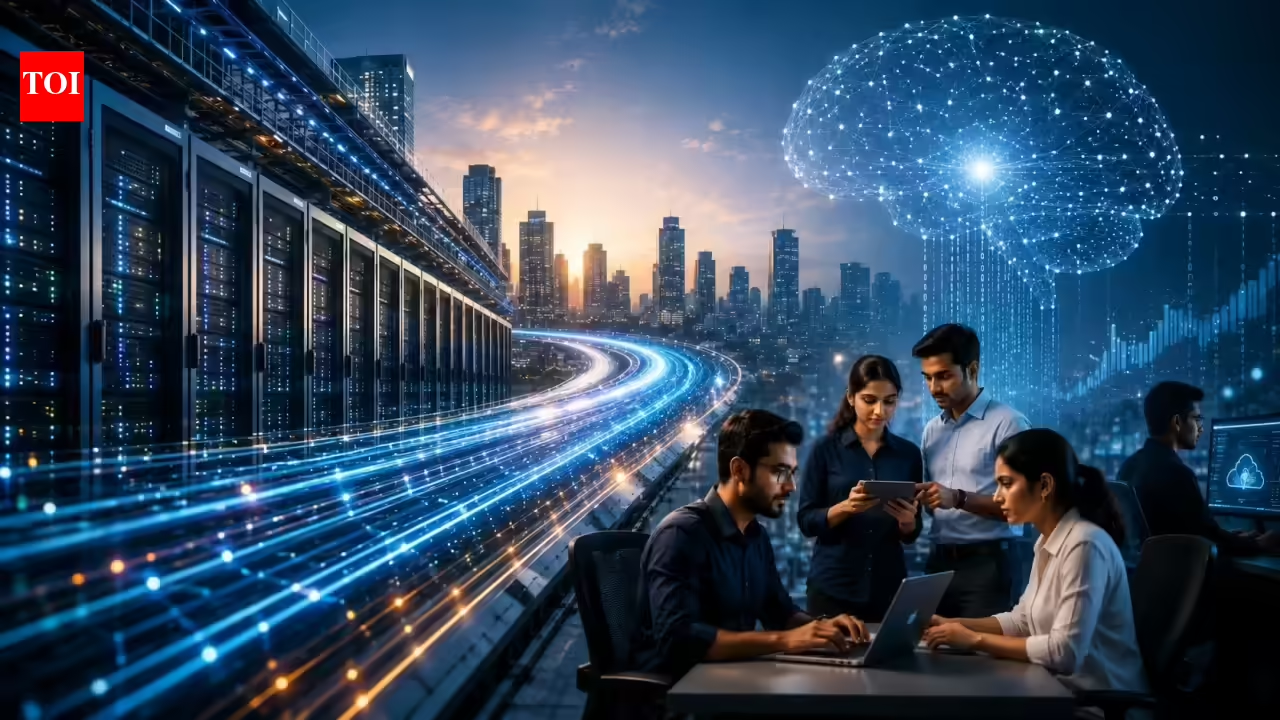
AI infrastructure is powering the next research frontier
This article is authored by Rishi Relan, Siemens Energy India Limited, Gurgaon and Manisha Saini, BML Munjal University, Gurgaon, India.
531 words~2 min read