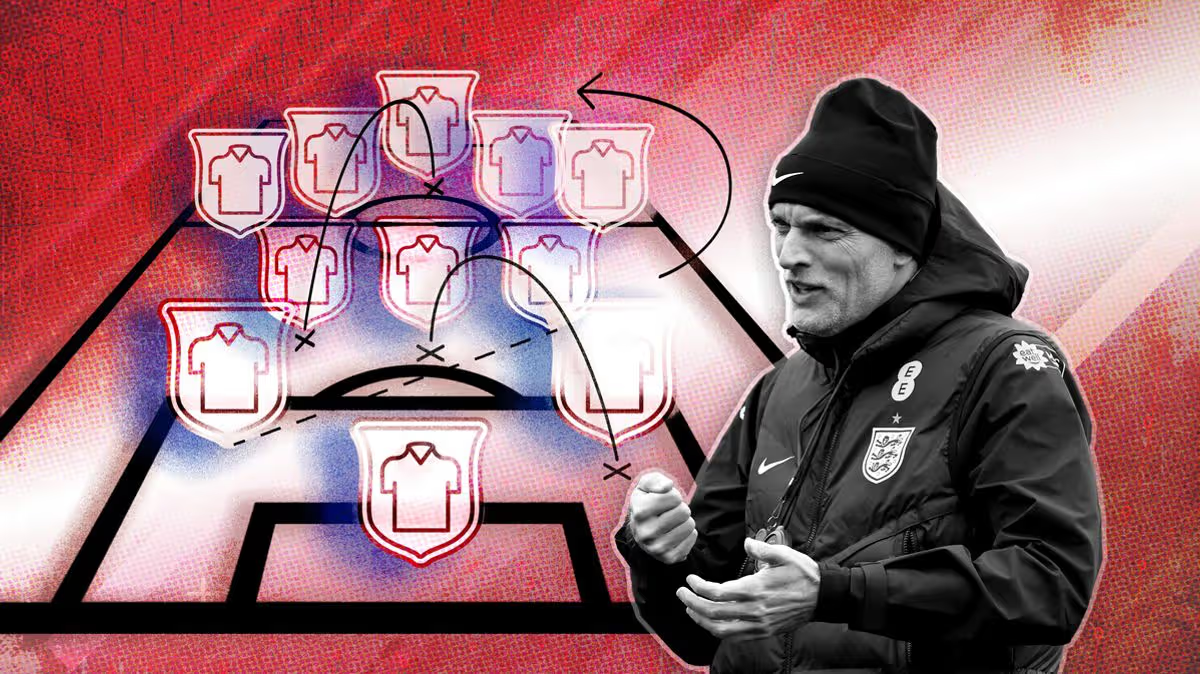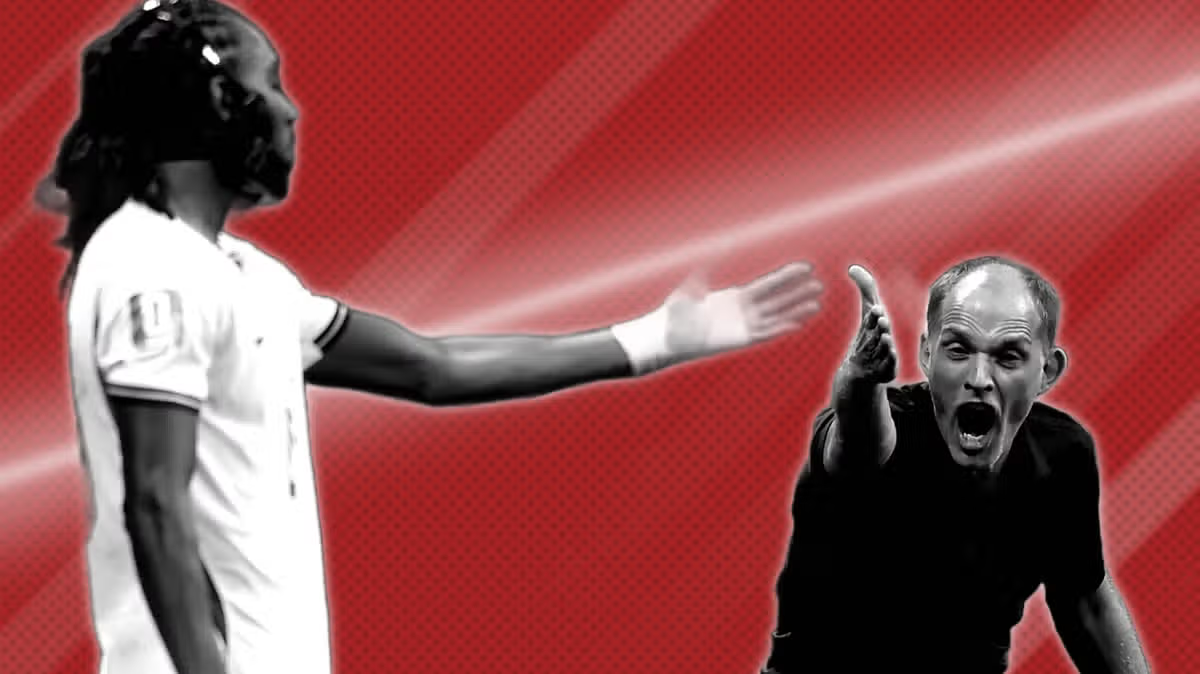
Take yourself back to the end of May - before the World Cup, before that thrilling victory over Croatia, before the underwhelming England performances that have followed. Doesn't it feel like a lifetime ago?Thomas Tuchel was fielding questions from the media after the announcement of his chosen 26 players to represent the Three Lions in North America had raised plenty of eyebrows, with plenty of big names like Cole Palmer, Adam Wharton, Harry Maguire, Trent Alexander-Arnold and Phil Foden left out of the squad."I think from day one we were very clear that we are trying to select and build the best possible team, which is not necessarily to select and collect the 26 most talented players," Tuchel told the press."Teams win championships, it is as simple as that. What we are trying to achieve in the summer can only be achieved as a team."That team chemistry has proved difficult to build - but using Machine Football's cohesion data, we can take a closer look at the interactions between the player Tuchel has selected and what needs to improve for England against Mexico.Get the latest World Cup news straight to your inbox by signing up to our Make Football Great Again newsletter now!Problems out wideAt times this summer, England have looked anything but a cohesive team. Tuchel's tactical plan is there to see - press high and circulate the ball in wide areas to create openings - but England have struggled to break down low blocks and looked, at times, a shambles at the back.Nowhere has this been more visible than on the flanks. Tuchel has chopped and changed his full-backs and wing-backs constantly, starting eight players across the four positions, which hasn't been helped by the foreseeable injury issues of Reece James.The England manager was seen berating Djed Spence against DR Congo, and has previously discussed his struggle to maintain cohesive units on the flanks. Speaking after the 0-0 draw against Ghana, Tuchel aired his frustration."The unit on the left side hasn't provided the same quality as they did against Costa Rica [a pre-tournament friendly]," Tuchel said. "They were so good, I saw the game against Costa Rica and thought: 'OK, left side is solved, this unit, they find their link.'"Then Marcus came on the left side, together with Eberechi Eze and Djed Spence, and they did so well. So I thought: 'Oh, we have two units. They know what they're doing and they're clicking.'"It turns out we played the first match and they're not clicking, I'm not even sure why, but it was not the same amount of connection, not the same amount of penetration, not the same amount of verticality, and this was the same in the second match."Machine Football's cohesion scores, which reflect the relative impact of players' interactions on the pitch compared to all other connections among teams at the tournament, shed some light on England's troubles on the left.Nico O'Reilly, despite starting all but one of England's games at left-back, hasn't built up enough interactions with either Anthony Gordon or Marcus Rashford to produce a reliable cohesion score, and those that have occurred have not typically produced much progression.Tuchel's criticism of Rashford's connections as part of the left-side 'unit' is borne out by the data, too. Rashford's cohesion score with Harry Kane is just 61.12 from 10 interactions, and his 14 interactions with Declan Rice - the midfielder that normally links up with teammates on the left-hand side - have produced a score of only 52.38.And Gordon, though he manages a 96.01 cohesion score with Kane thanks to assisting the striker twice, has racked up just seven interactions with England's No. 9 - but a better 65.66 with Rice.Over on the other flank, the prognosis is similar. While Elliot Anderson has linked up well with both Noni Madueke (76.90) and Bukayo Saka (75.96), neither of these right-wingers have formed strong relationships with the player at right-back - and neither have them have had enough meaningful interactions with Kane to receive a cohesion score.James has featured for 180 minutes at right-back at the World Cup so far, but has a cohesion score of just 38.87 from 30 interactions with Madueke and 39.40 from a much lower 13 interactions with Saka, whose fitness has been managed at the tournament.Spence has featured on the right of defence for 97 minutes, mainly alongside Madueke, with whom he has a cohesion score of 44.00 - better, but still not fantastic.Interestingly, Spence scored much higher linking up with Gordon from left-back instead, producing a cohesion score of 75.45.Central partnerships strugglingThough England focus much of their build-up down the flanks, the central combinations of any team are important for maintaining control over games.Kane and Jude Bellingham in particular - despite the latter's assist for the No. 9 against Panama - have struggled to combine consistently, achieving a cohesion score of 61.43 from 13 interactions.In fact, only two players score above 65 for cohesion with Kane - Gordon (96.01) and Rice (97.09).This can be extended to Bellingham's chemistry with his other fellow attackers - the No. 10 scored 42.52 and 40.40 with Rashford and Gordon respectively, plus 40.25 with Madueke.By contrast, Bellingham's cohesion score with Saka is much higher at 83.61, albeit from just eight interactions - less than half as many as with Madueke or Gordon, given the No. 7's reduced game time.The concerns stretch further back down the pitch into the midfield. First-choice partnership Rice and Anderson have a lowly 50.65 cohesion score from 39 interactions at the World Cup, and their relationships with Bellingham are only marginally better at 62.36 and 65.59 respectively.Rice has only managed 13 on-field interactions with Bellingham - less than a quarter of the number (53) between Anderson and the Real Madrid midfielder.Defence: good and bad. Is Rice the answer at right-back?One of the few real positive connections that stands out amid England's cohesion scores is the partnership of Ezri Konsa and Marc Guehi (86.21) at the back. As Tuchel's most-used partnership ahead of the tournament, it was a surprise to see John Stones start ahead of Guehi against Croatia and the duo were duly restored for the following three games.Though the defence has come under criticism, it is the connections between centre-backs and full-backs that could provide more cause for concern. James (55.25) and Spence (55.82), England's most-used right-backs, have not built strong connections with Konsa on the right - while O'Reilly (54.53) has similarly struggled to gel with Guehi on the left.Tuchel cited the connection between Rice and Saka, as well as the former's crossing ability, as the reason for moving the Arsenal midfielder to right-back during the game against DR Congo.Could this be seen again against Mexico? Despite playing at the Azteca, Mexico only had 43% possession against Ecuador but won 32 of their 48 aerial duels - winning 2-0 thanks to structure and organisation.For one of the shorter sides at the World Cup, Mexico are deceptively strong in the air, so focusing play out wide to get crosses in may not be England's best hope.Starting Rice - whose instinct is to support the midfield - at right-back for the round of 16 game could be useful if England want to prioritise control, Rice sustaining pressure while Madueke or Saka stretches the width of the pitch.However, it's more likely Tuchel restores James to the line-up if fit, in the hopes of retaining Rice's strong relationship with Kane and control in the centre of the pitch.Whatever line-up Tuchel chooses, we need to see these connections firm up and more consistently provide the patterns of play to help England get ahead in games while they're on top.Join our new WhatsApp community and receive your daily dose of Mirror Football content. We also treat our community members to special offers, promotions, and adverts from us and our partners. If you don't like our community, you can check out any time you like. If you're curious, you can read our Privacy Notice
The data that shows Tuchel's 'connections' and 'chemistry' plan hasn't worked
England have made it through but not without questions lingering over the team's cohesion - we looked at the data to see where Tuchel can go from here
1,326 words~6 min read