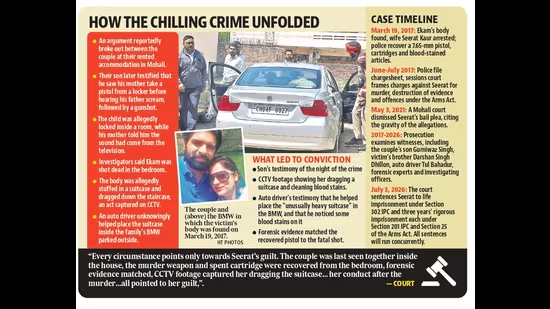
Nine years after 40-year-old businessman Ekam Singh Dhillon’s body was found stuffed inside a suitcase in the back seat of his BMW outside his rented accommodation in Phase 3B1, a Mohali court sentenced his wife, Seerat Kaur, now 44, to life imprisonment for his murder.Soon after her arrest in 2017, Seerat claimed she had acted in self-defence after an argument with her husband and later refused to undergo a lie-detector test, telling the court that she had already admitted firing the shot. (HT Photo)The court held that closed-circuit television (CCTV) camera footage, forensic evidence, the testimony of the couple’s son and her conduct before and after the crime formed a complete chain of circumstantial evidence pointing only to her guilt.Additional sessions judge Hardip Singh convicted Seerat under Sections 302 (murder) and 201 (causing disappearance of evidence) of the Indian Penal Code and Section 25 of the Arms Act.Besides life imprisonment for murder and a fine of ₹50,000, the court sentenced her to three years’ rigorous imprisonment each for destruction of evidence and possessing the illegal firearm used in the crime. All sentences will run concurrently.The murder had allegedly taken place on the intervening night of March 18 and 19, 2017. According to the victim’s brother, Darshan Singh Dhillon, who is the complainant in the case, he had reached Ekam’s rented accommodation after receiving information about some untoward incident. There, he found his brother’s BMW parked outside with blood stains near the rear door. When police opened a suitcase lying on the rear seat, Ekam’s body was recovered. A post-mortem later confirmed that he had died from a gunshot injury.The prosecution alleged that Seerat had murdered her husband to usurp his properties and money before attempting to dispose of the body by stuffing it into a suitcase and placing it inside the family’s BMW.Son’s testimony in courtDuring trial, the prosecution relied on the testimony of the couple’s son, Gurniwaz Singh, who was 11 at the time of the incident. Gurniwaz told the court that he had seen his mother remove a pistol from a locker on the night of the incident. He also recalled an argument between his parents over a man named Nimrat before his father returned home. Later that night, he heard his father’s scream followed by a gunshot but found himself locked inside another room from outside. When he questioned his mother, she told him the sound had come from the television.The following morning, the child witness said he saw his mother cleaning the house before handing a mobile phone and a packet to her sister.CCTV evidence from neighbouring housesCCTV footage from a neighbouring house emerged as another crucial piece of evidence. The recordings showed Seerat dragging what the prosecution said contained her husband’s body down the staircase, pushing the suitcase onto the ground floor and taking it towards the BMW parked outside. The footage also captured her cleaning the staircase, where blood stains were later detected during the investigation.The court also relied on the statement of auto driver Tul Bahadur, who told investigators that he had unknowingly helped Seerat place the suitcase containing Ekam’s body inside the BMW.Ring of truth in son’s testimony: CourtRejecting the defence, judge Hardip Singh held that every circumstance pointed only towards Seerat’s guilt. The judgment said the couple was last seen together inside the house, the murder weapon and spent cartridge were recovered from the bedroom, forensic evidence matched the pistol, CCTV footage captured her dragging the suitcase and cleaning blood stains from the staircase, while her conduct after the murder, including shifting the body, buying a new mobile phone and making several calls without attempting to contact her husband, strengthened the prosecution’s case.The court observed that once these circumstances were proved, the burden shifted to the accused under Section 106 of the Indian Evidence Act to explain the events that occurred inside the house, a fact especially within her knowledge. It held that the recoveries of the pistol, fired bullet and bloodstains from the bedroom further strengthened the prosecution’s case, but Seerat failed to offer any satisfactory explanation and merely denied the allegations.It also rejected the contention that the complainant’s family members were interested witnesses, observing that evidence cannot be discarded merely because a witness is related to the deceased if the testimony inspires confidence. Referring to Supreme Court precedents, the court held that the testimony of the couple’s son, Gurniwaz, was natural, reliable and carried a “ring of truth”, leaving no reason to believe that he would falsely implicate his own mother.Soon after her arrest in 2017, Seerat claimed she had acted in self-defence after an argument with her husband and later refused to undergo a lie-detector test, telling the court that she had already admitted firing the shot.Advocates Terminder Singh, Pooja Malhotra and Manpreet Singh Kaler represented the complainant during the trial.Seerat sought leniency citing mother’s old ageBefore sentencing, Seerat sought leniency, telling the court that her widowed mother was suffering from multiple illnesses due to old age and had no one to care for her because her brother and nephew had died. Her counsel also argued that she was a first-time offender. The court, however, declined the plea.While the prosecution pressed for capital punishment, calling the murder exceptionally brutal, the court held that although the offence was grave and meticulously executed, it did not fall within the “rarest of rare” category warranting capital punishment. It instead sentenced Seerat to life imprisonment.
Mohali ‘suitcase murder’: 9 yrs on, victim’s wife awarded life term
The court held that closed-circuit television (CCTV) camera footage, forensic evidence, the testimony of the couple’s son and her conduct before and after the crime formed a complete chain of circumstantial evidence pointing only to her guilt.
903 words~4 min read