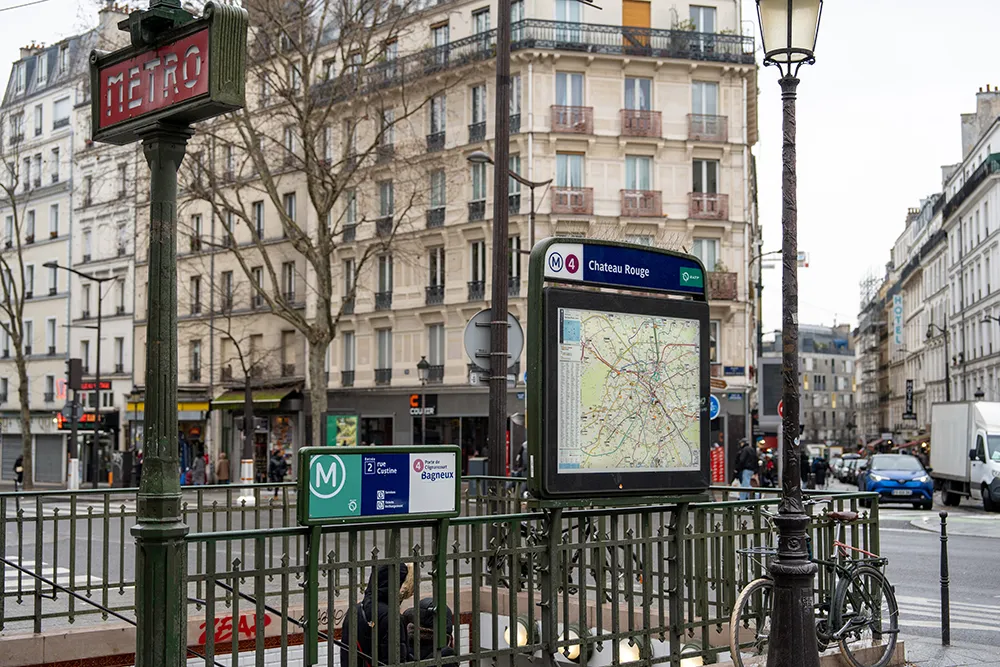
Chateau Rouge Author: Amit ChaudhuriISBN-13: 9780571394937Publisher: Faber & FaberGuideline Price: £14.99, 195ppThe narrator of Amit Chaudhuri’s ninth novel is an Indian writer who arrives in Paris for a prestigious fellowship. But neither the capacious yet grimy flat he’s subletting, nor the neighbourhood – the eponymous Château Rouge – satisfy his “niggling craving for the Paris of Proust’s house and Baldwin’s digs”. In the shadow of the Sacré Coeur, Château Rouge is a multicultural neighbourhood in the 18th arrondissement, affectionately referred to as “Little Africa”; with its dirty pavements and its lack of outwardly “French” cafes, the locale appears unimpressive to the narrator at first glance. He laments that to “live in Paris and be separated” from an idealised version of it “would be dreadful”.Soon, the narrator’s wife arrives and astutely reminds him that Château Rouge is exactly the kind of neighbourhood Hemingway would have lived in – “not some fancy made-up place”. The remark allows the narrator to appreciate he is free to chart the uncharted and create his own Paris by keenly documenting the one he lives in. The novel is composed of attentive, quotidian moments – some no longer than a sentence – and the reader soon comes to know the neighbourhood by the frequent trips the narrator takes to an M & S food hall, and his daily rhythms.Chaudhuri has been praised as a writer of great subtlety; here, the nuance of his prose is felt less in the intricate poetry of his earlier novels, and more in the specific ambivalence of the narrator’s initial reactions to his new surroundings. While looking at Monet’s paintings in the Musée d’Orsay, a man appears before the narrator – an African, he surmises, “from the colour of his neck”. The narrator feels “a resistance: as if [the man] was a reminder of some kind”. Perhaps the man recalls to the narrator the neighbourhood he has briefly escaped from. Nevertheless, his presence unsettles the narrator just as Château Rouge unsettles our image of a classically “French” Paris. We feel the narrator’s inherent separateness from his new surroundings, one that belongs historically to the literary expatriate. Though he finds linguistic connection with Pakistani and Bengali immigrants, our narrator is distinguished from this community by his class and social standing. Such separation could easily transform the novel into an account of contemporary alienation, but Chaudhuri sidesteps this line of inquiry. His account of Paris attempts an expansion, offering a new history of the city’s lesser observed streets, and enlarging the expatriate perspective and the sentiments it can express.
Château Rouge by Amit Chaudhuri: a different take on Paris
Ninth novel from Indian author questions expectations and notions of ‘classic’ French ideal
425 words~2 min read