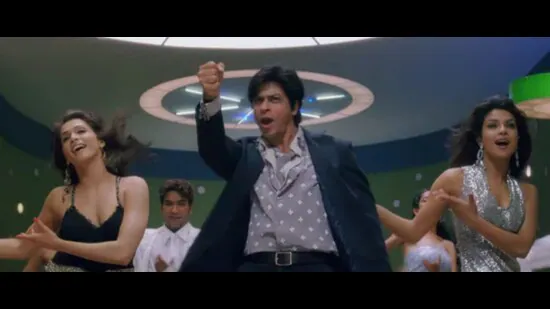
Set in contemporary Mumbai and its mirror image, Mumbai Right, where a struggling actor’s dreams of stardom have come true, this is an ode to old masala Bollywood with an enjoyable SF twist In the last decade, the perception of Bollywood has changed. Politics, the rise of social media, feminism, and an intrusive paparazzi have toppled superstars off their pedestals and reduced the reverence with which they are viewed. Mumbai’s charm as the Mayanagari, where common people go to achieve their dreams of stardom, is now put to question. Amid these changing perceptions, and with a speculative twist thrown in, Amal Singh’s Slow Burn evokes nostalgia for the narrative of a struggling artist trying to make it big.Amal Singh’s Slow Burn plays with the doppelganger trope even as it evokes nostalgia for the old Bollywood masala film. Above, a scene from Don (2006) (Film still)288pp, ₹399; PenguinRishi Tripathi, a 32-year-old man with a “lithe frame” and “dark features” from Varanasi, is frustrated with his life in Mumbai where he keeps failing auditions. His roommate Prabhu writes for television because the money is good. Rishi cannot imagine compromising his standards for money. His girlfriend Manisha quits her salsa lessons and decides to leave Mumbai for good. When Rishi sees his arch nemesis, Aashish Mishra — a boy from Bihar who made it big —chilling with Prabhu, he loses his cool and punches the wall next to the mirror in his room. Suddenly, he is transported into a world where he is superstar Rrish Kumar. In this alternate reality, Mumbai-Right, his dreams of stardom have come true. Though puzzled, he decides to stay in this reality but soon begins noticing the cracks that lead him to the darkness that the real Rrish Kumar has left behind for him to deal with. Then begins his journey to find the maker of mirrors who can help him find his way home.Before Rishi is transported through the portal, the story lets the reader know something is afoot: a phantasm “wavy thin borders and vibrant, like the colours on the surface of a soap bubble” appears in the railway station where Rishi sits defeated after an embarrassing gig playing a clown at a birthday party; an idli seller visits his neighbourhood every evening, sells idli at 8.59 and vanishes at precisely one minute past nine; a woman appears to him in moments of distress with a plate of unlimited idlis. It would seem that multiple realities exist together and are also in dialogue with each other. The references to classic portal-stories like Lewis Carrol’s Alice’s Adventures In Wonderland and Frank Baum’s The Wizard of Oz act as amusing asides for lovers of speculative fiction.Mumbai-Right, the book’s alternate reality, “was ashamed of its age and had begun to hide it with more steel and place.” It is a world where sci-fi, noir and fantasy are successful but there’s no space for typical Bollywood musical romcoms. The futuristic DigiAct requires an actor to perfect just 15 expressions and actions; everything else is developed in post-production. It’s entertaining to witness Rishi Tripathi act as superstar Rrish Kumar, who doesn’t have to act, not in the ‘real’ sense of the word.Singh’s worldbuilding is impeccable and when it snows in Mumbai, the reader doesn’t bat an eye. Such cold settings set the stage for even colder actions of the real Rrish Kumar, who, as Rishi will learn, was “darker, edgier, angrier.” In Rishi’s “Carrolian voyage” — as Gautam Bhatia calls it in the book blurb — to dig up Rrish’s past so he can find his own way home, the story of Majnoo, the maker of mirrors and the many worlds in them, and his first love, Laila, shines the brightest. The many Bollywood references and the direct adaptation of the lyrics of Naadan Parindey from Imtiaz Ali’s Rockstar in this section are truly enjoyable and make the reader yearn for more in the same vein.Author Amal Singh (Courtesy the subject’s account on X)This Mumbai without the Khans and Kapoors is a place that recalls familiar tropes of doppelgangers accidentally interchanging lives and discovering both peace and violence. However, in this story, familiarity and alienation are in constant dialogue and the reader is always wondering what will happen next, and more importantly, how it will happen.The action-packed climax on a bridge makes you nostalgic for traditional Hindi masala films before the scene was taken over by jingoistic cinema. Still, the screenplay discussions in cafes and the appearance of a memorable cat, Muskaan, who accompanies Rishi on his adventures, makes Slow Burn as contemporary as it can get.Amal Singh has a way of recreating old-world charm in comfortable reads that question morality. His debut novel, The Garden of Delights, full of bangle-sellers and travelling film people, recalled memories of a millennial childhood. Likewise, Slow Burn is a fantastic ode to Bollywood; the one that many of us grew up with.Akankshya Abismruta is an independent writer.
Review: Slow Burn by Amal Singh
Set in contemporary Mumbai and its mirror image, Mumbai Right, where a struggling actor’s dreams of stardom have come true, this is an ode to old masala Bollywood with an enjoyable SF twist
823 words~4 min read