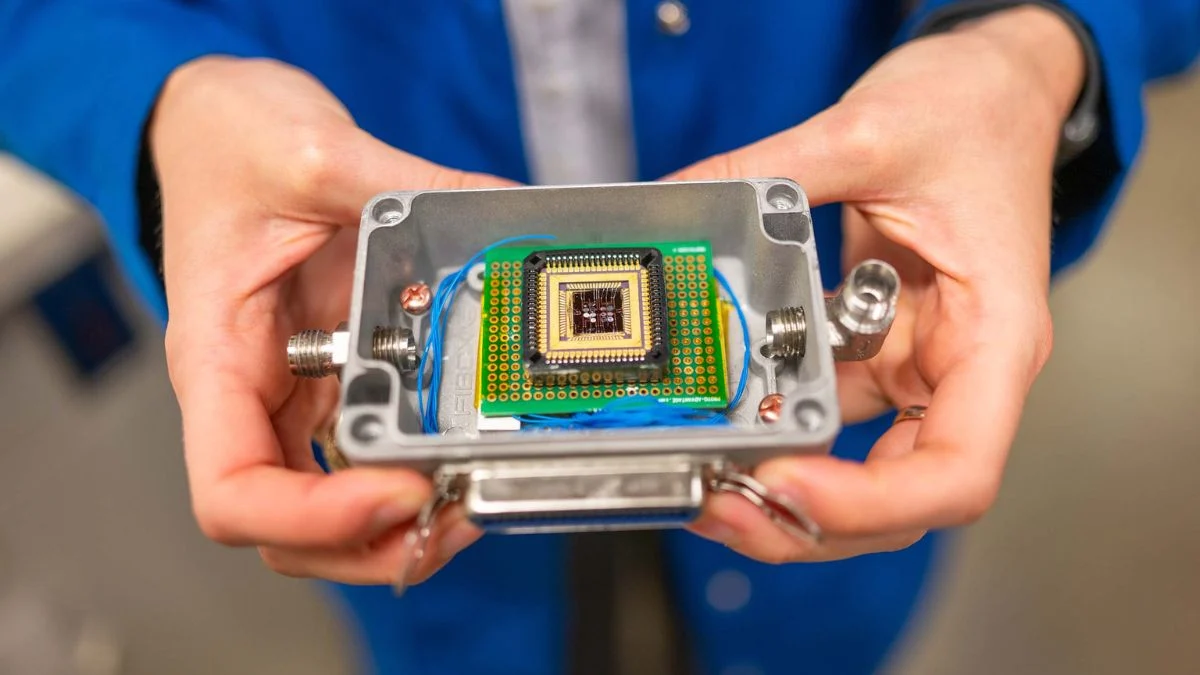
If you wind up with an upset tummy after eating some questionable food, you're probably one of the lucky ones.Food-borne illnesses are a global and potentially lethal problem that causes much more than intestinal anguish.It's estimated that more than 850 million people fall ill every year after eating contaminated foods, resulting in over 1.5 million annual deaths, according to the World Health Organization (WHO).And although technology has commandeered most aspects of daily life, our go-to food safety practice is still a quick, perfunctory sniff test to determine the freshness of yesterday's milk or last week's leftovers. But the human nose is an imperfect chemical detector, as evidenced by many morning-after Pepto-Bismol chugs.So, to save us from a secretly sickening slice of salmon, engineers at the University of California (UC) Berkeley have developed an 'electric nose', describing their work in Science Advances.The electric nose, developed at UC Berkeley, can improve food safety by detecting gases associated with spoiled food or common food allergens. (Brandon Sánchez-Mejia/UC Berkeley)Importantly, this technology can be incorporated into everyday appliances to protect us from hidden pathogens, including those associated with food spoilage."I think 'smart' fridges – which come with sensors that you can control on your phone – would be a great application for this kind of technology," explains Carla Bassil, an electrical engineer at UC Berkeley and the study's lead author."How great would it be if your fridge could tell you, 'Hey, your broccoli's going to go bad soon, so you should probably eat that'? Or, 'Your chicken is on its last day'?"The 'electric nose' consists of 16 sensors, each sensitive to a slightly different mix of gases, to give uncertain eaters a thumbs up or down on that leftover chicken leg.Bassil likens these sensors to 'digital taste buds', each tuned to a different stimulus."Each of these 16 sensors has a different sensing film on it, and it works by converting chemical reactions between the sensor surface and the gas molecule into electrical signals," she explained in a recent talk.
This Tiny Device Could Help Save Millions From Food Poisoning
If you wind up with an upset tummy after eating some questionable food, you're probably one of the lucky ones.
870 words~4 min read