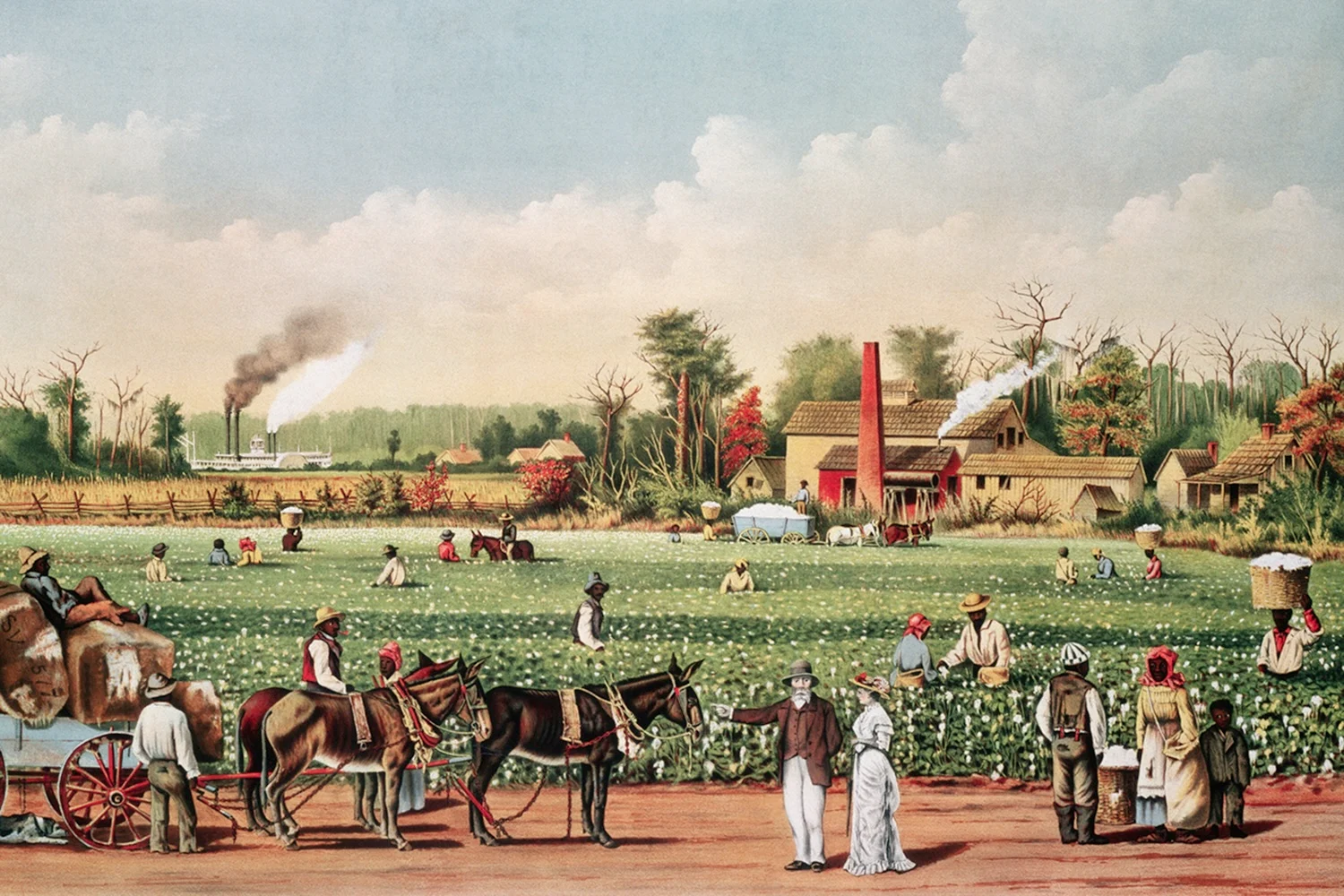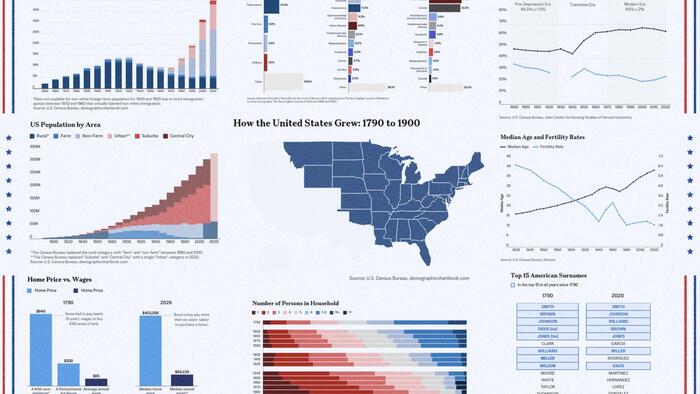
As we prepare to mark the 250th anniversary of the United States, we are taking a look back at some of the defining moments that shaped the American economy and how the choices made throughout our history shape the economy we live in now. 1776 to 1826We begin with money itself, which, in the early Republic, was still in flux. States were printing their own currency, war debts were everywhere, and there was barely any credit. Enter the First Bank of the United States. The goal of the bank was to ease credit problems stemming from the Revolutionary War and its aftermath, said Jonathan Levy, a historian at Sciences Po in Paris.With the added benefit of being “partly privately owned, privately subscribed, so private citizens could own the stock of the First Bank of the United States,” he said. “So it was pretty much a split public and private institution that both had a monopoly on the banking business of the United States government, but also made loans to private individuals to try to spur and support American commercial growth.”But not everyone saw it that way. To some of the era's biggest names, the bank wasn't a solution; it looked more like a betrayal of what the revolution stood for.Visitors are seen around the painting "Declaration of Independence" by John Trumbull in the United States Capitol Rotunda in July 2025.Matt McClain/The Washington Post via Getty Images“Thomas Jefferson thought that mutual interdependence was corruption, a corruption he identified with the British Empire, which was precisely the empire that the revolution had been fought against,” Levy said.That same credit system would soon be used to finance the domestic slave trade: “What made possible the domestic slave trade was a very sophisticated mode of financing it,” Levy said. “Slaves become the principal form of collateral for the Southern credit economy — through mortgage markets, through credit markets, through currency markets.”The system Levy refers to was sophisticated, brutal, and came at an enormous human cost. People were bought, sold, and used as collateral for loans and investments, while providing the foundation for much of the nation's economic growth.Slavery also laid the groundwork for future economic and political divisions that risked the future of the country itself.“I think the most lasting characteristic of the first 50 years — it's still with us — is the conflict between capitalism and democracy,” Levy said.That tension that Levy refers to shows up again and again — in the fight over banks, in who could vote and participate in politics, and who was able to profit from the nation's economic dynamism. It's a tension that has never been fully resolved.1826 to 1876Above, a memorial remembering Confederate prisoners of war in Chicago, in 2017. The Civil War fractured the country — and the nation's economy.Scott Olson/Getty ImagesEven though the North and the South started down different paths, the two economies were deeply intertwined. “The Industrial Revolution in the Northeast of the United States was also led by cotton textiles supplied by southern plantations,” Levy said. “It's also true that there was Southern demand for many northeastern goods, so they do feed off of one another. At the same time, the developmental dynamic that emerged from the slave economy, I think, had limits.”Something shifted around 1830, and the two economies began to pull apart.“Eventually, we see a new dynamic emerge from the North — a much more entrepreneurial economy. An economy that has public education, different kinds of human capital,” Levy said. “Really, only after 1830 do you start to see a divergence between the Northern and Southern economies, but I'd add that that economic divergence was really important in creating political lines of conflict that ultimately led to the Civil War.”1876 to 1926After the devastation of the Civil War, the United States entered a turbulent period of Reconstruction as the country attempted to stitch itself back together politically and integrate 4 million formerly enslaved black Americans into the post-war economy. Key to that economic recovery was the rapid expansion of and investment in railroads. According to the Library of Congress, there were only about 45,000 miles of railroad in the U.S. prior to 1871. Between that point and 1900, another 170,000 miles were laid. “I think the very peak years of railroad line production happens in the 1880s, and so you're kind of in the midpoint of that transportation revolution in the United States that really knitted regions closer together with obvious economic implications for interregional trade, interregional mobility,” said William J. Collins, a professor of economics at Vanderbilt University.The 1872 painting "American Progress" by John Gast, which represents U.S. expansion Westward — and the violent displacement of Indigenous peoples.John Gast via Wikimedia CommonsAround this time, a generation of settlers keen to expand West leaned into the concept of Manifest Destiny but ran into a native population already settled and cultivating the land. What followed was a campaign of forced relocation that brought about the Indian Removal Act of 1830. It confiscated Native land in existing U.S. states and moved Native Americans to unsettled land. That removal, including the Trail of Tears, displaced or killed tens of thousands of Native Americans. “The rules of the game, in a sense, are being changed unilaterally by the federal government of the United States, putting Indigenous nations at a disadvantage,” Collins said. “So they're ceding more and more land with this sort of threat in the background that if the land isn't ceded, it may just be taken. And so, as a consequence, Indigenous nations are being kind of rolled back further and further West over time.”Then, in the early 20th Century came World War I, which reshaped the labor force as workers moved to industrial jobs in the Northeast and Upper Midwest.“That tends to pull a lot of Southern migrants, including a lot of Southern Black migrants, into these labor markets,” Collins said. “And so the great migration of Black Americans begins in this period with World War I.”1926 to 1976In the midst of the Roaring ‘20s, a period of rapid growth after World War I, economic trouble was already brewing beneath the surface, Collins pointed out.“You know, but things in the 1920s were already kind of weak in some sectors. The farming sector was struggling, and that was still an important part of the American economy in the 1920s,” he said.Then, the stock market crashed in October of 1929, devastating America's economy and its people. Millions lost their jobs, waited in breadlines for food, or lived in shantytowns, often called Hoovervilles. Eventually, the government, under the command of newly-elected President Franklin Roosevelt, swept in with a series of policies starting in 1933. Jobs and agriculture programs, banking reforms — packaged together, they were called "the New Deal," and the sweeping changes made lasting changes to the American economy.President Franklin D. Roosevelt in 1939.ACME/AFP/Getty Images“There are a bunch of reforms, like big reforms that happened in the 1930s. There are things that we sort of take for granted today, but were novel at the time, like all of the stuff in the Social Security Act, for instance,” Collins said.And it wasn't just those social programs that gave the economy a boost. World War II — and the vast infrastructure required to supply the Allied fighting force — was a grim driver of growth and economic mobility for some.“Especially after the U.S. joins the war at the end of 1941, labor markets get super tight,” Collins said. “That led to increasing wages for everyone, but especially for folks who tended to be at the lower end, or jobs that tended to be at the lower end of the pay scale before. They tend to get pulled up quite a bit. And it's also pulling a lot of women out of, say, domestic service jobs and into other kinds of work.”So, coming off the heels of the war, there was significant prosperity.“You know, there is this period between, like, 1940 and 1970 where things look pretty good, in retrospect,” Collins said. “There wasn't just like a lot of income growth, but it was, it was spread throughout the income distribution in a way that was novel.”Collins said there's a lesson to learn from this period: “I think it's really important to understand that rising inequality, isn't, you know, automatic. It's not inexorable. It doesn't always go that way.”1976 to 2026The past 50 years have transformed not just how Americans work, but who makes up the nation’s workforce.One major factor has been immigration. Since 1970, the percentage of people in the U.S. who were born abroad has more than tripled, according to the Pew Research Center.“The immigrant contribution to the U.S. economy is both towards the lower-wage part of the workforce, but also some of our major technological changes that we've experienced clearly — immigrants play a role,” said Richard Fry, a labor economist and senior researcher at Pew.He said women also made significant gains in labor force participation during the 1970s and 1980s. But for men, labor force participation moved in the opposite direction, partly due to the loss of many manufacturing jobs as rapid changes to technology reshaped the economy. “Men are less likely to be participating in the labor force than they were 50 years ago. And where it’s particularly striking? It’s not college-educated men; it’s particularly less educated men. Their participation in the labor force has fallen,” Fry explained.A worker wearing a face mask, gloves, and a party hat stands next to a sign about face mask requirements a reopened AMC theatre in Highlands Ranch, Colorado, in August 2020.Tom Cooper/Getty ImagesThe recovery from the Great Recession was slow, affecting a generation of workers. Those same workers later had to pivot again in response to the COVID-19 pandemic, which shifted the understanding and requirements of how we get work done in the modern era.Now, as businesses and workers begin an even more rapid adjustment to artificial intelligence, the American economy is set to adapt and change again — as it’s been doing for the last 250 years.
A timeline: 250 years of the U.S. economy
As the United States turns 250, we reflect on the defining moments that have shaped the U.S. economy.
1,675 words~8 min read