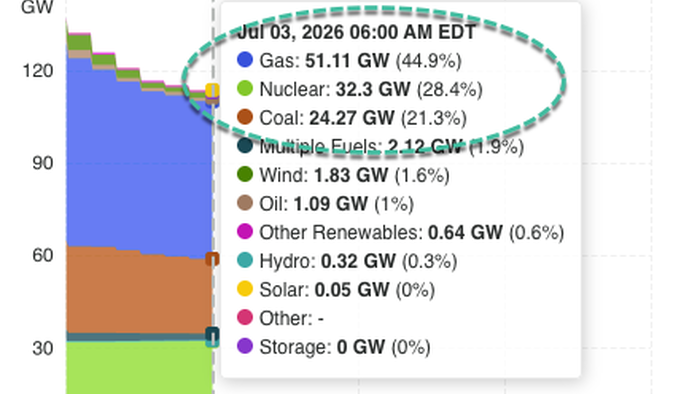
America's biggest power grid pushed to the edge of an all-time record this week, and the bigger force behind it may be tied to data centers.PJM Interconnection, which delivers power to 67 million people across 13 states and Washington, D.C., saw electricity demand surge to roughly 163 gigawatts on Thursday as a brutal heat dome pushed heat indices past 110 degrees from Washington to New York, according to Reuters. That fell just short of the grid's 2006 all-time peak of 165,563 megawatts, even after PJM had forecast Thursday's load could top 166,000 MW. Wednesday's preliminary peak hit 161,910 MW, among the highest readings PJM has ever recorded. The National Weather Service has warned the dangerous heat will persist through the Fourth of July weekend, with heat indices reaching as high as 115 degrees in parts of the mid-Atlantic, per Utility Dive.The U.S. Department of Energy stepped in Tuesday with its third emergency order of 2026, authorizing PJM to push power plants past normal pollution limits and, as a last resort, force large data centers onto backup generators during peak hours.The order lets PJM direct any customer with at least 50 megawatts of peak load to switch to onsite backup power within 15 minutes of an emergency signal, freeing capacity for homes and hospitals. The DOE issued similar orders after a January cold snap and a May heat-and-maintenance squeeze. “Maintaining affordable, reliable, and secure power in the PJM service territory is non-negotiable,” Energy Secretary Chris Wright said in a statement Tuesday.Day-ahead power topped $2,000 per megawatt-hour in parts of the system Thursday, and the Western Hub benchmark settled at $1,222.75/MWh, according to power markets data firm Yes Energy, nearly triple where it stood during a comparable peak last summer. PJM's operating reserves, the cushion it keeps on hand for the unexpected, sank to 5,091 MW Thursday from 10,996 MW a day earlier, leaving little room to absorb a plant tripping offline.During a comparable late-June peak this year, natural gas supplied 44 percent of PJM's generation, coal another 19 percent, nuclear 20 percent and solar just 6 percent, according to the U.S. Energy Information Administration.PJM projects peak demand will grow by 32 gigawatts between 2024 and 2030, with all but 2 gigawatts of that increase coming from data centers, according to PJM figures cited by Canary Media. The buildout has already pushed PJM's capacity market, the mechanism that pays generators to guarantee future supply, to a record $333.44 per megawatt-day, up more than 11-fold from $28.92 just three auctions earlier. Independent market monitor Monitoring Analytics has tied 63 percent of that run-up to data center demand, a tab of roughly $9.3 billion now landing on ratepayers.Utilities asked customers to help bridge the gap in the meantime… Maryland's BGE and Potomac Edison told customers to raise their thermostats, grill outdoors instead of cooking inside, and hold off on running dryers and dishwashers until evening. PJM's 18 gigawatts of fast-start reserves held, and the grid avoided rolling blackouts. But the record it dodged this week is one it's now forecast to break soon enough, with or without a heat wave to blame.By Michael Kern for Oilprice.com
Power Prices Triple on PJM as Heat Wave and Data Centers Collide | OilPrice.com
PJM's power grid neared a 20-year demand record this week as a heat wave and surging data center growth strained the system.
522 words~2 min read