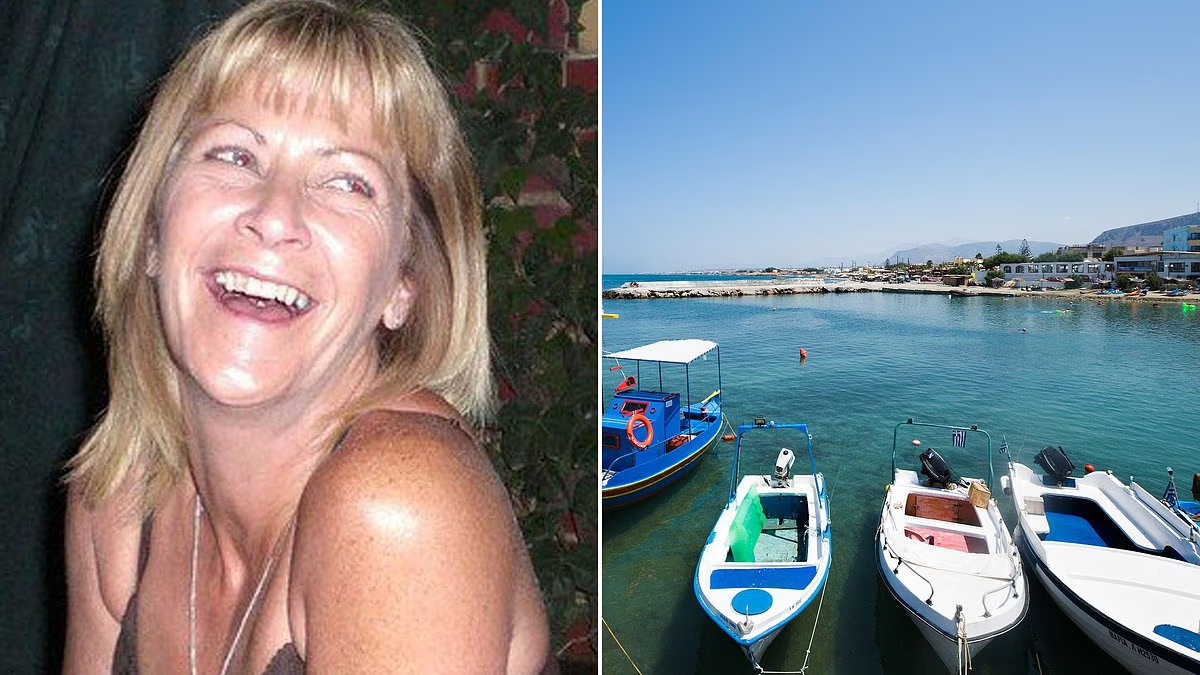
A Greek man who stalked a British woman after she ended their short relationship has been found guilty of murdering her 17 years ago.The body of Scottish mother Jean Hanlon was found in the harbour of Crete in 2009.For years, the police insisted the 54-year-old's death had been an accident, prompting her distraught family to demand a second post-mortem and even hire a private investigator to uncover the truth.But a breakthrough occurred when information written in Jean's personal diary came to light, leading prosecutors to suspect one of her ex-partners.A 54-year-old man has now been found guilty and sentenced to 10 years in prison following a four-day trial at the Lasithi Law Courts in Neapoli.Under Greek law, the man will not be named until the court process, including appeals, is over.He will not go to prison until his appeal is heard, after the court recognised his diminished responsibility due to mental health conditions.The trial opened at the Lassithi Criminal Court in Crete, where, according to Greek newspaper OEMA, the man said: 'I have done nothing. It is a sin to go to prison for the rest of my life without having done anything.' Jean Hanlon disappeared in 2009 after moving to the holiday island of CreteJean's three sons gave evidence, with one claiming she had been 'bullied' by the man after ending their relationship.The mother, a former hospital secretary, had been living in Kato Gouves, a village about 12 miles from Heraklion, for a number of years where she worked in a variety of local bars and tavernas.She went missing in March 2009 during a night out, after telling friends she was meeting a man at a cafe.But she later sent a text message saying simply: ‘Help’. Four days later, on March 13, 2009, her body was found in the sea at Heraklion.While an initial post-mortem examination determined Jean had drowned, a re-examination in 2019 showed she suffered a broken neck and ribs, a punctured lung and facial injuries, and was probably dead before she entered the water.Her determined family, originally from Dumfries, has managed to force the Greek authorities to reopen the case four times since her body was first discovered.The decisive moment finally came when Jean's private diary was discovered, in which the defendant was named.The court heard they had been involved in a romantic relationship, but Jean had 'politely' ended it.One of her sons, Robert, said the man continued to bully his mum, despite what he said was a polite separation.The court also heard from a forensic pathologist, who became involved in the case following a review in 2019, but did not directly examine Jean.The pathologist said the mother's cause of death was likely caused by an incomplete tear of the brain stem.She added that the fatal injury was caused by a forceful blow to the back of the neck with a blunt object, noting that her injuries weren't consistent with a fall.During the trial, the court heard that the now 54-year-old had been diagnosed with schizophrenia and bipolar disorder and was on daily medication.According to his sister, he would become aggressive if not on the pills. The prosecution argued he had been off his medication when seeing Hanlon. Jean's three sons have campaigned tirelessly for years in search for answers about their mother's sudden death.In 2020, they launched a fresh appeal on the Greek equivalent of Crimewatch, which failed to yield any new information.In 2021, they enlisted specialist officers working as part of a unit investigating organised crime.The officers failed to yield any meaningful result, though they did rule Jean's death was 'foul play'.The investigation was officially reopened in June 2024 after private investigator Haris Veramon, hired by her sons, transferred a 28-page dossier to Greek authorities.The man was finally charged in January last year, but the case later appeared to collapse.Appeal judges in Heraklion overturned that decision in August and ruled that he must stand trial for murder. He was charged in November.Michael Porter, one of Jean's sons, previously said: 'Mum’s diary gave us the best clues ever because you can’t change the words of the dead.‘One, two weeks before her death, she wrote how many times this guy was turning up at her house uninvited, turning up at the bottom of the street, basically stalking her because she had refused him.‘The guy wasn’t her boyfriend, he was someone that she met occasionally. It wasn’t love, it was someone she dated, an acquaintance.’Although previously told to ‘just stop now and live your life’, he and his brothers have travelled to Crete to witness the proceedings.He added: ‘When you see your mum the way you saw her, that never leaves your mind. To think of what she must have gone through that night, it haunts you for life, and it changes you in a way that you just can’t describe.‘She was our mum, and the bottom line is you’d do anything for your mum or anybody you love.’ Jean Hanlon's sons Robert, David and Michael haven't stopped searching for answers Jean Hanlon's remains were recovered from Heraklion harbour on March 13, 2009When it was announced last year that a trial would open, he said the news felt ‘absolutely amazing’ after years of heartbreak and disappointment.He added: ‘It’s really reassuring. We’re feeling extremely happy and positive that, finally, it looks like we’re going to get our mum the justice she deserves. It’s absolutely amazing, you can’t put it into words.‘It’s hard to get too excited when you get picked up so many times over the past 16 years and then knocked back. The last year has definitely been the most impressive for us since bringing in the private investigator.’The trial was scheduled to begin last Friday, but after the appointment of a defence attorney for the man, a request for a postponement was submitted in order to study the case file.At the time, Michael expressed the family's anguish over the possibility of more delays, saying: 'We were incredibly devastated and stressed about the possibility of a postponement for months, especially when you have prepared yourself psychologically for so much.'According to the family's lawyer, Apostolos Xiritakis, Jean's diary was crucial for the indictment, as well as some contradictions by the defendant himself.While he allegedly claimed that they had never met again after their separation, the victim's diary showed that he continued to pressure her to get back together, the lawyer said, according to Cretalive News.
Greek man who stalked Brit is found guilty of her murder
The body of Scottish mother Jean Hanlon was found in the harbour of Crete in 2009.
1,067 words~5 min read