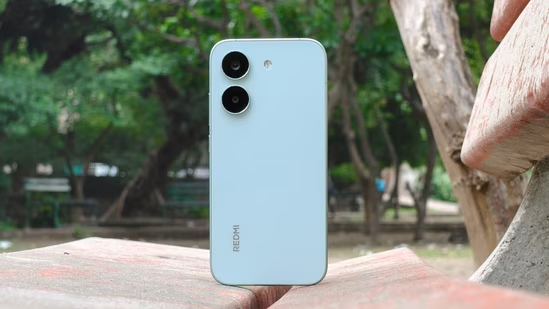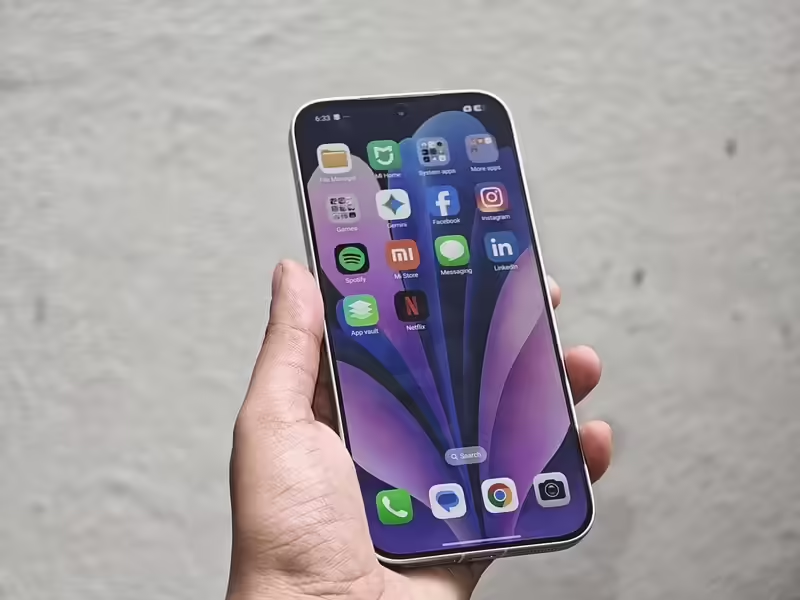
The Redmi Turbo 5 arrives in India at Rs 37,999, carrying a 7,540mAh battery, MediaTek's Dimensity 8500 Ultra chipset and a 6.59-inch 120Hz AMOLED display — the biggest cell Redmi has ever fitted into a phone, and the Indian debut for both the Turbo badge and this particular slab of 4nm silicon. On paper, it reads like a spec-sheet mic drop. In hand, after weeks of Delhi summer, late-night gigs and the unglamorous grind of being my daily driver, the story turns out to be more interesting — and more complicated — than the numbers suggest.Here is the short version. The battery is magnificent. The build quality is genuinely excellent, armoured to a degree that borders on paranoid. The performance is adequate — a word I choose deliberately, and one I will defend at length below. And the design is derivative to the point of being uninspired, a photocopy of a photocopy that Xiaomi's accountants clearly signed off on before the designers got their morning chai. Whether that trade sits well with you at Rs 37,999 depends entirely on what you want a phone to be: a workhorse or a statement.A Familiar RiffEvery gigging musician knows the tribute band problem. The playing can be technically flawless, the tone dialled in, the setlist watertight — and yet the whole evening feels like a karaoke night with better amplifiers, because every note belongs to someone else. The Redmi Turbo 5's design is precisely that evening. It is, panel for panel and colour for colour, the Poco X8 Pro wearing a different t-shirt. Same flat aluminium sides, same rounded corners, same two-tone back, same circular camera rings with their little red accents. Xiaomi swapped the badge, fitted a bigger fuel tank, and called it a new model. In China, where the Turbo line has history, this counts as continuity. In India, where the Turbo brand landed for the first time in June, it counts as a missed opportunity to make an entrance.The Turbo White unit I carried does have its moments. The visual texture on one half of the back panel catches light pleasantly, and the Matrix lighting ring around the camera module — which pulses for notifications and media, and can be customised in settings — is a party trick that earned genuine attention at a bar counter or two. But moments are all they are. Put this phone face-down on a table next to an iQOO, a Poco and a Realme, and you would need three guesses and a torch to pick it out. For a phone whose entire billing is speed and aggression, the styling has all the menace of a hatchback with a spoiler bolted on.And yet — and this is where my complaint splits cleanly in two — the construction underneath the anonymous styling is superb. Glass front and back, an aluminium frame, 204 grams distributed with real balance, and a rating sheet that reads like an insurance policy: IP66, IP68, IP69 and IP69K. That last one certifies survival against high-pressure water jets, which is overkill in the most reassuring way possible. It got tested, involuntarily, at a gig in south Delhi when a gentleman with more enthusiasm than spatial awareness baptised the bar counter — and my phone — with most of an Old Monk and cola. The Turbo 5 took the hit, took a wipe with a napkin, and carried on displaying the setlist as if fizzy rum were a listed operating condition. Try that with something sleeker and more fragile and you are shopping for a replacement by morning.So the verdict on this section is a strange one: a body I would trust with my life, wearing a face I would forget by Tuesday.3,500 Nits Against the Delhi SunThe display is where the Turbo 5 stops borrowing and starts performing. The 6.59-inch AMOLED runs a 1. 5K resolution of 1268 x 2756 pixels — a crisp 460ppi — at 120Hz, with 12-bit colour, Dolby Vision and HDR10+ support, 3,840Hz PWM dimming for the flicker-sensitive, and a claimed 3,500 nits of peak brightness. Corning's Gorilla Glass 7i sits on top.Numbers are one thing; a July afternoon in Delhi is another. This is a city that stress-tests screens the way Jarama used to stress-test brakes, and the Turbo 5 passed with room to spare. Booking a cab at 2pm with the sun directly overhead, the Sunlight Display mode kept everything legible with zero squinting and zero cupped-hand shading. Colours are accurate out of the box rather than the radioactive-saturation defaults this segment usually ships with, the bezels are slim and nearly uniform, and the panel responds properly to wet fingers — a detail you only appreciate once monsoon humidity arrives.Two small gripes. The refresh rate tops out at 120Hz while a few rivals in adjacent segments have started flirting with 144Hz, and gamers who count frames will notice the ceiling. And the under-display optical fingerprint reader sits a touch low for my thumb's liking, though it reads quickly once you retrain your muscle memory. Beyond that, this is comfortably one of the two or three best panels under Rs 40,000, and the single component that feels borrowed from a phone twice the price.Where Does the Power Actually Go?Now, the part everyone came for — and the part where I depart slightly from the prevailing hymn sheet. The Dimensity 8500 Ultra is the first of its kind in an Indian phone, paired here with 8GB or 12GB of LPDDR5X RAM and 256GB of UFS 4.1 storage. My lab numbers, averaged across multiple runs:BenchmarkScoreAnTuTu (v11)~20,85,000Geekbench 6 (Single-core)1,588Geekbench 6 (Multi-core)6,3233DMark Wild Life Extreme4,429CPU Throttling (peak retention)~81 per centPCMark Battery (100–20 per cent)~17 hoursThose are strong figures. The AnTuTu tally clears the 20-lakh mark Xiaomi promised at launch, the multi-core Geekbench result embarrasses everything running Qualcomm's 7-series in this bracket, and the 81 per cent throttle retention means the engine keeps most of its horsepower even when you hold it at the redline for half an hour. BGMI and Call of Duty: Mobile both ran at 120fps with the Wild Boost mode engaged, and both held those frame rates through extended sessions with only minor dips.So why "adequate" rather than "astonishing"? Two reasons, both earned the hard way.First, the single-core number. At 1,588, the Dimensity 8500 Ultra sits well behind the 2,100-plus scores that Snapdragon 8-series rivals post, and single-core grunt is what you feel in the hundred small moments of a day — app cold-starts, web rendering, that half-beat pause when the camera app wakes up. The Turbo 5 is fast. It is rarely instant. The difference is subtle, like the gap between a session guitarist who nails the part and one who makes it sing, but sixteen years of handling phones tunes your ear to exactly that gap.Second, the thermals. Xiaomi's 3D IceLoop cooling system — a 5,300 sq mm dissipation layer that the company claims triples the efficiency of a conventional vapour chamber — does honest work, but Delhi in summer is a hostile dyno. After 40-odd minutes of BGMI, surface temperatures climbed by roughly 14 degrees Celsius, concentrating around the camera module, and on the hottest afternoons the warmth crossed from noticeable into mildly uncomfortable. Performance held; comfort wavered. Sitting in the back of an un-air-conditioned taxi while the phone rendered a firefight, I found myself shifting my grip the way you shift a hot cup of chai between hands. That is the kind of detail benchmarks fail to capture and palms remember.The honest summary: this is a quick, well-sorted powertrain that delivers everything the segment demands and holds its pace under pressure — a solid midfield car that scores points every race. Call it a podium contender on the right weekend. The championship material sits a price bracket above.The Long EncoreIf performance is where I temper the enthusiasm, the battery is where I abandon restraint entirely. The 7,540mAh cell in the Turbo 5 is the finest single argument for buying this phone, and one of the best batteries I have used at any price this year.The averaged PCMark figure of around 17 hours from full to 20 per cent tells part of the story. Real life tells it better. A typical heavy day for me runs email and Slack from 8am, a couple of hours of calls, navigation across half of Delhi, an hour of streaming, social media grazing throughout, and — several nights a week — a gig, which means the phone doubles as setlist display, voice-memo recorder, and torch for finding a dropped plectrum in a dark green room. The Turbo 5 finished those days with 30 to 40 per cent remaining. On lighter days it sailed into a second evening. One demanding stretch — 30 minutes of video streaming stacked on top of an hour of gaming — drained a combined 14 per cent, which for a phone this powerful is remarkable frugality.The 100W HyperCharge brick (included in the box, along with a case — small mercies in a penny-pinching market) refills the tank from 20 to 100 per cent in about 51 minutes. For a cell this size, that is a genuinely quick pit stop. There is also 27W reverse wired charging, which turned me into an unofficial charging station: at one gig, our vocalist's phone died mid-evening, and the Turbo 5 topped him up between sets while barely denting its own reserves. A phone that charges other phones as a party trick and still outlasts everyone in the room has understood its assignment completely.One caveat, because honesty demands it: standby drain overnight ran a touch higher than the cell's capacity should allow, suggesting some background-process housekeeping remains on Xiaomi's to-do list. It dents an otherwise flawless report card by a decimal point.Two Lenses, One SoloistThe camera system is where the Turbo 5's budget allocation becomes visible. You get a 50MP Sony IMX882 primary sensor with OIS, an 8MP ultrawide, and a 20MP fixed-focus selfie camera. That is a power trio with one virtuoso and two members recruited from the classifieds.The main sensor, to be fair, plays well. Daylight shots come out sharp, vibrant and social-media-ready straight from the app, with pleasing colour science and a 2x in-sensor crop that frequently passes for optical zoom. Portrait edge detection is clean, subject separation convincing. Low-light results are respectable for the class, with OIS earning its keep on handheld night shots outside a venue. My complaints begin with the processing: skin gets a sharpening pass so aggressive that faces occasionally acquire a faintly artificial, over-etched quality, and HDR in high-contrast scenes — a stage wash against a dark room, say — swings between excellent and clumsy depending on its mood.The supporting cast struggles. The 8MP ultrawide produces soft images with visible detail loss the moment light gets tricky, fine for the occasional group shot and little else. The selfie camera is serviceable for video calls and tops out at 1080p video, a fixed-focus arrangement that feels a full generation behind. Rear video reaches 4K at 60fps with decent stabilisation, which content creators will appreciate, but the overall system is transparently a two-priority phone's third priority. Rivals such as the Motorola Edge 70 Pro simply shoot better pictures. If the camera is your lead instrument, audition elsewhere.HyperOS 3 and Old HabitsThe Turbo 5 ships with HyperOS 3 on Android 16, backed by a promise of four years of OS updates and six years of security patches — an update commitment that stretches this phone's useful life towards 2032 and materially strengthens the value case.The software itself is Xiaomi being Xiaomi: dense with features, deeply customisable, quick in daily operation, and visually indebted to Cupertino in ways the company has stopped pretending to disguise. The Settings app remains the least Android-flavoured in the business. Theming support is elaborate, multitasking is well-handled, and the Gemini-era AI toolkit — Circle to Search, AI Erase, the usual suspects — is all present. The bloatware situation, however, deserves a stern word: the out-of-box app load is heavier than a phone at this price should carry, and while most of it uninstalls, the fact that a Rs 38,000 device greets you with a scavenger hunt of deletions feels like finding flyers stuffed under the wiper of a car you just bought. Budget it fifteen minutes on day one.Connectivity rounds out well — 5G, Bluetooth, NFC, and the ever-useful IR blaster that quietly makes a Xiaomi phone the remote for every appliance you own. The 3. 5mm jack is gone, microSD expansion is absent, and the stereo speakers with Dolby Atmos delivered louder, fuller sound than I expected, holding composure at full volume — useful for reviewing rough mixes when earphones are out of reach, though a proper monitor it will never replace.Rs 37,999 in Delhi TrafficTime for the scorecard, and the competitive reality check that goes with it.CategoryRating (out of 5)Design3.5Build Quality4.5Display4.5Performance4Cameras3.5Battery5Software3.5Value for Money4.5Overall4SpecificationRedmi Turbo 5 (India)Display6.59-inch 1. 5K AMOLED, 120Hz, 3,500 nits, Dolby VisionChipsetMediaTek Dimensity 8500 Ultra (4nm)RAM/Storage8GB/12GB LPDDR5X, 256GB UFS 4.1Rear cameras50MP (IMX882, OIS) + 8MP ultrawideFront camera20MP fixed-focusBattery7,540mAh, 100W wired, 27W reverseIngress ratingIP66/IP68/IP69/IP69KSoftwareHyperOS 3, Android 16 (4 OS + 6 security years)PriceRs 37,999 (8+256), Rs 40,999 (12+256)The awkward question first: the Poco X8 Pro is functionally this exact phone with a smaller battery and a lower price, which makes the Turbo 5 a premium paid almost entirely for those extra milliamp-hours. For me, given how I use a phone, the bigger cell justifies the gap — but you should make that call with open eyes. Around it, the OnePlus Nord CE6 offers an even larger 8,000mAh battery for endurance obsessives, the Motorola Edge 70 Pro shoots meaningfully better photographs, and a few thousand rupees more opens the door to the Poco X8 Pro Max and Poco F7 with genuinely quicker silicon. The Turbo 5's answer to all of them is breadth: the toughest build, a top-two display, near-best battery life and competitive speed, assembled into one package with fewer glaring weaknesses than any single rival.The Tribute Band That Sells Out AnywayHere is the thing about tribute bands: the good ones pack venues. The audience knows every song belongs to someone else, and they buy tickets anyway, because execution has a value all its own. The Redmi Turbo 5 is exactly that proposition. It borrows its face from the Poco parts bin, its performance sits a rung below true flagship silicon, and its cameras play rhythm rather than lead. But the battery is an all-nighter, the build shrugs off spilled rum and pressure hoses alike, the display outstares the Delhi sun, and the whole package costs Rs 37,999 with six years of software support behind it. Buyers who want a statement piece should look elsewhere. Buyers who want a phone that simply refuses to die — through gigs, heatwaves, traffic and everything this city throws at a working day — will find the Turbo 5 one of the easiest recommendations of the year. The encore is the whole show.end of article
Redmi Turbo 5 Review: Big Battery Brilliance Wrapped in a Borrowed Suit
Redmi Turbo 5 has been unveiled in India and reviewed, priced at Rs 37,999. Featuring an impressive 7,540mAh battery and powered by MediaTek's Dimensity 8500 Ultra, it stands out for its solid construction and vibrant 120Hz AMOLED display. While the design may not inspire awe, it delivers satisfactory performance for everyday use, making it an ideal choice for users who value reliability and endurance in a smartphone.
2,492 words~11 min read