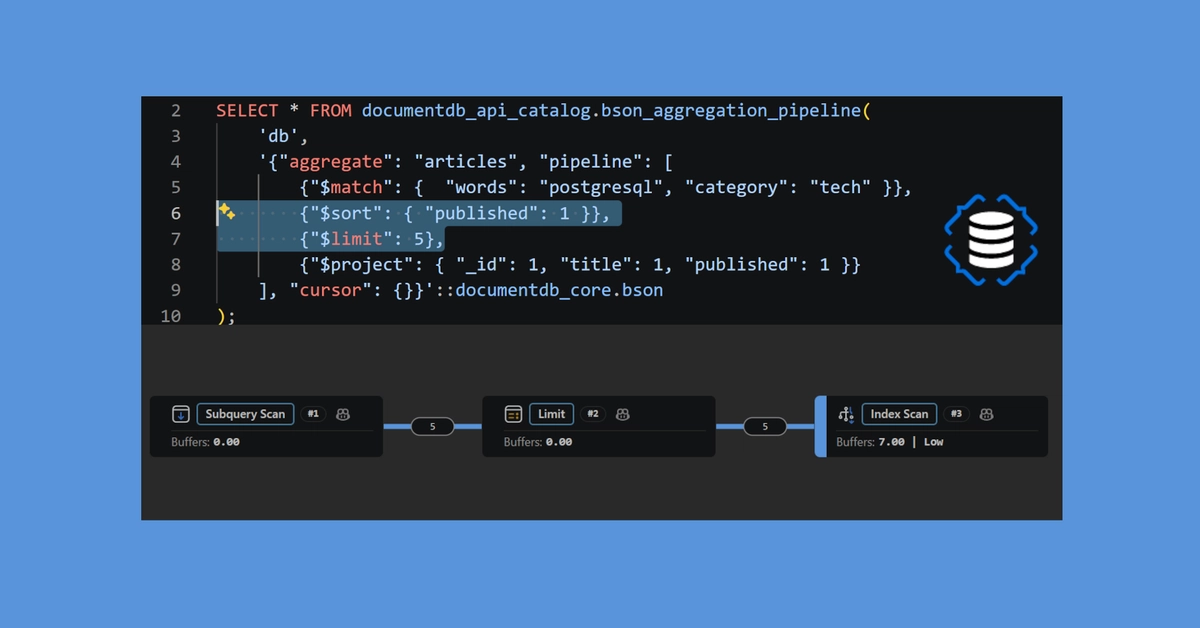
The main challenge in document databases is the flexible nature of fields: the same path can be a scalar, an array, nested, or missing. Despite this, an index must specify what it covers and the order in which rows can be produced. B-tree indexes work well for fixed-scalar columns, enabling prefix filtering and returning sorted rows. GIN and RUM inverted indexes support flexible, repeated values, but traditional RUM ordering relies on distance operators on attached values rather than standard document-style ORDER BY field LIMIT n.
DocumentDB's Extended RUM closes that gap. It extends the RUM access method for compound document indexes by generating composite index terms from the indexed paths and applying an ordering transform during the scan. The result is an inverted, multikey-style index that can filter, sort, and stop at LIMIT in a single Index Scan, while preserving document semantics for arrays and missing fields.
Here is the table I created for my previous blog post, RUM—Storing More in the Index:
postgres=# \d articles
Table "public.articles"