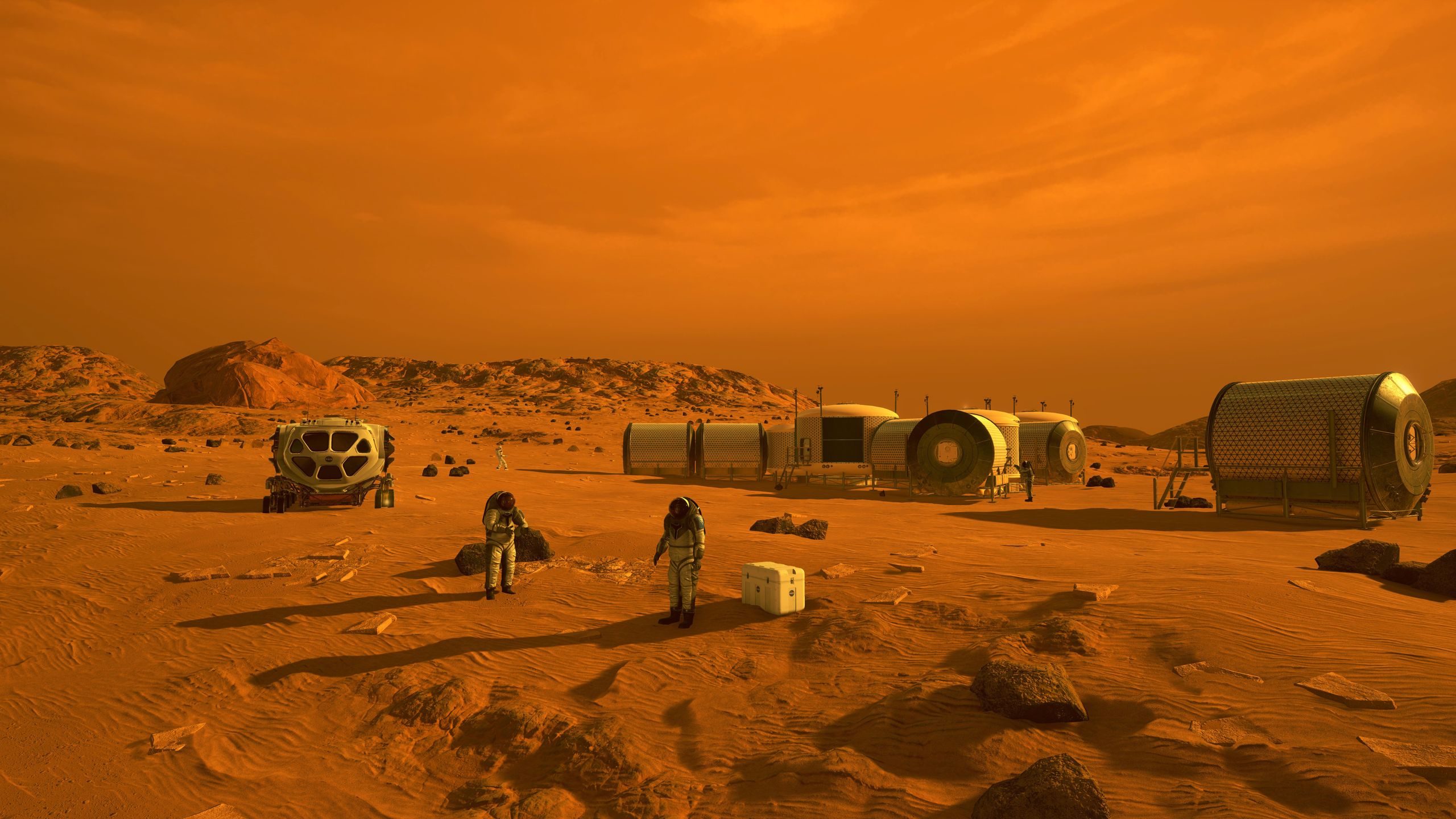
Artist's concept of astronauts and human habitats on Mars.
(Image credit: NASA)
The United States has taken some significant steps into the final frontier during its first 250 years.The nation has put people on the moon, helped build and operate a long-running space station in low Earth orbit (LEO) and sent fleets of robotic explorers to many corners of the solar system — and even beyond it, into interstellar space.All of this work has been done relatively recently, as the space age didn't dawn until 1957; when the U.S. was born on July 4, 1776, humanity was still seven years away from even balloon-borne flight. Where might we be another 250 years from now, on the nation's 500th birthday, should it be fortunate enough to live that long? Trying to see that far into the future is so difficult as to be a fool's errand, but it's fun. So let's have a brief and far from exhaustive crack.A vibrant in-space economyThe United States and other space powers have already established an off-Earth economy — one based on the activities of communications satellites. Companies like Vantor and Planet sell imagery to a variety of customers, for example, while others like SpaceX (via its subsidiary Starlink) and Viasat provide internet service from above.That nascent industry will doubtless expand greatly over the next 250 years, and we're already seeing some of the directions it may go. For instance, space tourism has gotten off the ground; wealthy people can book trips to suborbital space, and the super-rich can fly all the way to Earth orbit, as the experience of NASA chief Jared Isaacman shows. (Isaacman, a tech billionaire, has funded and commanded two missions around our planet using SpaceX hardware.)We've also seen the dawn of in-space manufacturing, with companies such as Made In Space making stuff off Earth and bringing it down for analysis (and eventually, if all goes to plan, sale). This is a field that could really explode over the coming years and decades, according to Dava Newman, director of the Human Systems Lab at the Massachusetts Institute of Technology, who served as deputy administrator of NASA from 2015 to 2017."If you give me a nice big time horizon to look at, I've actually always thought it would be a pharmaceutical breakthrough — manufacturing, more medical-related," Newman told Space.com.That's because the microgravity environment is great for growing flawless crystals, potentially enabling a newly efficient and effective production line for a wide range of pharmaceuticals and other high-value goods. The California company Varda Space recently demonstrated this potential, successfully crystallizing a stable form of the HIV drug ritonavir in one of its orbital "minifactories" and bringing the drug safely down to Earth.