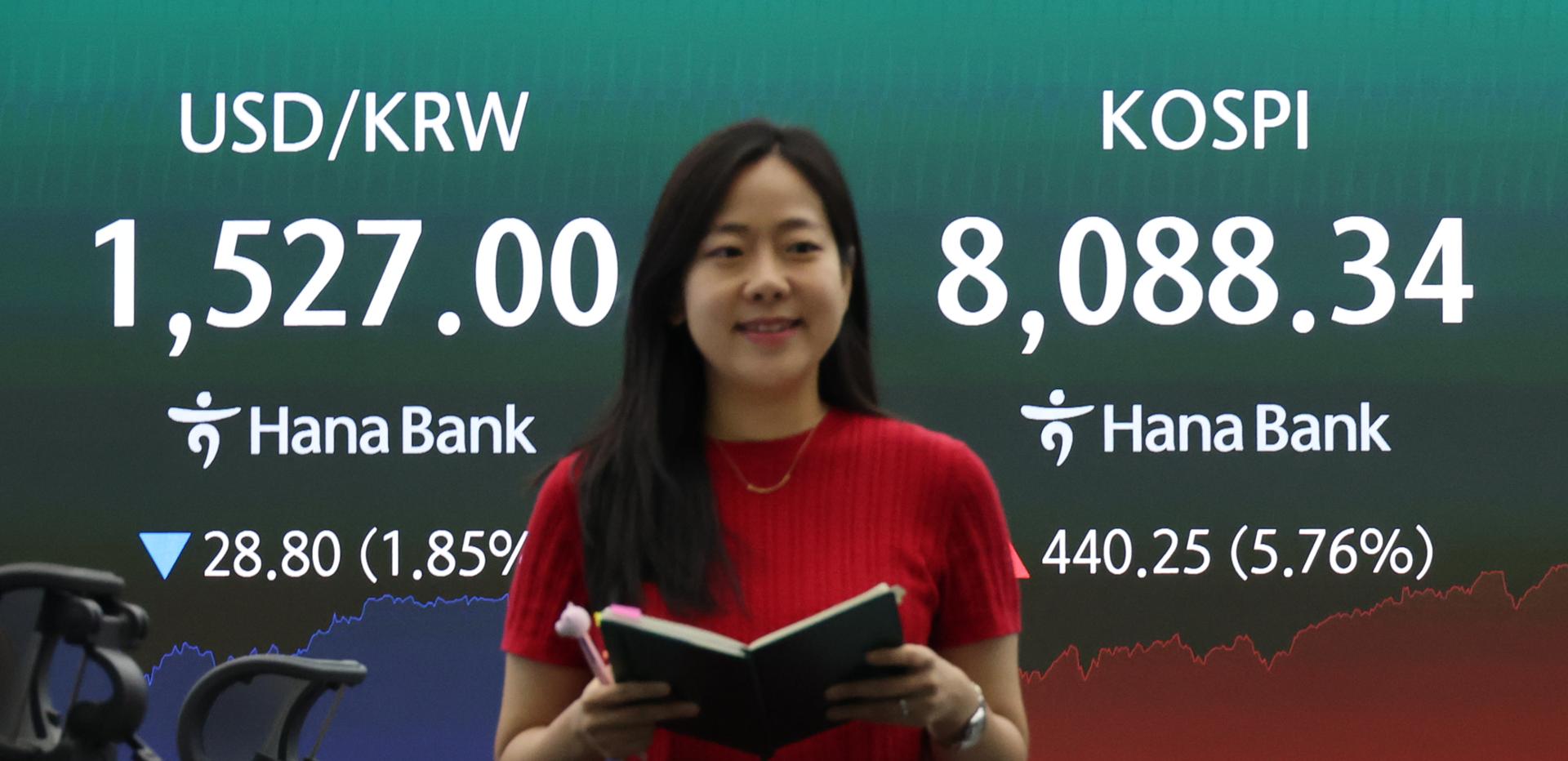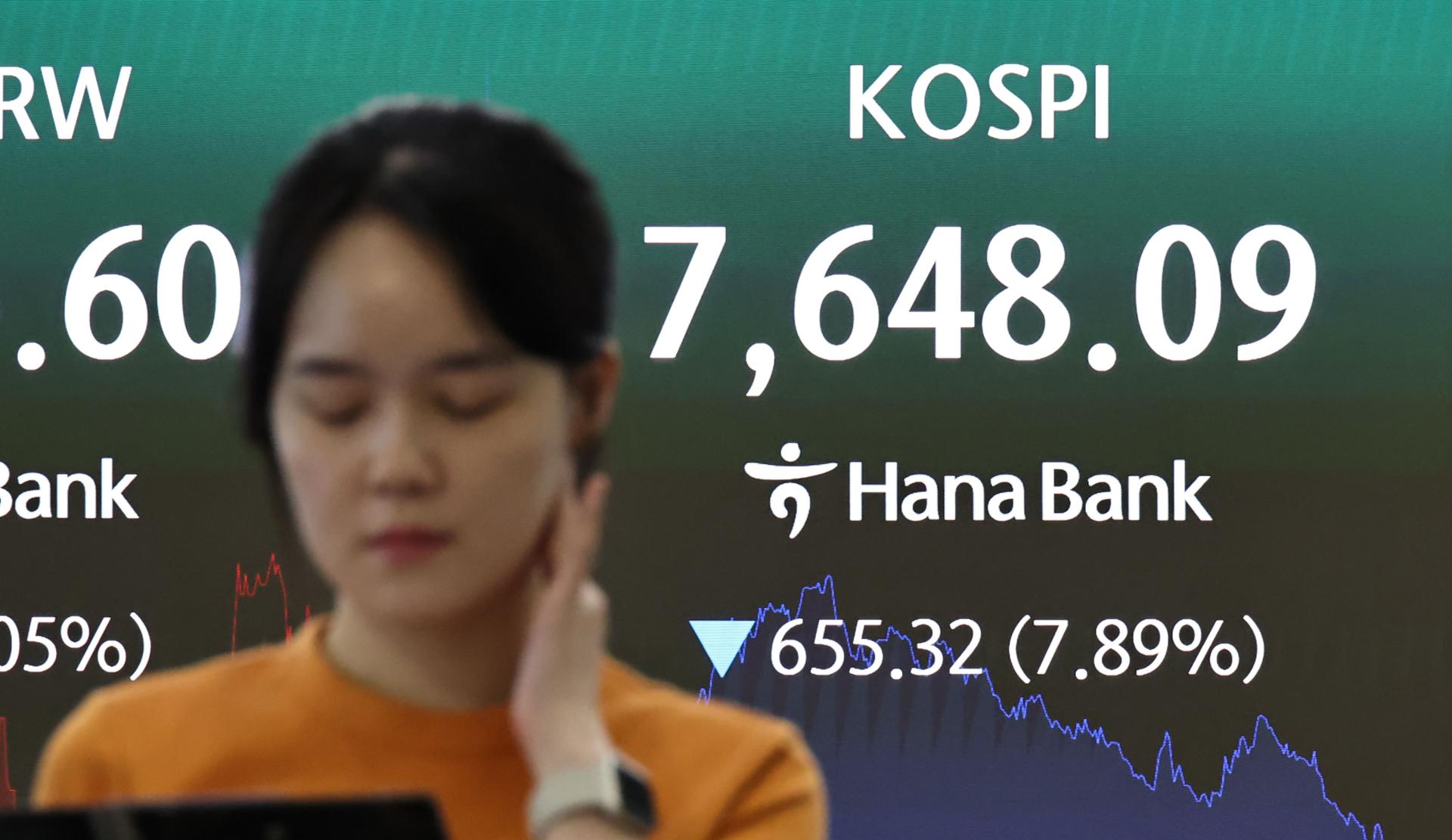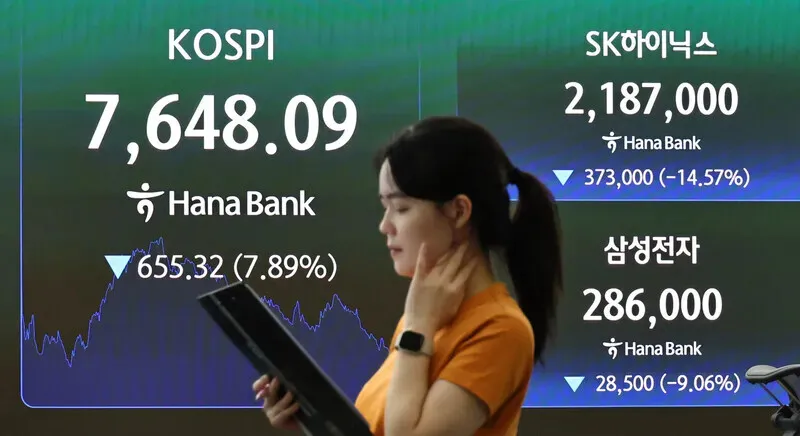
Monitors in Hana Bank’s trading room show the closing figures for the KOSPI, SK Hynix and Samsung Electronics on July 2, 2026. (Yonhap)
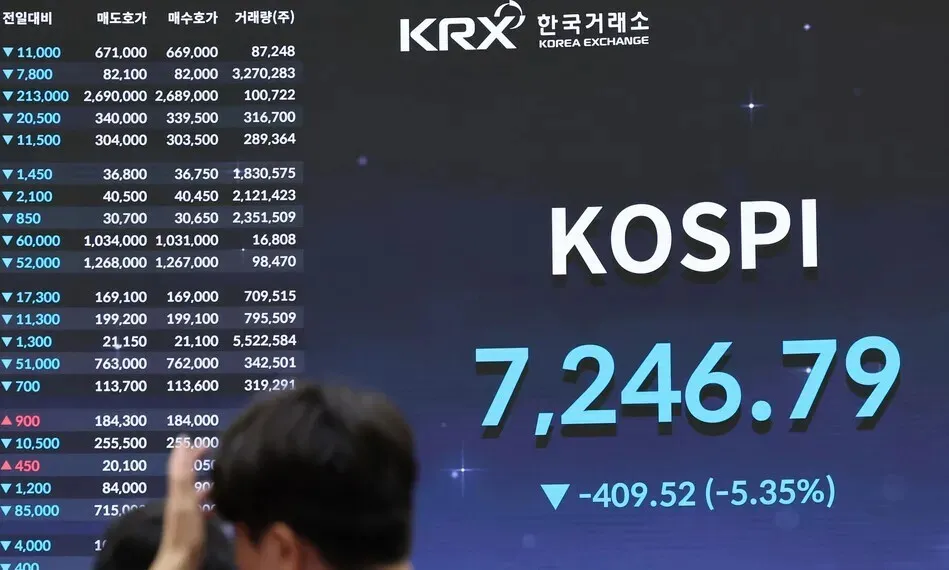
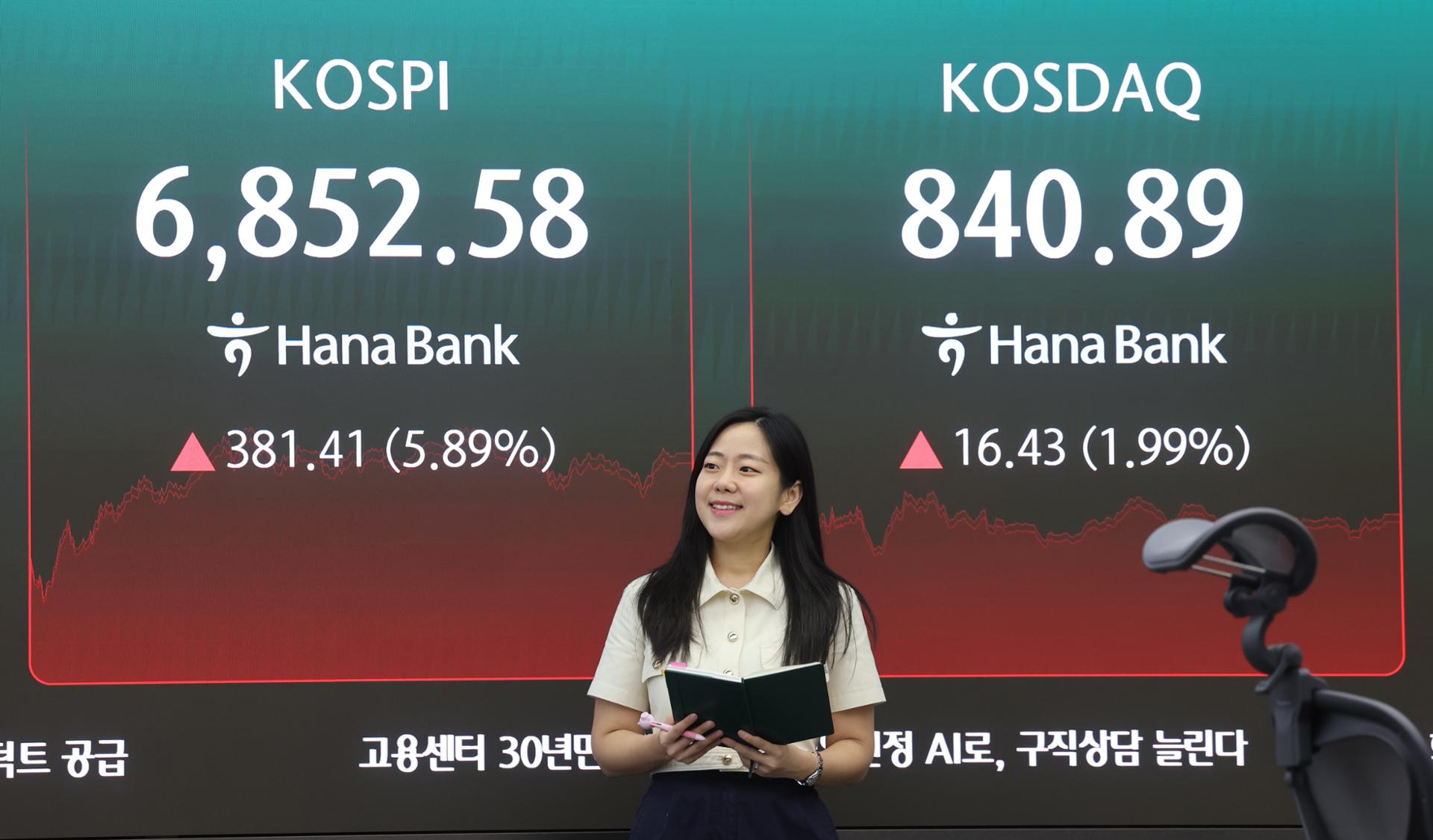
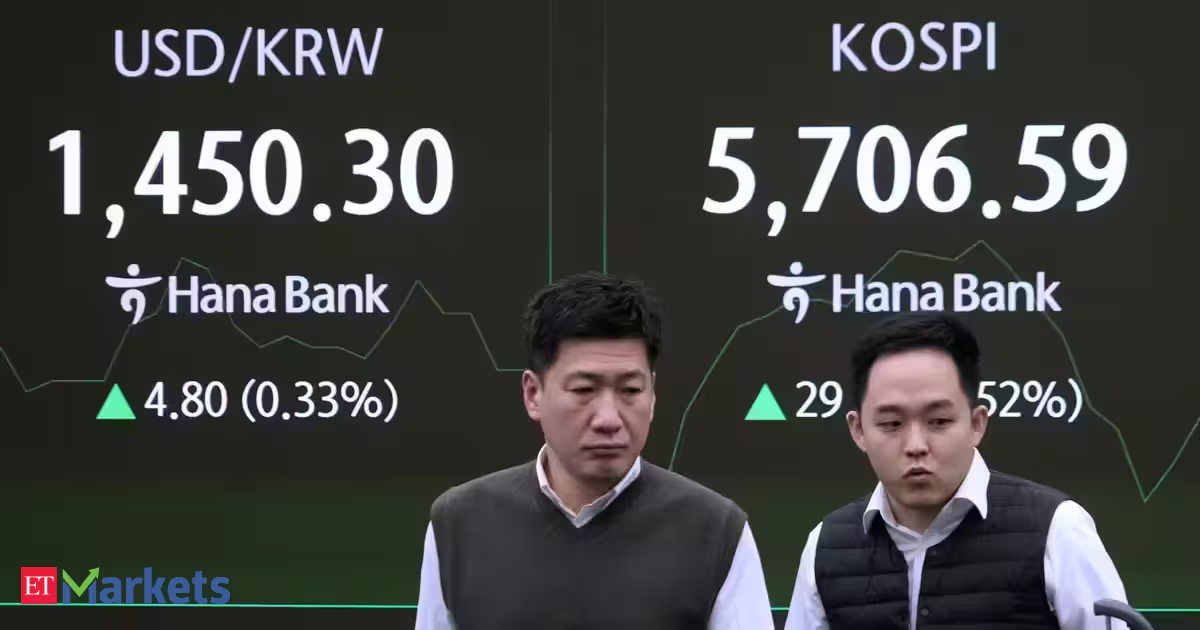
A mere two weeks after it made history by breaking 9,000, the KOSPI nosedived below 8,000 on Thursday before making a recovery above the 8,000 mark on Friday. The selloff has unfolded at nearly the same pace as the index’s earlier rally. Much of the turbulence stems from the market’s heavy concentration of large-cap semiconductor stocks. The recent rollercoaster has shown that not only Korean semiconductor stocks, but Korea’s stock market as a whole, are increasingly sensitive to shifts in outlooks for the artificial intelligence industry. Single-stock leveraged exchange-traded funds (ETFs) based on Samsung Electronics and SK Hynix shares are further fueling this trend. The KOSPI closed at 7,648.09 on Thursday, a 7.89% decrease compared to the previous day. This plummet took place a mere 10 trading days after the index surpassed the 9,000 mark for the first time on June 18. In the past month, the KOSPI has traded between a high of 9,385.59 and a low of 7,394.46, a swing of roughly 2,000 points. In that time, the circuit breaker mechanism, which temporarily halts trading when indexes plunge more than 8%, was invoked a whopping three times. Circuit breakers have been activated 11 times in the entire history of the KOSPI, with five instances happening in 2026 alone. These circuit breakers were usually triggered by major calamities such as 9/11, the COVID-19 pandemic, and the US and Israel’s war in Iran. The last three instances were not caused by any major disasters, but by slumps in semiconductor, tech, and Big Tech stocks. The KOSPI 200 Futures index experienced a 5% drop from the previous day, causing the Korea Exchange to activate its sell-side sidecar mechanism at 9:07 am, halting program sell orders for five minutes. This was the 30th time that the sidecar mechanism was activated this year, far exceeding the number of times it was activated in 2008 (26), during the global financial crisis. The activation of both buy- and sell-side sidecars on 15 occasions reflects extreme volatility in the market.On Friday, the KOSPI ended trading at 8,088.34, up 440.25 points (+5.76%) from the day prior. The index opened at 7,739.75, up 91.66 points (1.20%) from the previous session, before sliding as low as 7,378.10 intraday. It later reversed course and moved back into positive territory, reclaiming the 8,000 level around 1:39 pm, before extending its gains further.The concentration in large-cap semiconductor stocks is seen as the main driver behind the KOSPI’s volatility. Securities firms refer to Samsung Electronics, SK Hynix, and related stocks — including Samsung Electronics preferred shares, Samsung Electro-Mechanics, Samsung C&T, Samsung Life Insurance, and SK Square — as the “S7,” which makes up roughly 60% of total market cap.Even minor noise that casts doubt on the outlook for the AI industry — a key driver of the semiconductor boom — has been roiling the KOSPI.On Thursday, global equities were rattled by reports that Meta plans to enter the cloud computing business by selling excess AI computing capacity to outside customers. The news fueled concerns that massive AI infrastructure spending could ultimately lead to overcapacity and weaker demand for semiconductors, sending chip stocks lower, including Micron Technology, which tumbled 10.57%.Investor sentiment was also weighed down by reports that Apple is in talks to purchase chips from Chinese memory makers, including ChangXin Memory Technologies (CXMT), raising questions about future demand for products from Korean firms like Samsung Electronics and SK Hynix.Although the same headwinds affected semiconductor stocks across Asia, Korea’s market suffered steeper losses than its neighbors. Japan’s Nikkei 225 fell 2.47% on Thursday, while Taiwan’s benchmark TAIEX index slipped just 0.58%.Observers also pointed to the launch of single-stock leveraged exchange-traded funds (ETFs) in late May as a factor amplifying volatility. The 14 leveraged ETFs tracking Samsung Electronics and SK Hynix at twice their daily returns plunged an average of 27.33% on Thursday. “The main reason the Meta news triggered a much sharper correction in the Korean market lies in the structure of domestic market flows,” said Kim Seok-hwan, an analyst at Mirae Asset Securities, who said the products “have amplified both upside and downside volatility.”Foreign investors were net sellers of 4.3 trillion won on Thursday, while retail investors bought a net 6.2 trillion won, extending a pattern in which individual investors absorb shares sold by overseas funds. At the same time, the scale of people going into debt to buy stocks is growing in Korea. The cumulative value of forced liquidations resulting from unpaid settlement balances in ultra-short-term leveraged trading reached 3.09 trillion won as of the end of last month, up 359% from a year earlier. Analysts warned that the trend could create a vicious cycle, with forced liquidations not only increasing the risk of financial distress among retail investors but also generating additional selling pressure that further weighs on the market. By Kim Ga-yoon, staff reporterPlease direct questions or comments to [english@hani.co.kr]