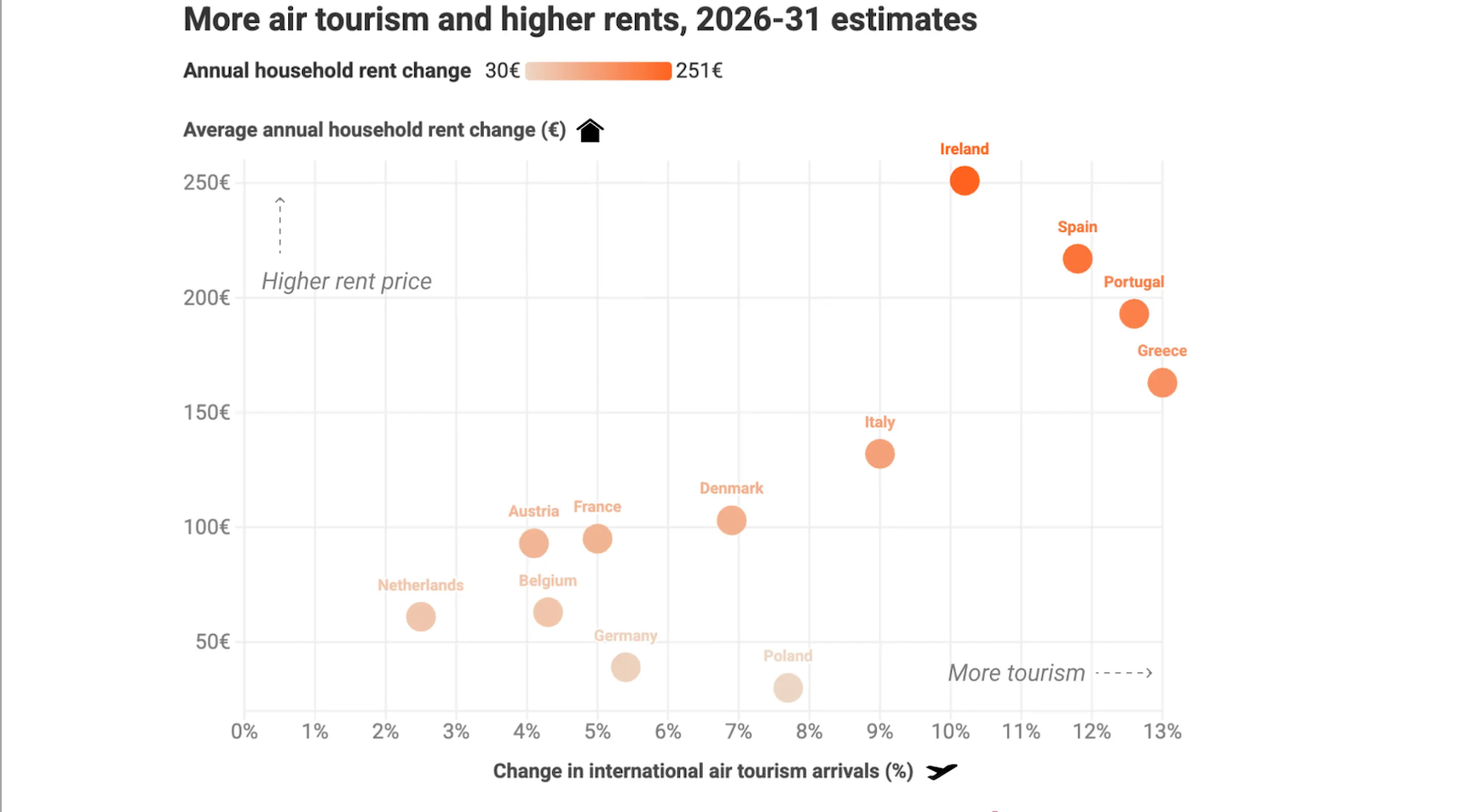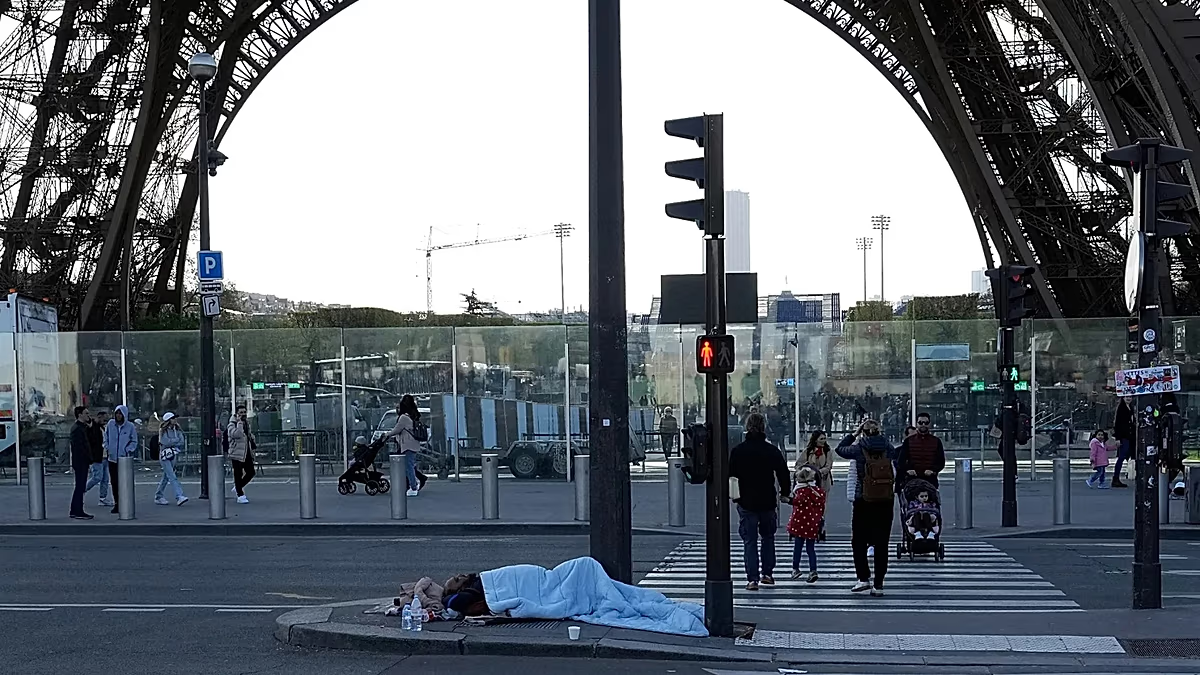
In March, the European Parliament adopted its first report on the housing crisis in the EU and possible ways to address it. Polls show that housing has become one of Europeans' most pressing concerns, rivaling national security in importance. Soaring property prices are contributing to declining birth rates, as families are reluctant to have children without a home of their own. The unaffordability of real estate is also fueling political radicalization among young people on both the left and the right. Restrictions imposed by governments on platforms such as Airbnb have failed to solve the problem. The most effective remedy may be large-scale construction of new affordable housing.Contents1.Nowhere to live in Europe2.How much have housing prices risen?3.Why prices are rising4.How the crisis is affecting the rental market5.How governments are responding6.Why these policies are falling short7."Not in my backyard"8.What happens if the problem goes unresolved?Nowhere to live in EuropeThe shortage of affordable housing is the most pressing problem facing people in European cities, according to a 2025 Eurobarometer survey. The study found that 51% of respondents identified housing as a major concern, ahead of unemployment (33%) and poverty (32%).An increasing number of Europeans believe they will never be able to buy a home of their own, polls show. The Czech Republic recorded the highest level of pessimism, with 44% of respondents holding this view, followed by Slovenia (39%), Italy (35%), and Ireland (33%). In many cases, housing problems are the result of government policies designed to benefit investors rather than residents.The housing crisis is also taking a toll on family formation. Young couples increasingly see parenthood as a luxury they cannot afford until they have secure housing. According to a Springer Nature study, the decline in birth rates across the EU since 2010 has been driven in large part by rising rents.According to Eurofound, the share of employed young adults aged 25–34 in Ireland who were living with their parents because of high housing costs rose from 27% in 2017 to 40% in 2022. The corresponding figure increased by 11 percentage points in Portugal and by 7 percentage points in Spain.For decades, the right to decent housing has been a cornerstone of Europe's social contract, and the public broadly believes it is the state's responsibility to protect that right. The same Eurobarometer survey found overwhelming support for government intervention: 88% of respondents want to see publicly funded renovation of the housing stock, 83% support direct subsidies for the construction of affordable housing, and 82% favor rent caps.In March 2026, the European Parliament adopted a sweeping report on the housing crisis that exposed a deep ideological divide in Brussels. On one side, a coalition of center-right, liberal, and conservative lawmakers from the EPP, Renew, and ECR groups says deregulation is the solution. They propose streamlining construction permitting, attracting more private investment and institutional capital, and stepping up efforts to combat the illegal occupation of vacant properties. On the other side, the left and the Greens are calling for stronger social protections. Their platform seeks to recognize access to housing as a fundamental human right, curb speculation by investment funds, and introduce legally binding rent caps across Europe.How much have housing prices risen?Between 2010 and 2024, housing prices across the EU rose by 55%, while real household incomes increased by only 10–15%. According to the Deloitte Property Index 2025, Amsterdam ranks as Europe's least affordable housing market — there, the average apartment costs the equivalent of 15.4 years of income, just ahead of Athens (15.3) and Prague (15.0). In the Netherlands, the monthly mortgage payment on an average home priced at more than €500,000 is about €2,500, while the average after-tax salary is €3,000.Renting has become more expensive as well. In 2025, the average rent across Europe was 27.8% higher than in 2010. Over the same 15-year period, rents rose by 220% in Estonia, 184% in Lithuania, and 115% in Ireland. The trend in new lease agreements is even more striking: according to the real estate platform Idealista, rents across the EU increased by more than 30% between 2021 and 2025. In Bulgaria, Ireland, Poland, Portugal, and Spain, renting a standard two-bedroom apartment consumes more than 80% of the median salary of a young professional, while in popular tourist destinations the figure often exceeds 100%.Why prices are risingThe rise in urban housing costs across the European Union has occurred despite an aging and shrinking population. This apparent paradox is explained by the fact that population decline is concentrated mainly in rural and peripheral regions, while major economic centers continue to grow thanks to an influx of both domestic and international migration. The situation is further compounded by changing household patterns: smaller household sizes and a growing share of people living alone require far more separate homes than in the past.A shortage of supplyThe main driver of the crisis is a severe shortage of new housing. According to CBRE, Europe is short about 9.6 million homes, equivalent to roughly 3.5% of the continent's housing stock. The European Commission estimates that meeting demand will require the construction of an additional 650,000 homes every year, requiring annual investment of about €153 billion. The gap between supply and demand continues to widen: between 2022 and 2025, the number of households in Europe's largest cities increased by 3.5%, while the housing stock grew by only 2.1%.The pace of new building permits suggests that the shortage will not be resolved anytime soon. In 2024, permits either declined or failed to increase in nine of Europe's 12 largest housing markets, and in 2025 only 64% of the required number of homes were built. In Germany, which lacks 1.4 million homes, only about 200,000 are being built each year, even though eliminating the shortfall by 2030 would require annual construction of 400,000 homes.Why is so little being built? The reasons are structural: inflation has driven up the cost of building materials and labor, permitting procedures remain cumbersome, and local residents often oppose new developments. These challenges are compounded by country-specific obstacles. In the Netherlands, for example, thousands of housing projects have been stalled in the courts because of nitrogen emissions regulations.Rising demandThe population of major cities continues to grow thanks to migration — both domestic and foreign. According to a Springer Nature study, a 1% increase in population raises housing prices by roughly 0.25%. The influx of refugees after 2022, together with rising labor migration, has put additional pressure on housing markets, particularly in Germany, Poland, and the Baltic states. Migrants themselves are hit harder by the housing crisis than native-born residents. According to 2024 Eurostat data, 33% of people born outside the EU live in overcrowded housing, compared with 13.7% of the native-born population.Another contributing factor is the changing composition of households. Demographers estimate that the growing number of people living alone, along with a later average age of marriage and a rising divorce rate, creates demand for hundreds of thousands of additional housing units across Europe every year.Housing as an investment assetA third driver of the crisis is the growing use of housing as a financial asset. According to a report by the European Central Bank, aggressive property acquisitions by institutional investors are driving up prices, increasing households' mortgage burdens, and weakening the link between wages and housing costs in local markets.The share of institutional capital in the housing market is growing rapidly. According to JLL, investment in Europe's residential sector increased by 34% in 2024 and by another 22% in 2025, surpassing €70 billion. Foreign investment in residential assets rose by 55%, driven largely by buyers from the United States and Canada. Overall, the sector now accounts for 21% of all investment in Europe — double what it was in 2008.During the recent period of high inflation, urban real estate has become investors' preferred store of value. Properties are increasingly being purchased to preserve capital against inflation rather than to generate rental income. As a result, part of the housing stock has effectively been taken off the market, with apartments left vacant as investment holdings.How the crisis is affecting the rental marketThe rental market is experiencing many of the same pressures as the homeownership market. Demand there is also rising faster than supply. Kate Everett-Allen, head of European research at Knight Frank, notes that many people who would normally have taken out a mortgage are now looking for rental housing instead. Landlords are also facing inflation, and those who financed their purchases with mortgages have been hit by higher interest rates, prompting them to pass those costs on to tenants.Landlords, too, are feeling the effects of inflation and passing the costs on to tenantsSome investors prefer to avoid renting out their properties altogether — it has become increasingly difficult to evict tenants who stop paying rent, and as a result, even more properties are being left empty. Others have taken advantage of soaring property prices to lock in gains by selling. In 2024, a record 26% of landlords sold at least one investment property, while only 8% bought new ones.In 2025, about 93,000 landlords exited the rental market in the United Kingdom, 43% more than the year before. Attractive sale prices, stricter tax rules, and new energy-efficiency requirements encouraged many to sell. As a consequence, average rents increased by 9–12% over the year, and each rental listing attracted about 10 prospective tenants. The United Kingdom is an extreme case, but similar trends can be seen in Germany, the Netherlands, and Ireland.Short-term rentals are also widely viewed as part of the problem. In tourist destinations, many property owners prefer to rent to visitors, earning enough during the high season to cover their annual costs. Tourism and short-term rental platforms such as Airbnb do contribute to this trend, but their role is often overstated by politicians.How governments are respondingAddressing the housing crisis has finally been recognized as a top-level policy priority. In December 2025, the European Commission presented the European Affordable Housing Plan, which is built around four pillars: increasing housing supply, attracting investment, supporting the most vulnerable participants in the housing market, and implementing structural reforms. Between 2026 and 2027, the EU plans to mobilize about €10 billion from its budget, while partner financial institutions are expected to raise up to €375 billion by 2029. At the same time, EU-wide rules for short-term rental platforms took effect in May 2026 requiring services such as Airbnb to share data on listings and rental activity with local authorities.Encouraging home purchasesGovernments are using a range of measures to encourage home purchases. France, Poland, Spain, and several others offer subsidized mortgages and financial assistance for young families, while Germany has launched its Climate Loan (KfW) program to support the purchase of energy-efficient homes.To ease pressure from investment demand, several countries have introduced restrictions on foreign buyers. Portugal has phased out its "golden visa" program for property purchases, describing it as one of the factors making housing less affordable. Denmark and the Netherlands have tightened purchasing rules for non-residents, with cities including Amsterdam now requiring buyers to occupy homes themselves rather than rent them out. The Czech Republic, Slovakia, and Hungary are discussing a tax on vacant investment properties.Lowering rentsIn February 2020, Berlin's authorities took the radical step of freezing rents for 90% of the city's housing stock for five years. The number of apartments available on the open market declined noticeably as a result. In April 2021, however, Germany's Constitutional Court struck down the law.Barcelona has instead focused on short-term rentals. By 2028, the city plans to revoke about 10,000 tourist rental licenses, significantly shrinking the legal market for short-term accommodations. A similar approach is emerging in Budapest, where residents of the city's 6th District (Terézváros) voted in a referendum to ban short-term rentals through platforms such as Airbnb. Florence has completely halted the registration of new short-term rental properties in its historic center, and Amsterdam and other tourist destinations have also imposed strict limits on the number of nights homeowners may rent out their properties through such platforms.Vienna has adopted a more systemic approach. Municipal and cooperative housing accounts for about 40–45% of the city's entire housing stock. According to the city authorities, as many as 75–80% of residents meet the income requirements to qualify for such housing. Rents in the municipal sector are significantly below market rates, while long-term, stable lease agreements reduce the risk of displacement and help mitigate the effects of gentrification.Some governments have also explored giving priority in the rental market to young people who were born and raised in a particular city. This approach is championed by Sinn Féin, which argues that young people should have the right to remain in their own communities. Critics warn, however, that giving preference to "locals" conflicts with the principle of equal opportunity for citizens from other parts of the country, potentially undermining their fundamental right to mobility within the EU.Why these policies are falling shortEurope's experience paints a discouraging picture. Most of the obvious policy tools have only a limited impact or create new problems. Subsidies and preferential mortgages drive up prices when housing construction fails to keep pace. When governments inject money into a market with a fixed supply, sellers simply raise prices, meaning the subsidy benefits them rather than homebuyers. Rent freezes reduce supply. The legal rental market shrinks, while the gray market expands through unofficial "furniture fees" and dual-contract arrangements.Restrictions on Airbnb have done little to lower housing costs. In Amsterdam and Barcelona, where short-term rentals have been regulated since 2018–2019, long-term rents have increased by 34% and 37%, respectively. In Barcelona, the number of vacant apartments has grown to roughly eight times the number of properties listed for short-term rentals.Restrictions on Airbnb have done little to lower housing costsReducing the number of short-term rental apartments in Berlin, Hamburg, and Munich did not lead to lower long-term rents. According to the authors of a report by the European Parliament's Special Committee on the Housing Crisis, such restrictions are effective at returning some properties to the local housing stock, but their overall impact on reducing rental and home purchase prices is limited.Why don't Airbnb restrictions work? Many landlords are reluctant to rent to long-term tenants because of the risks of non-payment and the difficulty of eviction. Instead, they move to other platforms and rent properties on a monthly basis to digital nomads and students. In addition, a study by the IZA and Nova School of Business examining Lisbon found that banning short-term rentals reduces prices only in the neighborhoods directly affected by the restrictions — and by no more than 8–9% — while leaving the broader rental market unchanged. The underlying problem is not Airbnb — it is housing supply.Europe's experience suggests that the only sustainable way to reduce housing costs is to increase supply on a large scale. That means speeding up the permitting process, developing underused land (including parking lots, abandoned industrial sites, and vacant plots near transport hubs), and taxing vacant investment properties to bring idle housing back onto the market."Not in my backyard"The housing crisis has also become a source of division at the local level, splitting neighborhoods and municipalities into two camps whose names have come to define urban planning debates: "Not In My Backyard" (NIMBY) and "Yes In My Backyard" (YIMBY).The first movement emerged in the 1970s and is made up largely of homeowners, older residents, and the established middle class. They are not opposed to new housing in principle, but they argue that it should not come at the expense of their quality of life or be built in their immediate neighborhood.The opposing camp emerged much more recently in response to the housing crisis. It is driven by younger people, long-term renters, urban planners, and progressive economists. Their reasoning is the opposite: if more housing needs to be built, they are willing to accept greater density because cities are suffering from a critical shortage of homes.From their perspective, unless sparsely populated neighborhoods are developed more intensively, rents will continue to rise and younger generations will never be able to afford housing. At the same time, they are not calling for drab concrete apartment blocks, but for “smart density” — well-designed mid-rise neighborhoods, the repeal of outdated zoning rules, and the transformation of inefficient spaces, parking lots, and abandoned warehouses into vibrant, walkable communities.The debate plays out on three fronts: finance, psychology, and politics. The NIMBY ideal is preservation. For its supporters, housing is their primary asset, one they expect to keep appreciating. Their activism is concentrated at the local level: they organize as homeowners, hire lawyers, and often block new developments in the courts for years.The YIMBY vision, by contrast, is that of a vibrant, inclusive "15-minute city" where land is used as efficiently as possible. Politically, the movement expresses itself through street protests against rising housing costs and support for parties that promise to cut red tape around construction. By 2026, Europe's political momentum had shifted toward the YIMBY camp. In the United Kingdom and Ireland, governments have passed legislation preventing municipalities from vetoing housing developments that comply with national housing strategies.At the same time, it was the NIMBY movement that pushed governments to impose stricter oversight on developers and helped preserve architectural heritage from the excesses of 20th-century modernization. The classic example was the campaign to save Greenwich Village in New York in the 1960s, when the city's master planner, Robert Moses, proposed building a massive 10-lane expressway across Lower Manhattan, demolishing the historic neighborhoods of SoHo and Little Italy in the process.Local activist Jane Jacobs organized the opposition. Residents staged protests and disrupted public hearings, ultimately forcing the city to abandon the highway project. Jacobs later wrote The Death and Life of Great American Cities, a landmark work that transformed modern thinking about urban planning.Europe has its own example. In the 1970s, activists saved part of central Amsterdam that city authorities planned to demolish to make way for urban expressways. Local residents and squatters barricaded streets and clashed with police on a large scale, ultimately forcing the government to abandon its plans to remake the city center around the needs of automobiles.What happens if the problem goes unresolved?The housing crisis has long since ceased to be merely an economic issue — it has become a political one. In Dublin, the situation has boosted support for the left-wing party Sinn Féin, while in Amsterdam it has fueled the rightward shift associated with Geert Wilders. When governments fail to provide people with access to housing, public trust in the political system erodes, opening the door to political extremism.The concept of welfare chauvinism is also gaining ground in urban policy — the idea that social benefits should be reserved for "our own people" or "locals" at the expense of outsiders. Traditionally, the term has referred mainly to immigrants, but in the housing debate it is increasingly being applied to people moving from other parts of the same country as well.Welfare chauvinism — the idea of reserving benefits for "locals" at the expense of outsiders — is increasingly shaping urban policyWhen cities such as Dubrovnik or Barcelona give priority to local residents, they create a zero-sum system in which one person's success in securing housing depends directly on someone else's exclusion. Favoring locally born young people is often justified as a way to preserve social cohesion, but in practice it risks producing the opposite effect: cities become closed clubs for either the wealthy or those fortunate enough to have been born there.Unless the trend is reversed, Europe risks entrenching a new class divide based not on income but on property ownership. Older generations who bought homes in the 1980s and 1990s continue to accumulate wealth as land values rise, while younger people remain trapped in an increasingly expensive cycle of permanent renting. The European Commission's decision to create, for the first time, the post of a dedicated Commissioner for Housing is itself an acknowledgment that the crisis can no longer be solved by relying on national governments alone.
Nowhere to live: Europe’s housing crisis has become the continent’s biggest political problem
In March, the European Parliament adopted its first report on the housing crisis in the EU and possible ways to address it. Polls show that housing has become…
3,326 words~15 min read